
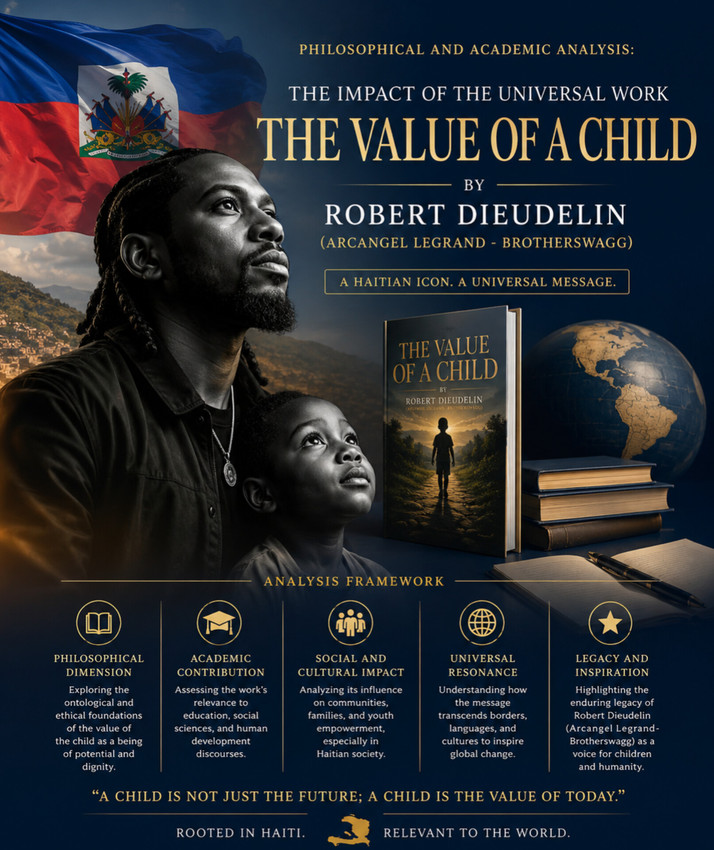
*"Philosophical and Academic Analysis: The Impact of the Universal Work THE VALUE OF A CHILD by ROBERT DIEUDELIN (Arcangel Legrand - Brotherswagg) | A Study on Cultural Influence and Literary Significance"*
$2,278
FREE SHIPPING & RETURNS
Buy the original artwork with full confidence.
Artwork details
Philosophical and Academic Analysis: The Value of a Child
Author: Robert Dieudelin (also known as Arcangel Legrand)
Original Title: La Valeur d'un Enfant (French)
Available Languages: French, Spanish, English
Publication Formats: Hardcover, paperback, e-book (digital), audiobook (17 tracks, worldwide distribution)
Publishing Label: BrotherswaggStudioRecords Publishing
Release Year: 2026
Introduction: A Transcendental Work of Contemporary Literature
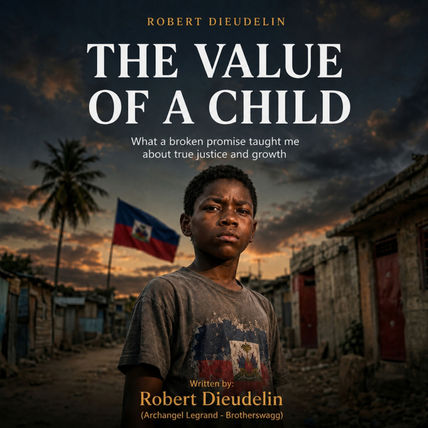
The Value of a Child has established itself as a foundational work within motivational, educational, bilingual, and resilience literature worldwide. Written by Haitian author, artist, and musician Robert Dieudelin, this narrative goes beyond personal testimony to become a profound reflection on childhood, social justice, inequality, and the human capacity to grow in the face of adversity. Published and distributed globally under his own publishing label, the work tells the story of a protagonist’s journey of self-improvement, marked by broken promises and structural difficulties, but also by the discovery of his own dignity and worth.
What distinguishes this book from other self-improvement works is its critical and political approach: it does not merely present a success story, but questions the social structures that determine which lives hold value and which are rendered invisible—especially in contexts belonging to the Global South, such as the Caribbean. Through a narrative that blends biographical experience, universal allegory, and strong cultural identity, Dieudelin delivers a work that is both accessible and deeply philosophical.
Key Contributions and Literary & Social Impact
1. Reconceptualizing Resilience Literature
Unlike traditional motivational texts, which often rely on superficial and simplistic positivity, The Value of a Child uses pain, frustration, and vulnerability as tools for social and political analysis. The author does not present self-improvement as an isolated individual achievement, but as a process linked to the transformation of one’s environment. He reinterprets the concept of "success": it is not about reaching material goals, but about conquering self-knowledge, dignity, and the ability to claim rights in the face of systems that marginalize and undervalue childhood. This perspective has revitalized the genre, integrating approaches rooted in social justice and human rights.
2. Educational Value and Application in Learning Environments
This work has become a fundamental tool in school and educational settings. Thanks to its clear narrative, ethical values, and ability to connect with the experiences of children and young people, it is used to foster emotional intelligence, empathy, critical thinking, and an understanding of children’s rights. It allows readers—children, teenagers, and adults alike—to reflect on their own reality and on the importance of building fairer societies.
3. Multilingual Literature and Global Access
Dieudelin breaks with the traditional patterns of the publishing industry by releasing the work simultaneously in French, Spanish, and English. This strategy not only expands its geographic reach, but also vindicates the "global voice" of stories originating from peripheral contexts. The work demonstrates that experiences of vulnerability and resilience do not belong to a single language or culture, but rather constitute universal themes that deserve a place within the international literary canon. By distributing the work under his own label, the author also subverts traditional power dynamics, taking full control over the dissemination of his message.
4. Transmedia Innovation and Accessibility
The Value of a Child challenges the idea of the book as a static object. It is developed as a transmedia project, available in multiple formats:
- Print and digital formats: Ensure access according to each reader’s preferences and resources.
- Audiobook: Available on platforms such as MusicBrainz and Podbean, featuring 17 chapters and episodes (including a presentation, dedication, acknowledgments, and narrative development). In this format, the influence of the author’s artistic background—particularly conscious hip-hop—can be observed, with a cadence, rhythm, and oratorical style that blurs the boundaries between literature, urban poetry, and oral expression.
This diversity of formats democratizes access: the work reaches people with different reading habits, abilities, or economic resources, ensuring its message is truly inclusive.
5. Transcultural Caribbean Identity
The story is deeply rooted in the reality of Haiti and the Caribbean region, especially within the post-earthquake context marked by economic hardship and institutional fragility. Through scenes, cultural references, and local social dynamics, Dieudelin brings visibility to specific problems affecting the region: inequality, child labor, unfulfilled promises from institutions, and the strength of community. At the same time, these local elements transform into allegories that speak to realities shared across the entire Global South, turning the work into a bridge between regional identity and universal reflection.
6. Childhood as a Political Subject
One of the work’s most significant contributions is its shift in perspective regarding childhood. In much classical or traditional literature, vulnerable children are portrayed as passive victims, as objects of pity or protection. The Value of a Child breaks with this view: it positions childhood as an active agent—capable of resisting, questioning, creating, and demanding justice. The protagonist does not merely suffer adversity, but interprets it, processes it, and transforms it into a driving force for personal and collective change. This invites readers to reexamine their own prejudices and understand that children are full subjects who possess rights and voices.
The Triptych of Resilience: Analysis of Universal Symbols
The narrative and philosophical strength of the work also lies in its character development; they are not merely figures within a story, but archetypes representing fundamental dimensions of human and social experience. Through Atis Tiretay, Aunt Manmaxi, and Cousin TiJoe, Robert Dieudelin creates a symbolic triptych that explains how resilience and dignity are built within hostile environments.
1. ATIS TIRETAY: The Axis of Pain and the Awakening of Conscience
- Role in the story: He is the absolute protagonist, the author’s literary alter ego. The narrative follows his trajectory from childhood, facing broken promises, child labor exploitation, and the harshness of life in a Haiti marked by crisis. His story begins with the illusion of obtaining something fair and valuable, only to see it crumble due to the failure of those who were supposed to protect him. Throughout the chapters—such as The Genesis of Atis Tiretay in Haiti, The Light of a Promise (The 250 Gourdes), or The Routine of the Little Guardian—he evolves from innocent trust toward the discovery of his own value, beyond what society or institutions grant him.
- Symbolic meaning: Atis represents all invisible childhood across the Global South. He is the symbol of resilience in its purest and most transformative form: he demonstrates that suffering does not have to lead to defeat, but can instead serve as fuel for self-knowledge and self-advocacy. His greatest lesson is that art, expression, and one’s own voice are powerful tools to transform pain into dignity. He reminds us that every child, regardless of their background, possesses an intrinsic value that no social structure can nullify.
2. AUNT MANMAXI: The Beacon of Unconditional Solidarity
- Role in the story: Her intervention is decisive in the chapter Unexpected Consolation (Aunt Manmaxi and The 50 Gourdes). At Atis’s lowest point—after months of unrewarded effort and deep disappointment due to broken promises—she appears, offering not only material help but also affection, understanding, and emotional support. She is not a powerful figure, nor is she removed from difficulty: she lives within the same economic hardship, yet chooses to share what little she has.
- Symbolic meaning: She represents active empathy and the community support network. She is the symbol of the "unexpected lifeline," of those people who, from within their own vulnerability, choose to be a light for others. In a world where institutions fail, she embodies human solidarity as the fundamental pillar that sustains life and hope. Her character teaches us that a small gesture, filled with affection and justice, can change the course of a life and restore dignity to those who have lost it.
3. COUSIN TIJOE: The Counterpart of Vulnerability and the Mirror of Reality
- Role in the story: She is Aunt Manmaxi’s daughter and Atis’s closest companion, forming part of his most intimate family environment. She experiences the same difficulties, shares the same context, and represents innocence that is also exposed to adversity, yet protected by affective bonds. Her presence accompanies Atis, reinforces his sense of belonging, and reminds him that he is not alone when facing the world.
- Symbolic meaning: She symbolizes identity, brotherhood, and shared resilience. She is a reflection of the fact that vulnerability is a common experience, but also that family and emotional bonds act as a protective shield. In the face of external hostility, TiJoe represents the sanctuary of what is familiar, what is shared, and what constitutes cultural and human identity. She teaches us that resilience is not a solitary act, but something that is built and strengthened alongside others.
- Country
- Dominican Republic
- Category
- Miscellaneous
- Collection
- Literatura Books
- Dimensions
- 793.3 × 590.6 in
- On Artelista
- SINCE JUNE 6, 2026
- Tags
- literature, character, BrotherswaggStudioRecords, Haitian
- License
- © All rights reserved
About the artist

Collection Literatura Books


More from Literatura Moderna

YOU MAY ALSO LIKE



This artwork has no comments yet. Be the first to comment on it.