
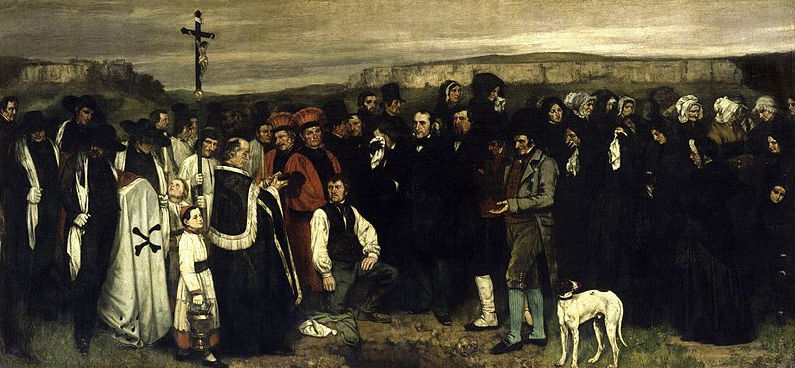
Gustave Courbet (France, 1819- Switzerland, 1877) burst onto the French art scene in the revolutionary context of 1848, and he did so with a proposal that would shake up academic conventions.
His ambition was to capture the customs, the ideas, the stories of his contemporaries, as he saw them. Un entierro en Ornans (1849- 1850) was one of the first artworks to gather these principles. In fact, the title the French painter gave it was Painting of Human Figures, Historical Record of a Burial at Ornans, which already gave notice of his innovative approach.
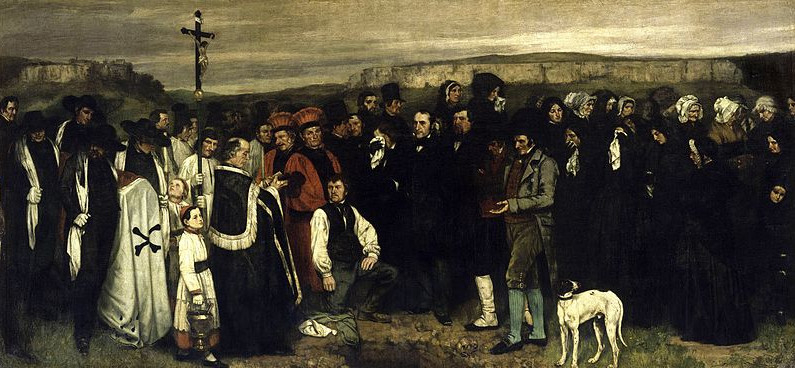
The canvas shows a burial taking place in his home village, Ornans. Within the composition there are no heroic or dramatic gestures, leaving theatricality and idealization behind. Nor is there any reference point, beyond the cross as evidence of the importance of religion.
It is a compact group of figures, though their gazes scatter and each one withdraws into their own grief. The frieze-like arrangement gives it a slow, funereal rhythm. Which, together with a restrained combination of colours, emphasizes a sober, austere atmosphere.
The subject, as the title already tells us, is surprising for how trivial it is: an ordinary burial. Death is the link between the different representatives of rural society. From the priest, the mayor or the judge to farmers, who attend with their wives and children. All the figures were inhabitants of Ornans, including some of the painter's relatives.
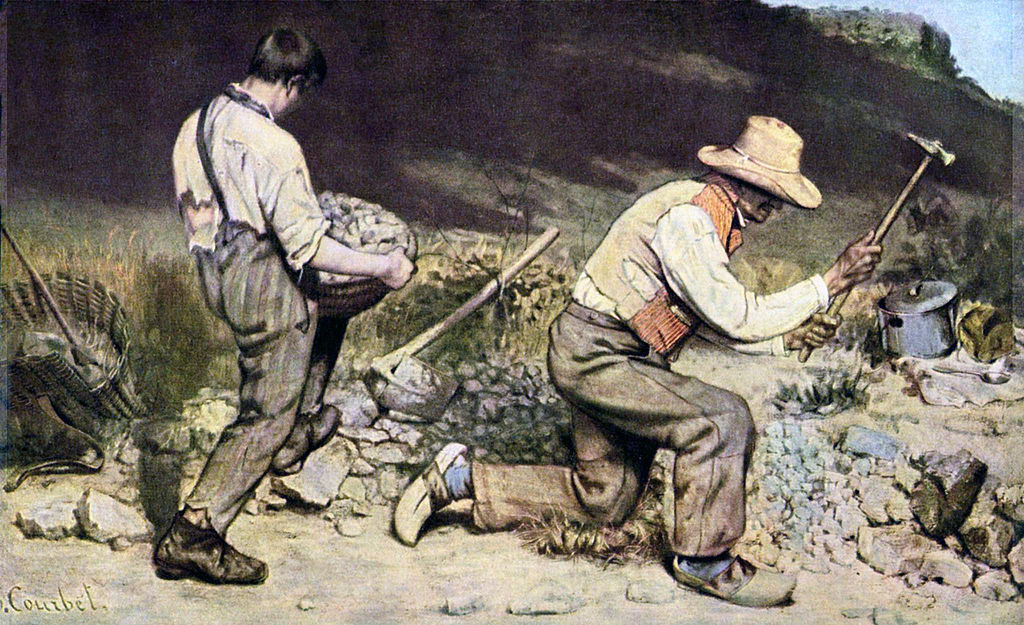
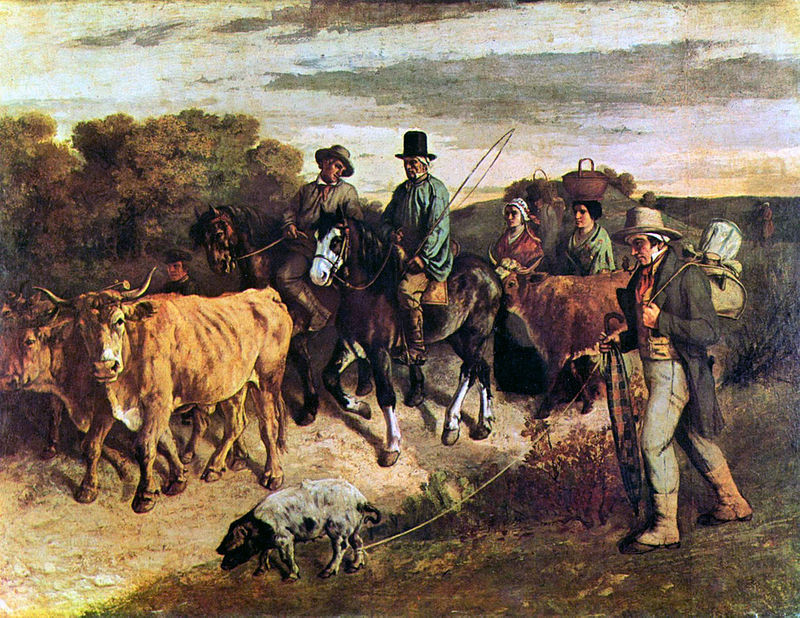
Courbet had also presented Los picapedreros (1849) and Los campesinos de Flagey regresando de la feria (1850). The Paris Salon was horrified to see, at life size, the depiction of ordinary people and everyday activities.
The monumental format was a slap in the face for the Parisian public. His close friend, the liberal politician and art critic Jules- Antoine Castagnary, described the reaction to his paintings like this: “It was like the roar of a whirlwind that had passed through the exhibition hall, shaking and shattering the windows". They considered it crudely vulgar. It was even thought that the intention was to offend the clergy.
And yet, going by Courbet's own words, all he wanted was to reflect honestly one of the most solemn acts of a rural community. For that he was accused of being a socialist, to which he answered yes, and added: “A democrat and a republican too, in a word, a supporter of every revolution and, above all, a realist". The new movement now had a name.
Un entierro en Ornans has been considered one of Gustave Courbet's masterpieces and a reforming painting. Man, any man, and his daily life became a source of inspiration for artists. And proletarian work and rituals became the protagonists of the canvases of the second half of the 19th century.
Comments (0)
Log in to leave your comment. Log in