
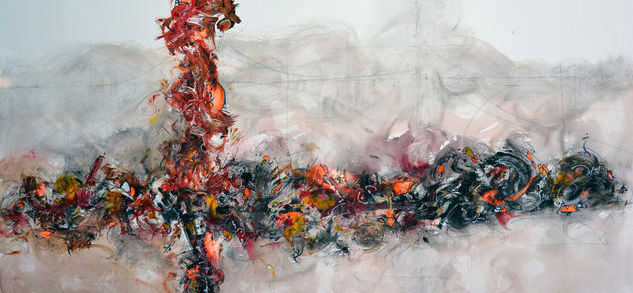
I'm going to suggest a game. It has no rules. There's no time limit. There's no cap on players. No dice needed either, no cards, no scoreboard. All you really need is a board. Maybe not even that. We could call it a map. We could, if we're feeling fancy, call it a canvas. But I insist, let's play, I invite you. Let's get lost inside a painting by Camplá Livesey and see where it takes us.
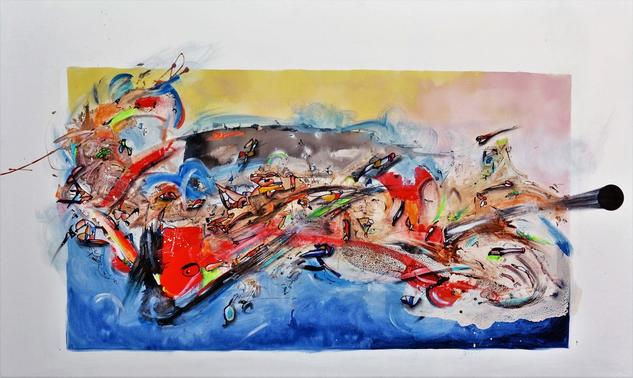
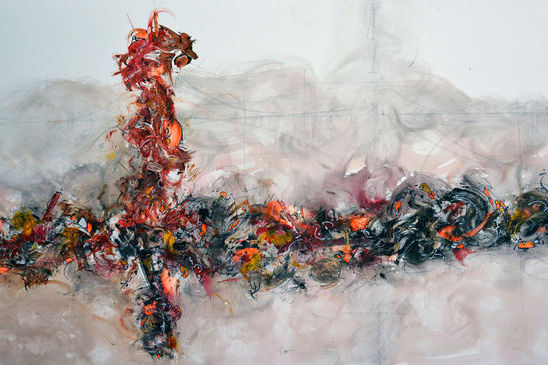
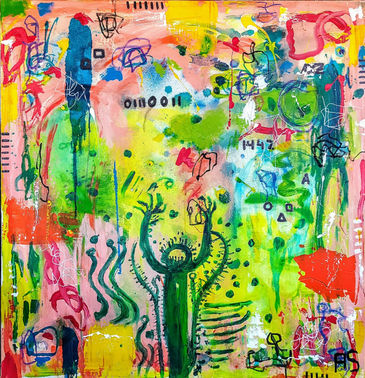
Let's start with his artwork Contrapunto, though any of them would do. And let's look at the label: abstract expressionism with “slight surrealist touches”. The game begins with this clue, from which we gather that along the way we won't find figuration or hierarchies, we won't bump into anything with a real appearance. The line is full of violent yet firm, decisive turns, the colours are essentially primary, the balance is offered to us precisely in its contrasts. So we have our first key: our game unfolds inside an inner conflict.
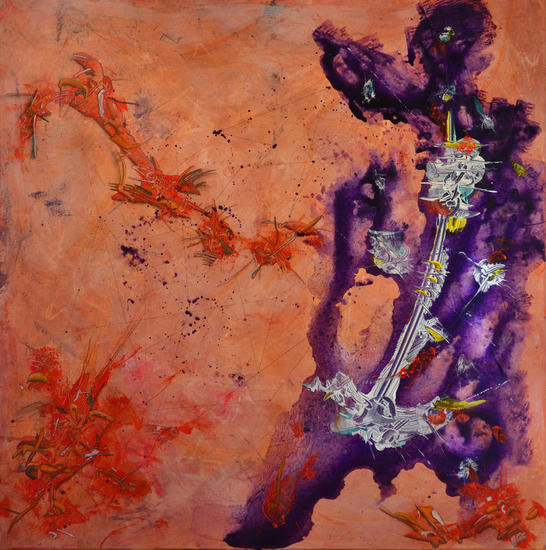
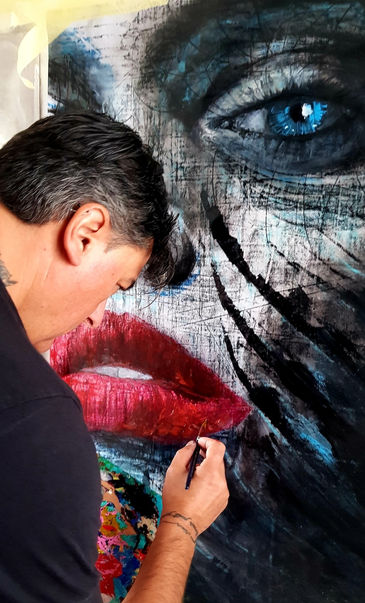
As a result, the forms gain or lose weight according to their psychological charge. No wonder the painter himself recommends looking at his artworks as if they were a Rorschach test. With this, Camplá Livesey is after what every good artist is surely after, to challenge you to interpret, to face you as a player with a reconstruction, that of the story of your own game through the scattered scraps of a game already played, and very probably lost, by the artist himself. That's the game. And the painter wants such freedom of movement for the way we look that the paint rarely reaches his canvases through a brush. Not even in the titles of his artworks does the Chilean artist want to steer us more than necessary.
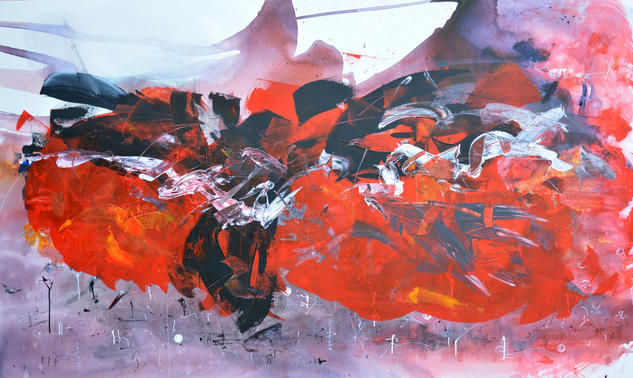
His move into painting after working as a designer and creative director at some of the biggest advertising agencies is a logical consequence for someone who handles the visual image with mastery and no secrets. There isn't a shadow of doubt in the appeal of his compositions. That command is palpable in how ideas are conceptualised. In the need for impact. His artworks convey that hypnotic pull that makes us decipher, among the shapes, the intimacy of our fear and the capacity of our desire. They are a faithful translation into image of our inner drives. And that, in the end, is the game.
Camplá says that his greatest ambition when he faces a canvas is to get his hand to beat his head. The painter tries not to think, and that way creation springs from his unconscious in the purest state possible. Though it's also true that, because of the career already mentioned, Camplá can do this naturally, and believe me it isn't easy, largely because he has the rules of aesthetics well and truly internalised.
Among his most notable achievements as a visual professional are hundreds of logos and complete corporate identities. The artist has worked alongside renowned international design studios such as that of Ettore Zottsass, founders of the Memphis movement, or that of Marco Zanini, among others. After this broad experience, he went on to found his own advertising agency in Chile along with several related companies, basing his school on principles drawn from the Bauhaus movement. Until today, when he devotes himself entirely to painting.
In September 2013 he was chosen as winner of the 8th ArtSlant Showcase in New York, a prize awarded by a world-class international jury. In August 2014 the painter was named a Visionary Artist by the prestigious European magazine Vision. The publication, one of the best in the art world, ran a 12-page feature on his life and his artwork.
Find out more about Camplá Livesey here!


Comments (0)
Log in to leave your comment. Log in