
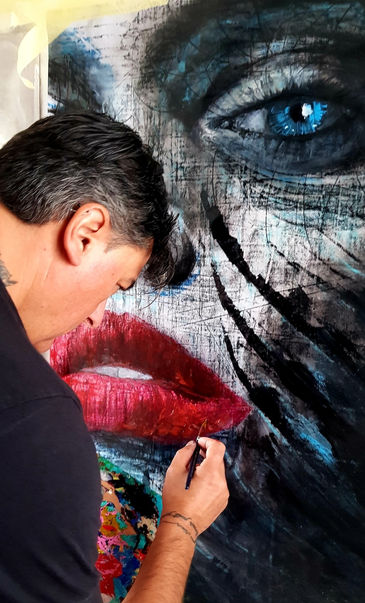
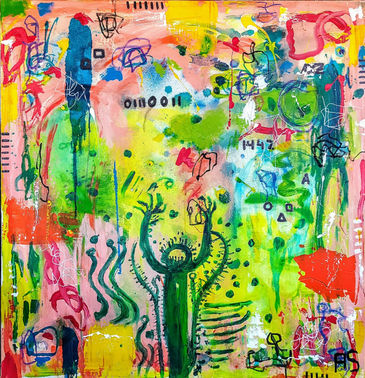
Like Keith Haring, Villabon doesn't lift the brush from the canvas either, or hardly ever, in the endless line of his paintings. He likes to call it Curvism: “a technique that transforms an object, element or area into a composition of large and small surfaces, divided into open and closed curved lines”. And, again like the New York graffiti artist, the Colombian often goes for muralism, which he practises palette knife in hand, with large amounts of pigment.
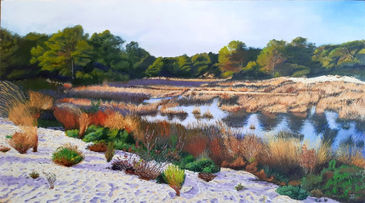
His murals, almost always landscapes, are more realistic than the rest of his work, both in execution and in colour, although you can spot the fluorescent notes that are his trademark. He starts from his own photographs as a reference, as well as from some of the great artworks of all time, which he subverts with his original style.
A clearly pop attitude, as we were saying, which also shows up in the canvases starring animals with human behaviour, decked out in some very underground sunglasses that echo Velázquez's play of reflections. Los animales que somos is a good example of this side of his output, which shines with the power of neon lights but isn't hollow like a commercial product. It lays bare the cult of appearance, of banality.
His portraits keep these stylistic constants but differ in intention. Some of the women covered by a veil bring to mind that legendary image of the green-eyed Afghan girl, Sharbat Gula, photographed by Steve McCurry in the Nasir Bagh refugee camp in Pakistan, which made the cover of National Geographic.
Above all, though, what this artist offers, with quite a few exhibitions behind him since his career began in 1991, is a hallucinogenic and positive metamorphosis of reality.
Visit Carlos Villabon's page here
Comments (0)
Log in to leave your comment. Log in