
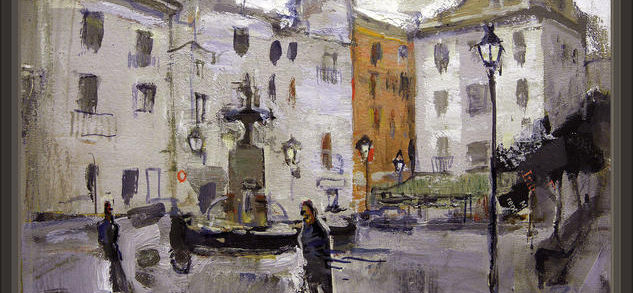
Prizes are nothing new to the artist Ernest Descals (Manresa, 1956). He's won more than seven hundred of them for his painting, watercolour and drawing. But surely none like the one he's just received: first prize in the Concurso Internacional Cecilia Giménez, which will let him exhibit at the Sanctuary of Borja his version of the Ecce Homo, painted in the 19th century by Elías García and which, after Giménez restored it, travelled around the world.
Religious subject matter isn't foreign to Descals either, though his painting usually deals with the natural surroundings, with the life that goes on in city centres and on the main streets of small towns, far more peaceful back then than it is now, when the stalls are starting to thin out in the once bustling markets and modern haste is changing the scene.
Descals records these changes in his artworks, where the human figure has been taking on a bigger role of late, in keeping with his ambition to reproduce the whirlwind of human activity within the landscape, which moves into second place. In his wish to convey the movement of the figures, which stretch out and blur their features in thick strokes of colour, his life-affirming painting has become, if anything, expressionist, and his palette colder and more metallic.
The artist has a special sensibility that lets him take note of the changes happening around him, whether physical or even changes of mindset: if cities are all becoming the same, then it's society we have to look at.
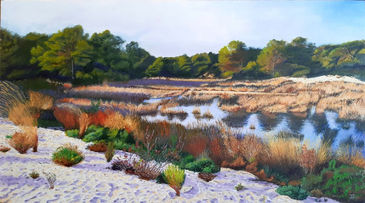
Descals has sung the praises of the Catalan countryside, of its farmhouses wrapped in nature and its mountainous horizon (as Cézanne did with Mont Sainte Victoire), of village squares and churches, of the solid stones that hold time within them, a time the artist wants to recover by capturing not only the surrounding atmosphere, the kind you can almost touch in his artworks, but another, more ethereal one: the historical. There is a bit of both in his delicate, hazy urban scenes and in his vivid Mediterranean compositions, among them lively seascapes, the essence of the moment that exists today but may no longer exist tomorrow.
See Ernest Descals Pujol's artworks

Comments (0)
Log in to leave your comment. Log in