
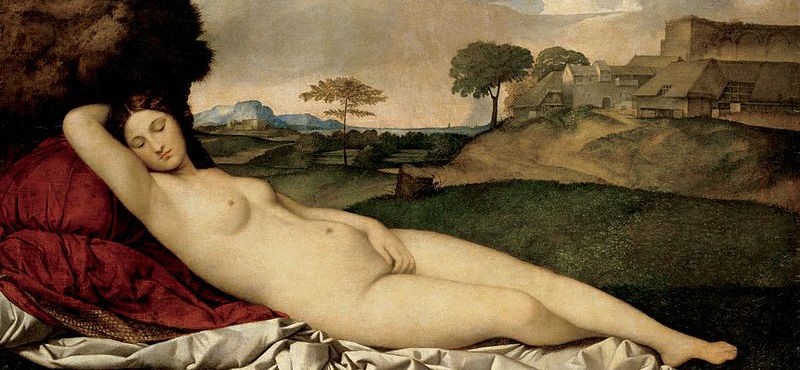
The Venus dormida set a precedent in the history of painting and, on top of that, a whole line of beautiful descendants. Among them, the Venus de Urbino. The two share the same appearance, and yet they are very different.
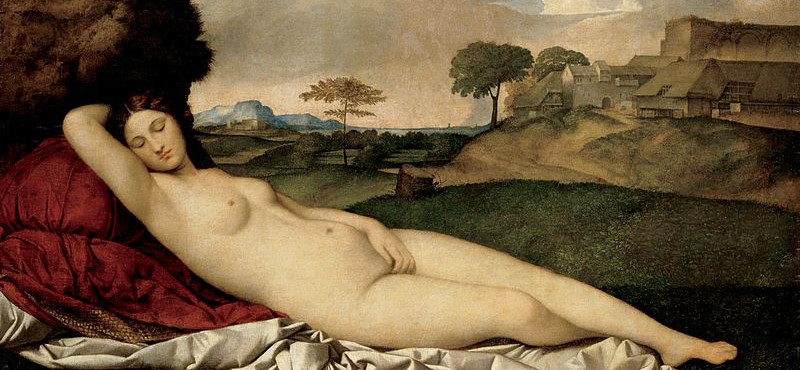
The Venus dormida, or Venus de Dresde, was born in a Venetian studio around 1510. The credit goes to Giorgione Barbarelli (Castelfranco, c. 1477 - Venice, 1510), who was in turn the teacher of the painter most devoted to the sensuality of the Roman goddess, Tiziano Vecellio di Gregorio (Pieve di Cadore, c. 1489 - Venice, 1576), and who is credited with finishing the artwork. This Venus radically changes the depiction of women in painting because, for the first time, a canvas shows a completely naked female body lying in the foreground.
Giorgione launches the theme by painting a body that is serene and at rest, in keeping with Renaissance ideals. The nudity, the light and the atmosphere hint at an erotic scene, and yet it is lost on the goddess, who is asleep and unaware of what is happening around her.
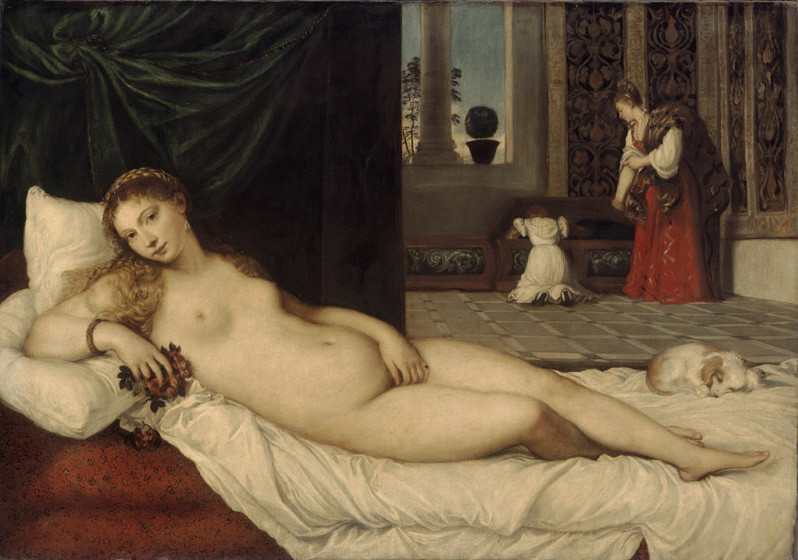
Almost thirty years later came Titian's Venus de Urbino, also known as the Venus del perrito (1538). To create it he drew on his teacher's Venus, copying her suggestive pose but changing her distant personality for one that is closer and more seductive.
Understood as an allegory of marriage, the painting was commissioned by the Duke of Urbino, Guidobaldo II della Rovere, as a private gift for his wife, Giulia Varano, to show her the obligations that came with it.
The obvious eroticism, expressed above all in her gaze, reminds her of the sexual intimacy she was to keep up with her husband. The dog at her feet stands for fidelity. And the scene in the background, where the maidservant watches the young girl as she rummages through the chest, symbolises motherhood.
Colour, the contrast of light and subtle allusions let Titian give shape to the forms of the perfect Renaissance woman, turning her, like Venus, into a symbol of beauty, love and fertility.
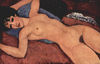
The Venetian genius was not the only one drawn to this theme. The thoughtful, unattainable sensuality of the goddess in the Venus dormida was reproduced by Annibale Carracci (c. 1602), Artemisia Gentileschi (1625-1630) and Nicolas Poussin (1627-1628), to name a few. Others, on the contrary, followed Titian's lead and left out that divinity to bring out her more worldly, seductive side, as Francisco de Goya did in La maja desnuda (1795-1800) or Édouard Manet in Olympia (1863).

Comments (0)
Log in to leave your comment. Log in