
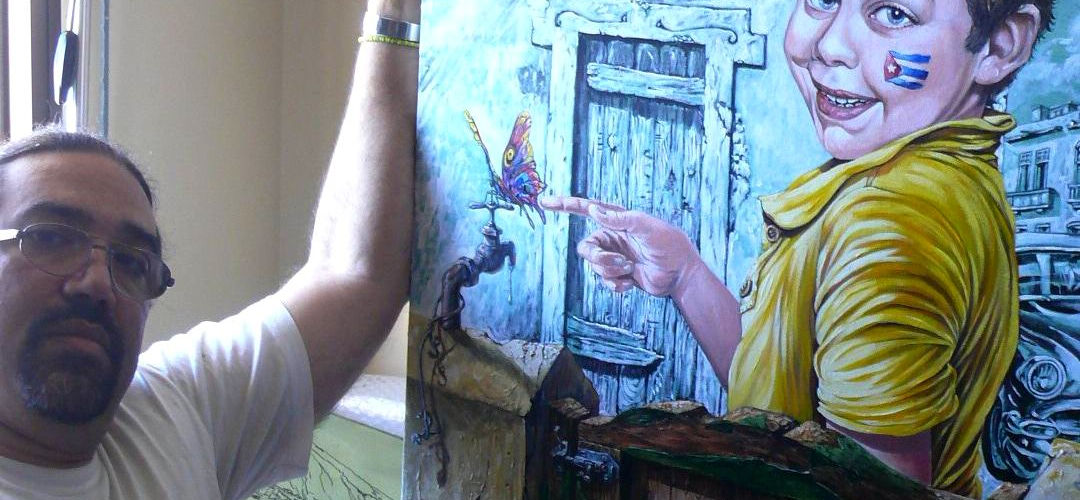
First of all, can you tell me a bit about yourself?
I'm an artist above all, one more dreamer, born on a very special Caribbean island. The son of two great artists, I inherited and learned from them the love of the craft and of creating.
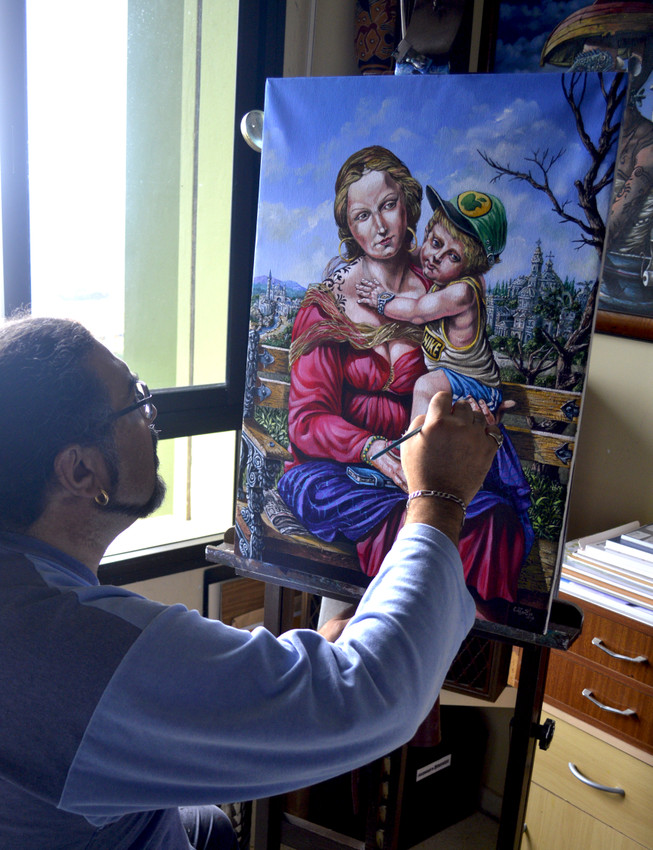
When and why did you start painting?
I started studying at the Academia Nacional de Bellas Artes San Alejandro when I was 13. Bishop Espada and the Real Sociedad de Amigos del País asked the court painter and director of the Royal Academy of Fine Arts of San Fernando in Madrid, Don Francisco de Goya y Lucientes, to intercede with the Catholic Monarchs so they would give permission to set up in Cuba an Academy like the Spanish one and at its level.
The San Alejandro Academy was inaugurated at the Sociedad Económica de Amigos del País on 12 January 1818, as a school of drawing and painting. Its first director was the French painter Jean Baptiste Vermay.
I did it against my father's will, he had already been for a long time one of the great masters of Cuban visual arts, and when I was months away from graduating I was called up for three years of Compulsory Military Service. I finished my fourth year of painting at the Academy at night, as a worker, and that's how I carried on studying, 4 years of Graphic Design and then 5 more to get my degree in Engraving at the Instituto Superior de Arte of the University of Havana. But painting, I tried that from the very beginning. Although to be honest, I think seriously only after mastering the craft and finding my language, we're talking about some 25 years ago. I sign as Carmelohijo because I have the same name as my father, who among other things founded the Association of Engravers of Cuba in 1948.
How do you think a gallery and its artists should help each other?
Of course. They should be well coordinated, able to exchange ideas and even to carry out sales strategies together that, in specific cases, can give good results. The artist has to be honest and give the best of himself, never feel satisfied and always push himself, improve, polish his work and his image and always pay attention to the notifications he gets from the gallery. The gallery has to know how to see, recognise and appreciate the artist's work, beyond personal preferences, tastes or fashions. Being partial in that sense loses more clients than it wins. And of course promote the talent that stands out through good craft, as opposed to the commercial, the everyday and the repetitive. The gallery should draw distinctions between art professionals, artists starting out and amateurs, so that the interested public doesn't get tired of searching in a labyrinth of colour and shapes where they can get lost or bored.
What advice would you give to artists who are starting to show their artwork?
That they be coherent, in the first show above all, that they understand they need a stamp of their own, a unique way of creating, so as to be recognisable and original. That they should try to be contemporary and that there are many ways of being so. That mastering the craft makes it easier to do and to say, and that you never master it completely even if you've finished an academy. A degree or a prize means nothing. It's the artwork that tells you the result and the level of the creator, whether he studied or not.
How did you sell your first artwork? Is there one you feel a stronger connection with?
I don't remember when I sold my first artwork, it was a long time ago. But I'll never forget the first one I sold well. It was at an exhibition at a congress in the Palacio de las Convenciones in Cuba and it was bought by the art gallery of the University of Toronto in Canada. The artwork was called Madonna negra.
All my artworks are like my daughters, but La Inocencia perdida is one of my favourites and got a lot of votes at the time on Artelista.
What is art for you? What part does it play in your life?
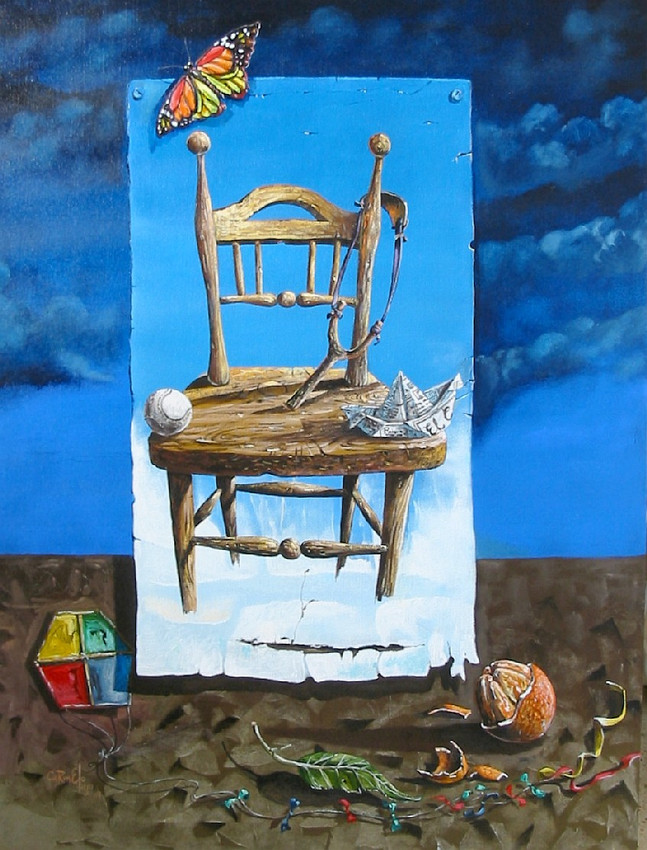
It's my reason for living, what I am and what makes me different. Painting is a language that connects me with the public, that lets me express myself. Because hedonistic painting doesn't interest me, I need to make people think, to have them look for the message or messages buried in the artwork. When I'm not painting I'm thinking and working out my next artwork in my head, I hardly ever do sketches, because I paint from memory, without photos, except in very special cases to get the details of objects that are very complicated.
You define your art as Structural Symbolism, can you explain what that is?
Structural Symbolism, as the name says, is a chained structure of symbols that lead, within an idea or theme, to a final reflection within it. Change the signifier and its order, and the meaning changes. Although it's possible for more than one meaning to be found, and that's valid too. I understood it at my first solo exhibition. Back then, more than 30 years ago, I found a group of people at the gallery standing around one of my artworks. I went over and there, between the artwork and the public, someone dressed like a simple labourer was explaining my artwork in detail. His explanation worked, it was correct, but it wasn't exactly what I wanted to say. My ego made me step forward and when he finished, since nobody knew who I was, I tried to give my own explanation of my artwork, of what I wanted to say. They all listened to me in silence and when I finished, that man, who I later found out was a cigar roller, looked at me, looked at the artwork and said: You don't know anything about painting!
Let me tell you the story of how Structural Symbolism was born in my painting. In 1999 I was invited to do a solo show in Catalonia. In a town called Sant Esteve Sesrovires, which had twinned with Havana. I exhibited in a lovely modern gallery at the Centre Cívic. A Catalan friend of mine, a journalist, writer and editor I already knew from Cuba, went to see the artworks I was going to exhibit and offered to write the catalogue text for me.
It so happened that at the time he was editing a book by a Catalan writer and philosopher, Joan Fortea, with whom I had exchanged thoughts about the structuralist philosophical movement. I also had the pleasure of meeting him on that occasion. When he saw my artwork and understood the chain relationship I set up between my symbols to lead the viewer to an idea, to a reflection between the signifier and the signified. Something more complex than it seems at first sight. He said to me straight away: "The thing is, without realising it you're painting a structural symbolism." And hearing his arguments and explanations, I agreed completely. He wrote the catalogue text, but he was very modest and wanted to stay anonymous, something I still respect today, and he signed it with a pseudonym: Adolfo Mena González. I asked him why, who that Adolfo Mena was. And he answered: "It was the name Ché used with the guerrilla in Bolivia, it's the closest thing I can use for the text in a catalogue by a great Cuban painter and friend."
I'll never forget it, and since then that's been my way of expressing myself in painting.
What are your sources of inspiration? Do you identify with any other artist?
I take my inspiration from the world around me and I criticise it or represent it. My artwork becomes my point of view, a snapshot of my time in the form of a network or structure of symbols which, related to each other, lead to a reflection on a current subject that in fact makes my work contemporary.
At the start every artist is influenced one way or another while looking for a language of his own. But even today I recognise the influence of my father's work in mine. Maybe because he taught me far more about the craft than all the academies I studied at put together. And because, like him, I paint in glazes over Verdaccio.
In your creative process, do you have any habit, practice or quirk that's peculiar or curious?
When I work out a subject in my head, I have to start painting it even if it's 5 in the morning. I always paint with music, as a frustrated musician I'm a big collector, maybe because the type of music I need to hear to get going depends on my mood and on how complex the artwork is.
Have you exhibited recently, what can you tell us? Do you have any new project in mind?
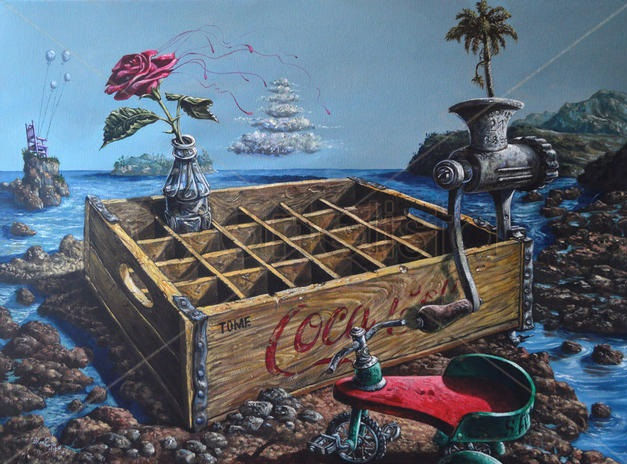
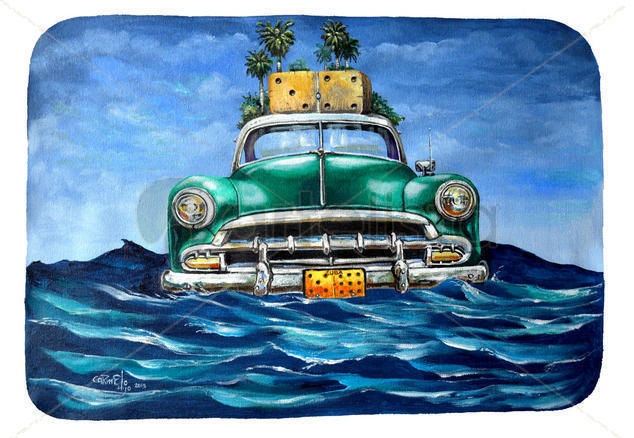
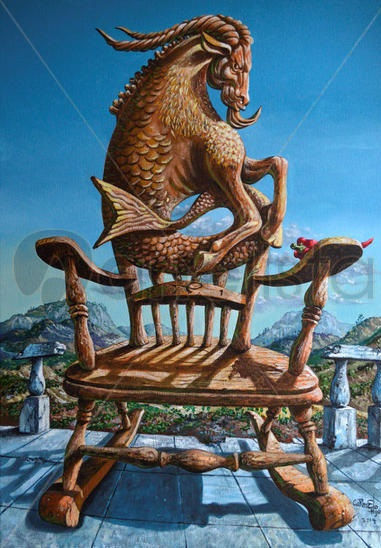
I haven't had a solo show since 2011. Group shows yes. I have several projects, because I'm working on several series at once. Boxes, Del éxodo y lo real maravilloso, last year I finished the series 12 Sillas and Objetos flotantes. So I have options to present, the where is what isn't clear to me. I think that because of some of my subjects my artwork would be very well understood in Latin America, North America and the Caribbean. Although another part of my work is already somewhat European.
Could you recommend us:
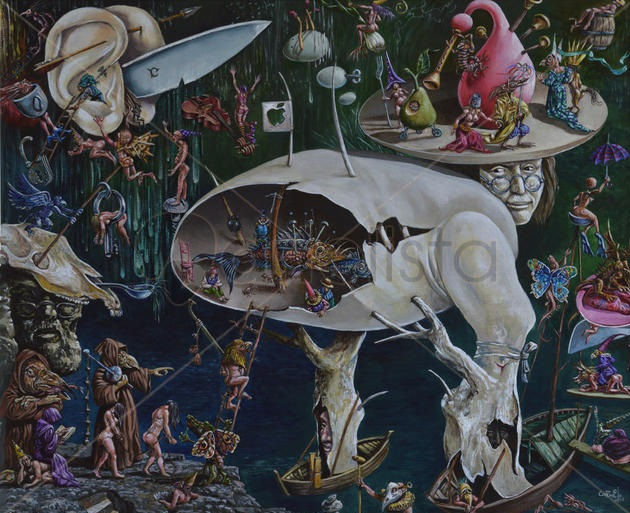
An artist: Hieronymus Bosch.
An artwork: The El Jardín de las delicias triptych by Hieronymus Bosch.
A book: One Hundred Years of Solitude by Gabriel García Márquez.
A film: The Godfather.
Thank you very much.
We invite you to visit Carmelo González Gutiérrez's gallery on Artelista and the review of his artwork.

Comments (0)
Log in to leave your comment. Log in