
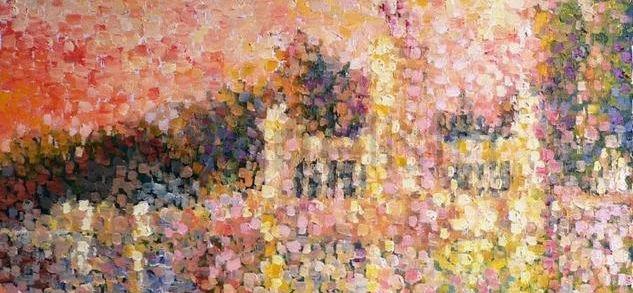
Pointillism turns the tiny into something immeasurable. It makes the minuscule sprout particles that strike the human eye as iridescent paradises. It turns every dot into a unique world of colour that urgently demands our attention in order to make sense of everything around it.
That could be the portrait of one of the many emotions the aesthetics of pointillism stir in the viewer. If we talk technique, its poetry becomes patience and method, carried out with systematic discipline and calculated intent.
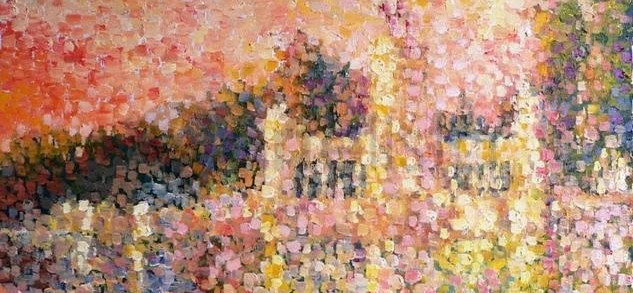
But first, what exactly is pointillism? It's a painting technique in which compositions are built by applying dots of pure colour right next to one another. Seen from a distance, the human eye merges the individual dots and turns them into areas of solid colour. That way, the viewer can make out the shapes and colours the artist set out to represent.
How does it manage that? Pointillism follows theoretical principles of colour and the use of complementary colours, and is characterised by a divisionist approach to tone. Just as the painter swaps broad strokes or brushwork for dots, the mixing of colour also departs from the traditional way. Pigments aren't mixed on the palette, there's an optical mixing of colour instead, meaning the colour is broken down into its components on the canvas and the tone is put back together on the retina.
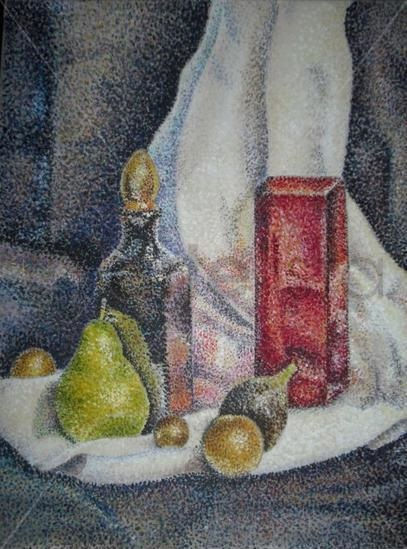
Colour, then, becomes a completely scientific matter. Each dot of colour establishes a relationship with the rest according to criteria set beforehand, such as the space it will take up in the painting or the elements next to it.
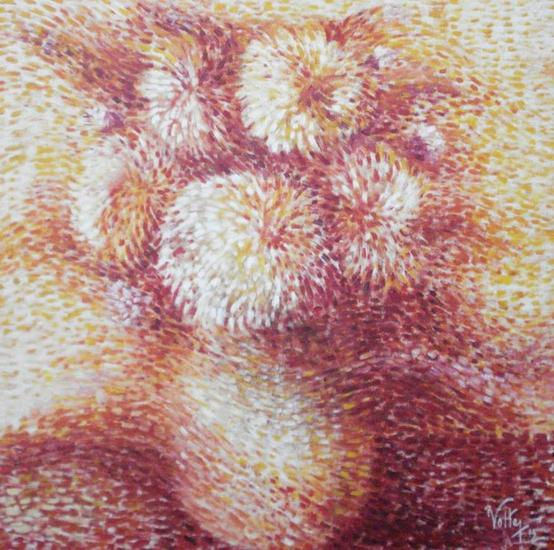
Pointillism appeared in France in 1884 out of Impressionism. In fact, it digs deeper into some of its guidelines, like painting from life and in front of the subject, the interest in the emotional notion of colours and, above all, capturing the luminosity of nature. Thanks to optical mixing, and with intuitive impulse banished, it goes beyond the Impressionist goal and pursues far more intense and brilliant effects of light and colour. It was this idea that led the art critic Félix Fénéon to call them Neo-Impressionists in 1886.
The driving force and main exponent of pointillism was the French painter Georges Seurat (Paris, 1859- 1891), and his canvas Tarde de domingo en la isla de la Grande Jatte (1884- 1886) was the movement's manifesto and, at the same time, one of the master paintings of the 19th century. Among the pointillist painters, Paul Signac (Paris, 1863- 1935), the group's number two, has to be mentioned.
If you feel like carrying on enjoying pointillism, you can do it here with our artists.
Comments (0)
Log in to leave your comment. Log in