
«Every child is an artist, the problem is how to remain an artist once he grows up». Those are the words of the grown-up Picasso, who spent a whole lifetime learning to «paint like a child». The child Salomoni listened to his father's fairy tales while he painted. Many years later, the grown-up Salomoni decided medicine was a thing for grown-ups and gave himself over to his childhood passion: painting.
Making tortellini out of memories
His grandfather Lino and his uncle Tito were painters too. His father, a carpenter. Manual, creative trades that shaped the first years of Carlo Salomoni's life (Ferrara, 1956). At 8 and 9 he started out copying the French Impressionists. But Salomoni, like everybody else, had to start thinking about his future, and he enrolled in Medicine and Surgery, a degree he finished.
«My wife's support was crucial to the development of my artistic career, since she encouraged me to devote myself exclusively to painting». In 1991, Salomoni put down the scalpel and picked up the brush. And he began to draw memories, dreams and longings.
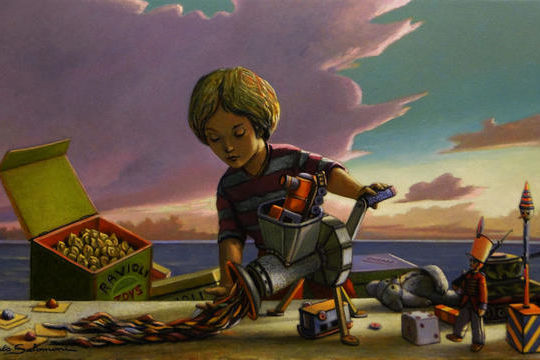
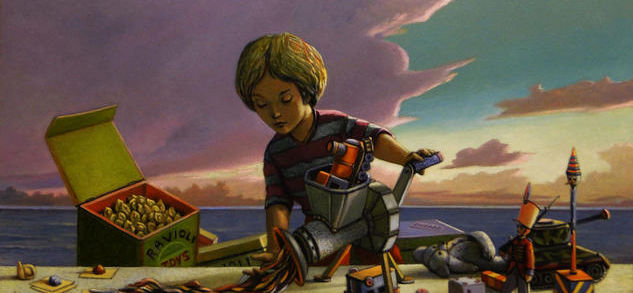
In Ravioli Toys or Juice Toys we see a boy, deep in concentration, working with the most serious material there is (for a child): the toy. Tin soldiers, stuffed animals, tanks… Everything goes into the blender to be turned into the elixir of eternal childhood. A little sip every morning is the best recipe for not forgetting that we were once children with no bills to pay and no idea what a mother-in-law was.
«Art is like a gift that lets me keep up the dialogue with my “inner child”. Thanks to art I've been able to stay in touch with the world of dreams and the imagination of my childhood».
Childhood is one of the most obvious stimuli in Carlo Salomoni's artwork. But there is more.
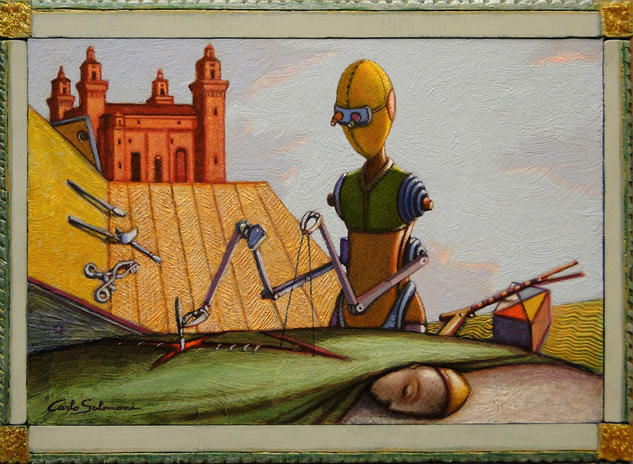
That is the title of one of the Italian artist's most eloquent artworks. The automaton at the centre of this painting on panel takes us back to the beginning of the last century, when the De Chirico brothers were shaping a current within the Italian avant-garde: metaphysical painting.
Futurism was a convulsion in artistic Italy. It opened up a path for experimentation that Giorgio De Chirico (Greece, 1888 – Rome 1978) used to head off in another direction. From the roar and the movement of the machine, to the solitude and unease of empty squares. A girl playing, a shadow growing longer and a mannequin coming to life. De Chirico stirred up the young Surrealists, who shaped a style that changed the history of 20th-century art.
Salomoni doesn't hide his influences, not even in the title. But this is a very personal artwork, an automaton surgeon operating on a sleeping person, a treatment made of beauty and art that heals the soul. Salomoni's most 'metaphysical' artworks don't unsettle or overwhelm the way De Chirico's do, but they don't aim to either. His dreams are closer to fantasy than to nightmare.
Wind, push me far away
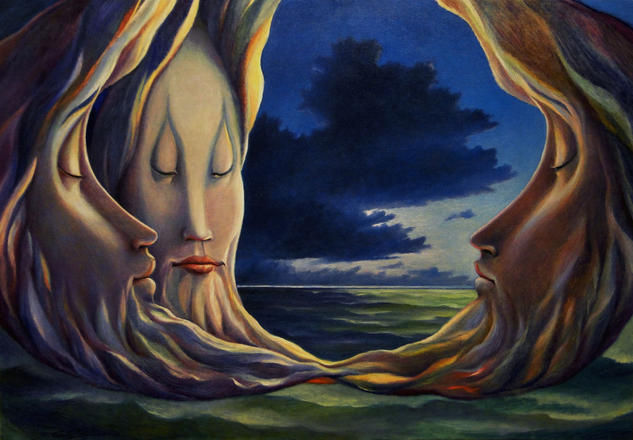
That's 25 years of professional career now, and Carlo Salomoni has had time to shape a style of his own. A style full of moons, tales and games. We could spend hours dreaming artworks like Las lunas de mi cielos inmensos or Convivio de las lunas, a theme that, according to the artist, «represents the world of dreams and the connection between our energies and those of the universe”. But one of the best things about Salomoni's artwork is that it doesn't need an interpretation guide to be enjoyed. His paintings comfort, they rock us gently until we dream.
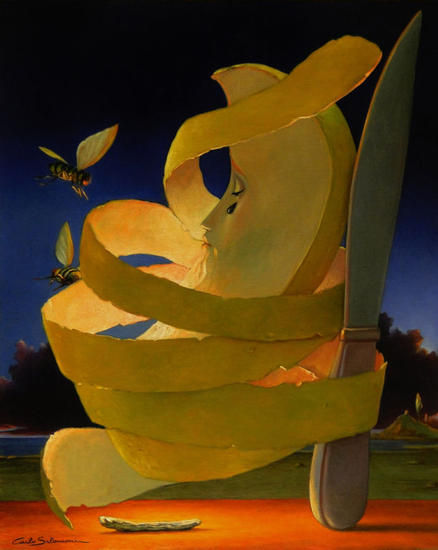
In other cases, though, as happens in En el corazón de la gran manzana, he makes his message concrete to refer to a contemporary event, always from a surrealist angle. Or he plays with the viewer in paintings like Un rival extraño, with its crossed glances and erotic reflections.
All in all, Carlo Salomoni's output satisfies because he has achieved a personal language starting from other voices familiar to everyone. The child still kicking away inside us has a fine time, pushed along by the wind Salomoni blows, crossing oceans of nostalgia until it runs aground on the reef of the soul.
Want to get to know Carlo Salomoni and his artwork better? You can visit his studio through the interview we did with him, or see all his artwork in his gallery.

Comments (0)
Log in to leave your comment. Log in