
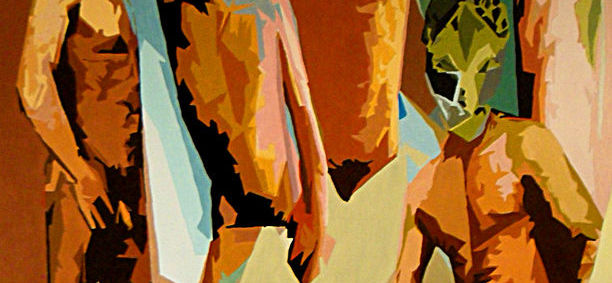
It was the first painting I looked for when I walked into the museum. Ever since my student days I'd fantasised about the chance to stand in front of that oil painting with which the young Picasso had changed the history of art. And when I finally had it there before me, I was lost in it for a few seconds. Then the obligatory photo, and on with enjoying the museum…
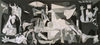
Las señoritas de Avignon is something more than just "another" Picasso painting. It's "the" painting. I don't know whether Juan Gallardo would agree, but the Andalusian artist has his own controversial version of Picasso's classic. Because Picasso is a classic by now and, every so often, classics need revisiting.
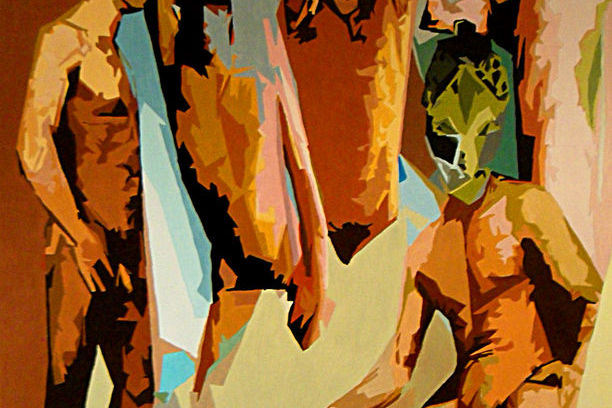
The gentlemen of Avignon and other versions
Picasso knew he was onto something big in his career, and that's why he chose such a large format. Ingres, Cézanne and so many others were on his mind when he took on the subject: a group of women showing themselves naked to the viewer, more or less shamelessly. But what turned Picasso's canvas into a classic was the style he chose, somewhere between Africanism and early Cubism: the art world had changed, the avant-gardes were arriving.
Juan Gallardo doesn't take on Picasso's painting formally, but from the point of view of its subject. Art changes because life changes, and Avignon sin señoritas takes the pulse of a society in which the naked man is also on display, also for sale. With a touch of humour and a touch of protest, Gallardo places five men in openly sensual poses, one of them even flexing his bicep. The faces don't matter, and neither really do the bodies, sketched in as they are. What matters is the attitude and the effect it has on the viewer.
Avignon sin señoritas is perhaps Gallardo's most appetising painting, but it isn't his only version of the classics. Like Picasso (and thousands of other artists over the last few centuries), the Cordoban painter also admires Velázquez and other artists of the celebrated Spanish Baroque.
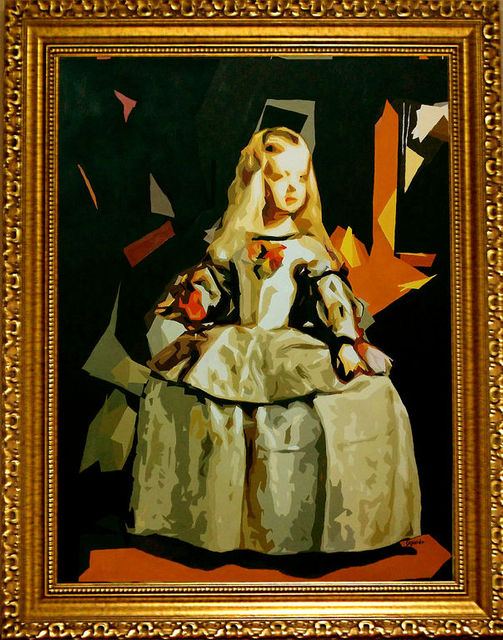
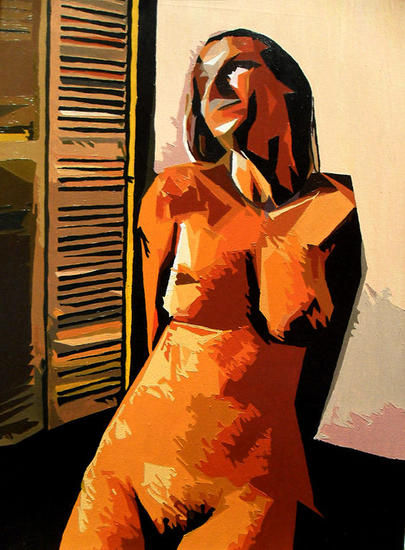
Gallardo turns to one of the figures from the hugely famous Las Meninas (in this case, the Infanta Margarita) to show his formal leanings: a reinterpretation of classic Cubism through facets that give shape to the figures and that, in the backgrounds, come close to abstraction. Gallardo isn't interested in details, but in the aesthetic effect the artwork creates, which is why he also puts so much care into his colour harmonies.
Along those lines, two paintings of saints stand out. On the one hand, San Francisco de Asís, reinterpreting the figures of Zurbarán and Pedro de Mena. Here the colour is muted, bringing out only the saint's silhouette and a background built from squares. And on the other, San Antonio, keeping to the usual iconography that shows him holding the Christ Child. The choice of background colours gives it a certain pop feel.
The window and the street
But beyond versions of the classics, in Juan Gallardo's output we find artworks in which the artist leaves the museum and looks around him. The influence of the photographic eye turns up in them too, as in Autorretrato, where the artist is lit by light coming in from one side through a large window.
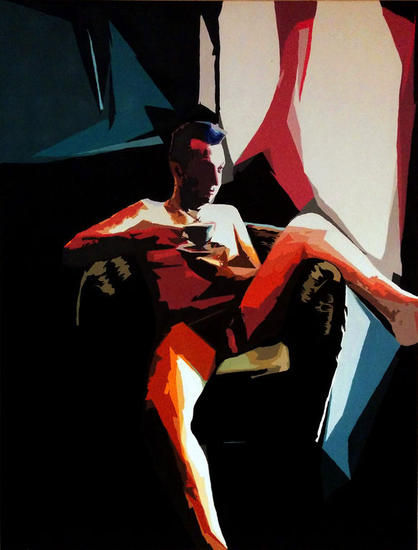
El amante del café, meanwhile, looks like a model straight out of Avignon sin señoritas who has decided to unwind with a cup of coffee after posing. While in Tres Músicos the artist heads down into the street to lay out his style of colourful geometric facets, a kind of pop Cubism that runs through all his work.
We invite you to visit Juan Gallardo's gallery on Artelista.


Comments (0)
Log in to leave your comment. Log in