
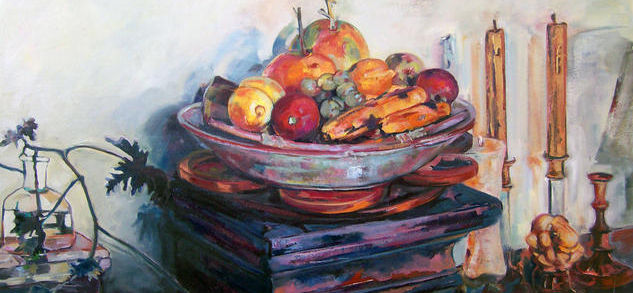
Klaudia Neuhardt's collection is large and varied. She has moved through urban realism, hyperrealist portraiture and Mediterranean impressionism, and lately she has focused her output on expressionist figuration. In this respect, an artwork like Soneto catches the eye. It's an oil on linen in which the German artist skilfully makes the most of the surface to lighten the artwork in painterly terms. That way, the sand and the woman's body connect visually.
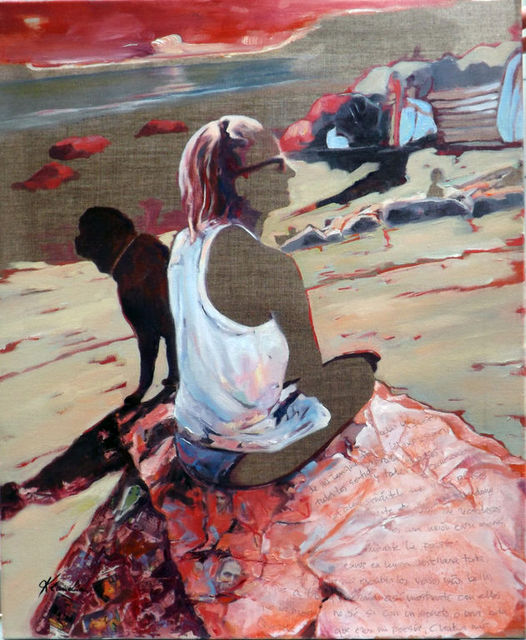
But there's more. In the chromatic economy of this curious artwork, the red that appears in the sky and in the stone stands out, creating a kind of cracking that looks like trickles of blood. In the end, it is this colour that stains the sheet which, like a towel, the woman is lying on: photos and text appear on it, and they explain the painting's title. Red can be violent, but also passionate. And yet the woman who dominates the composition, together with the dog, looks calm and confident, untouched by those cutting lines written on her crumpled towel.
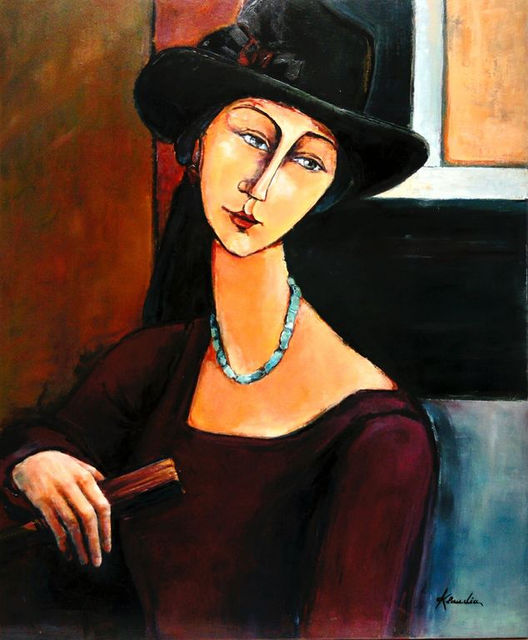
And what about Amedeo and Me I? We'd all like the chance to talk to the artists we look up to. In this artwork Klaudia talks to Modigliani, one of the most personal artists of the 20th-century avant-garde. This series inspired by the genius from Livorno may come as a surprise, because the rest of the German artist's output has little to do with Modigliani's archaic expressionism, but there's no doubt it's a tribute to the master.
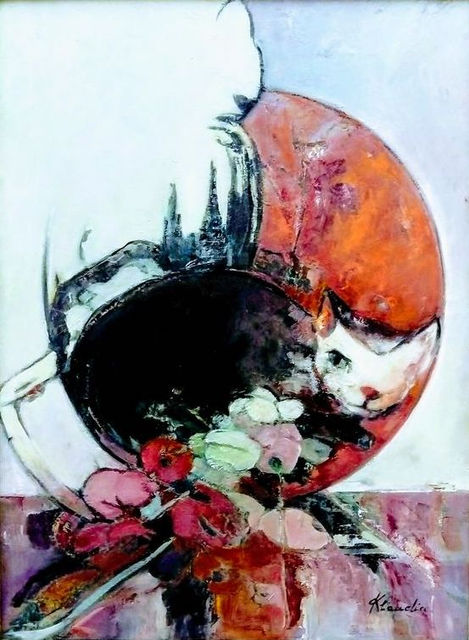
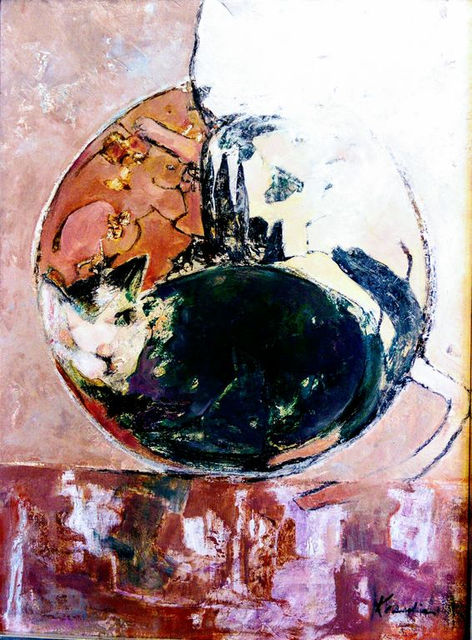
Along the same stylistic lines as these tribute paintings we can also place Chats avec jardin de clair de lune de Debussy, two artworks with a curious motif in which Klaudia Neuhardt explores expressionist painting technique.
More personal is her series of artworks featuring little girls, such as Flötenspieler (Flute player). The technique here points back to the classic figurative expressionism of the early 20th century that took hold precisely in Klaudia's own country with the artists of Die Brücke (The Bridge). The painter herself names Ernst Kirchner as one of her influences.
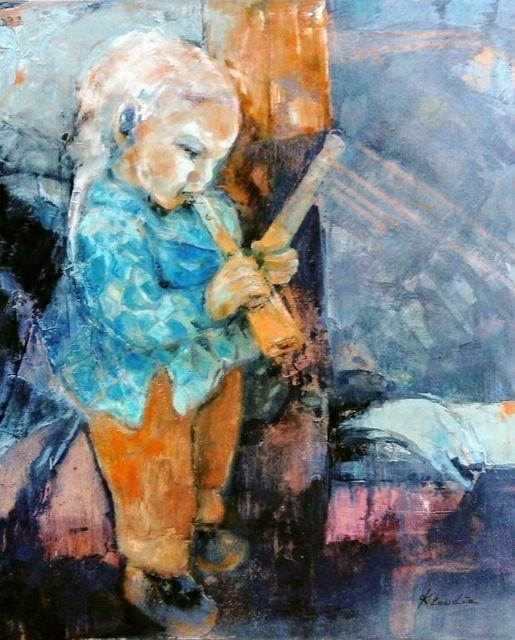
Without going as far as those painters' unsettling breakdown of reality or their (often) hysterical use of colour, in La flautista Klaudia shows the possibilities of this strand of painting, where the expressiveness of the colour, the placing of the figure in the foreground and the blurring of the background make the viewer narrow their eyes in search of some meaningful beyond inside the painting.
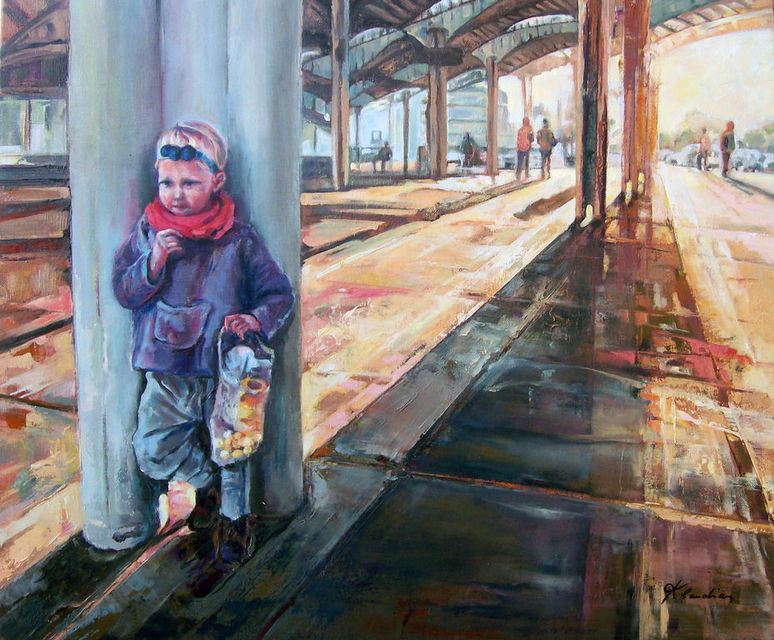
With a similar motif but a different technique, less loaded with paint, The Station also stands out. The constant coming and going, the flow of souls, make stations a common artistic motif for depicting melancholy. And although this artwork has a slightly Hopperesque air of resignation, the figure that dominates the composition isn't a middle-aged person staring into the distance, but an innocent girl for whom there is still hope.
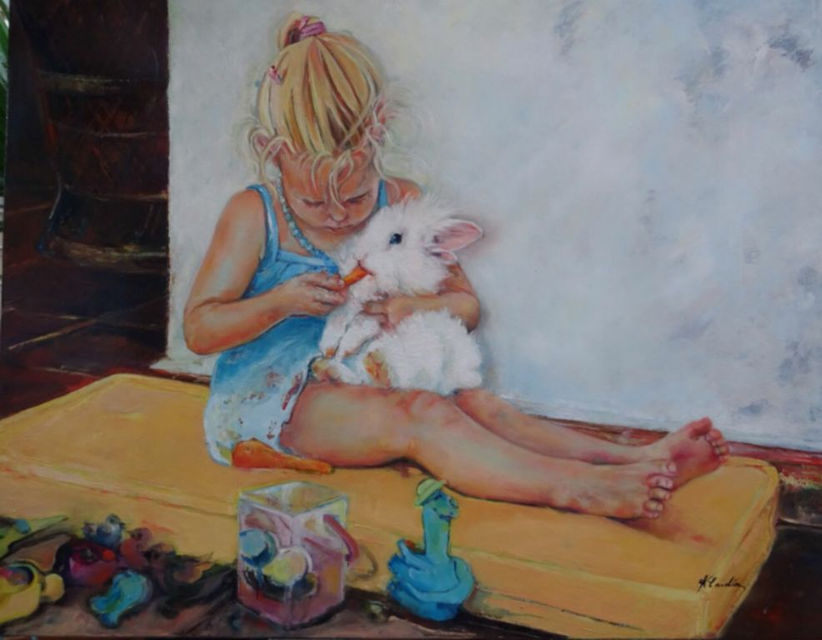
Her series Incondicionales, also featuring little girls, is connected to the impulse behind The Station: they're gentle paintings with a nostalgic touch, in which children and animals (pure souls) play in a protected world where hardly any spatial reference slips in.
But Klaudia Neuhardt's versatility goes a long way and she doesn't shy away from landscape. Although she has tried her hand at the symbolic hyperrealism of Modesto Trigo, her teacher and colleague, in her latest phases the German painter prefers to experiment with a style closer to post-impressionism, as we see in artworks like Lucena del Cid or Metáfora I. Also striking is En Tránsito I, which was included in the 2016 exhibition Contrastes Marinos, as was the aforementioned Soneto. It shares with it a certain expressionist touch thanks to the free use of colour applied, in this case, to the background and the sky.
And although Klaudia's output also includes more realist landscapes such as Gran Vía, Chinchón or Monasterio del Escorial, we prefer the reverie of her series Los cinco sentidos más el sexto. In both Tacto and El sexto sentido, especially the latter, the expressive use of colour and the surrealist approach to the motif are surprising. If in Tacto the painter goes for the fragmentation of reality through a decorative composition that hides a series of symbols, in El sexto sentido the painting comes across as an unsettling game in which the viewer has to try to perceive the imperceptible: precisely what escapes the other (five) senses.
We invite you to visit Klaudia Neuhardt's gallery on Artelista.


Comments (0)
Log in to leave your comment. Log in