
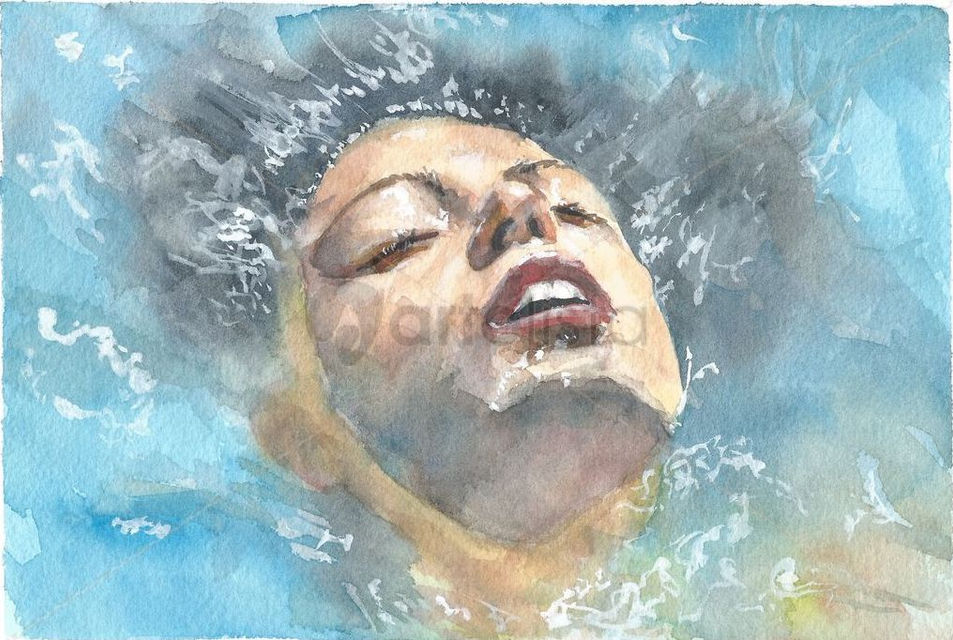
If Millais' Ophelia rests forever on the water, Marcos Cortés Vega's Ophelia is only taking a break. The artist gives us a close-up of the model with her mouth open but her eyes closed, unlike what happens with the Shakespearean character. It's an ironic nod to what may well be the most famous painting of the Pre-Raphaelites: Marcos Cortés' Ofelia en la piscina is playing dead, enjoying that instant of fullness on the water.
Woman and water. A breeze colouring the peak of silence, sun tanning select skins, framings that leave out any hint of harsh reality: no, today we don't want to know anything about what lies beyond, we want to stay here, taking baths of pure beauty, simple beauty, drowning the noise in an ocean of stillness.
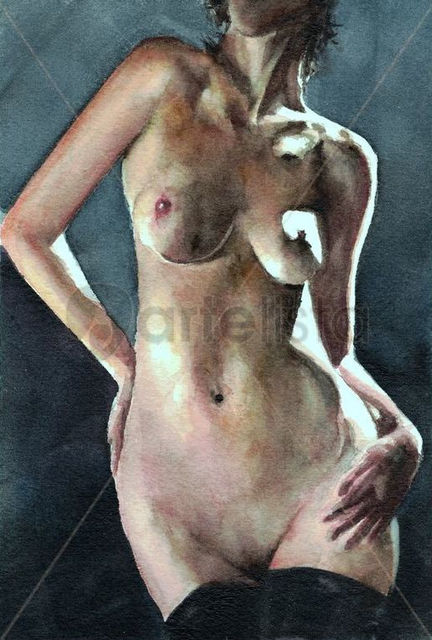
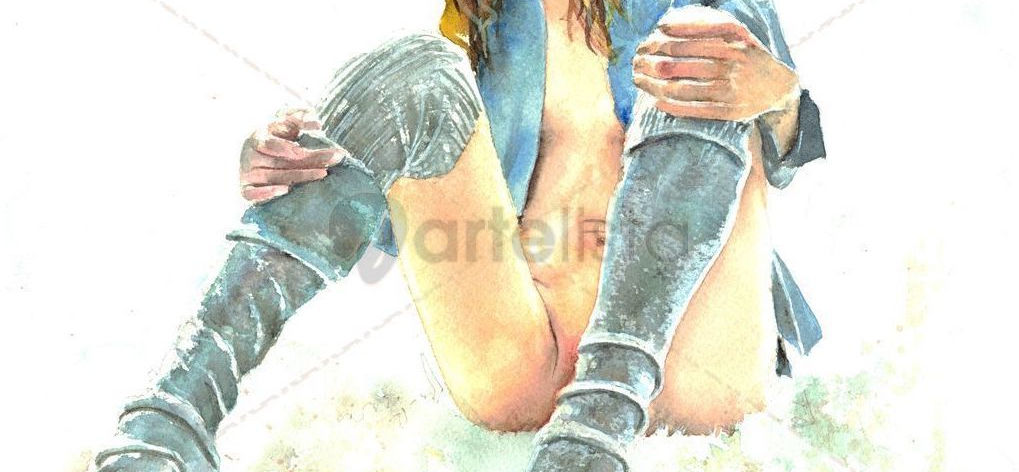
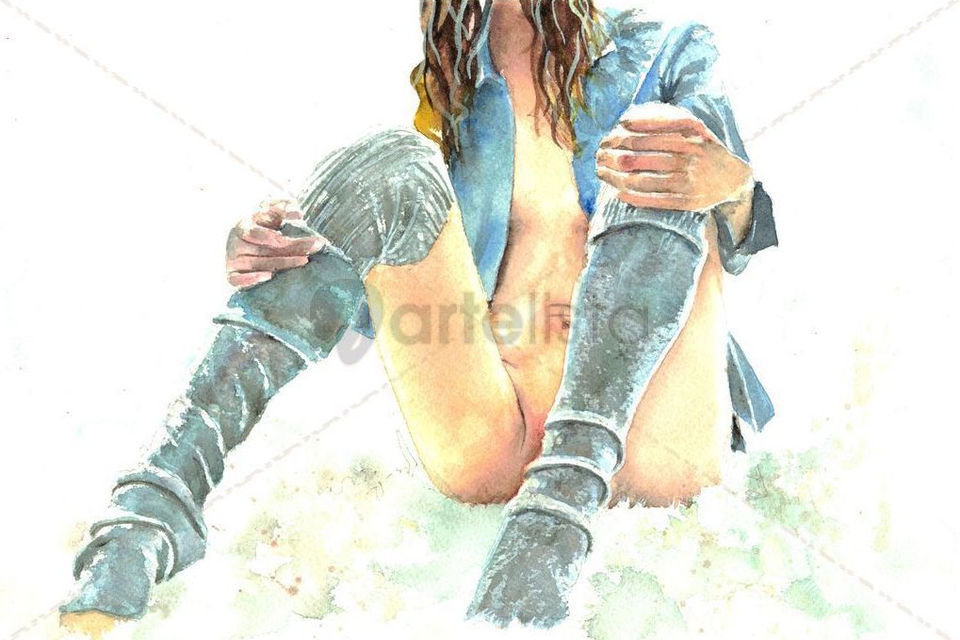
How could anyone not take a chance on Marcos Cortés' watercolours? The artist has undoubtedly chosen the perfect technique for this series called Mujer y Agua. Watercolour is one of the ideal techniques for painting water, dampness and the atmosphere it creates. And light, of course. Those are the three motifs that hold the series together: the human figure, generally in close-ups or detail shots, water and light, always natural, with a Mediterranean flavour.
The watercolours in this series taste of the sea, of endless summer. But there's something more. Many of the female figures Marcos Cortés paints in his artworks have their eyes closed. In some cases they surrender to serenity, as we also saw in the aforementioned Ofelia en la piscina or in the delightful Adiós and Romance. In others, those eyes close in the middle of an aquatic ecstasy, as in En Penumbra or Lluvia en la cara.
This happy artistic union between the female figure and water reaches its fullest expression in the underwater watercolours, where the woman dives towards her atoll of calm, as happens in Donde viven los pensamientos, Bajo la penumbra or Sueño Eterno. Nor should we forget the watercolours where we no longer even need the model's face to feel her placidness, as in El mundo al revés or A remojo. In short, everything is claro y limpio in the watercolours of this series.
But Marcos Cortés also takes out his brush in the urban half-light to tell other, less friendly, more literary stories. In his series De Noche, we turn the corner and run into a dark figure in the middle of the alley. Although the artwork is called Hacia la luz, we haven't reached it yet, the story hasn't said its last word.
The same thing happens in Huida blanca, a watercolour that could easily go with a mystery story. Where is she going? Why has she rushed out into the street in the middle of a snowstorm? If the artworks of Mujer y Agua work as prints of a state of mind, the watercolours of De Noche conjure up stories, with a twilit past and an ending still to be discovered.
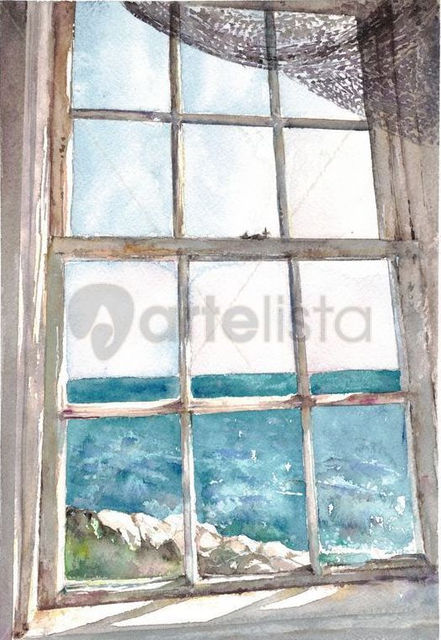
Within Marcos Cortés' output we can also find pieces with other motifs. In Clausura, the artist takes out his brush to fix the light filtered through a Gothic window. Or Aullido, an example of the artist's skill at painting animals in detail.
And the thing is, watercolour is in fashion. It has the qualities needed to catch instants and atmospheres, to evoke shifting realities. The watercolourist has had to fight for decades against the idea that his art is a learning technique, an almost childish one: oil on canvas is high art, colour floating in water and clinging to paper is minor art.
But there's no minor art any more, because there's no high art either. The concept of Fine Arts tastes of top hats and carriages. Ours is another time, and watercolour has that touch of immediacy that represents it so well. You only have to take a look at Marcos Cortés' output to see it.

Comments (0)
Log in to leave your comment. Log in