
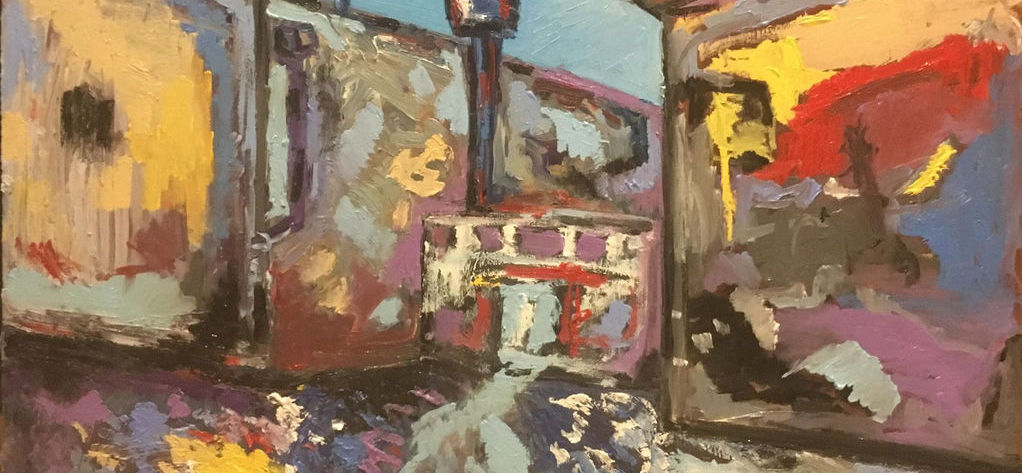
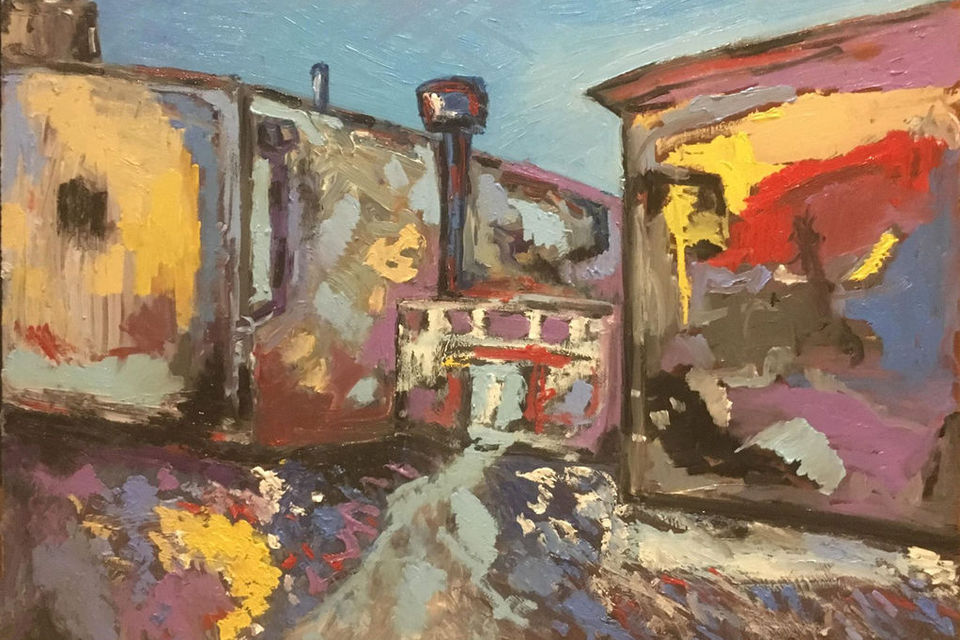
Gali Street is a street in Tbilisi, the capital of Georgia. Luka Jikia took an image of this street to build one of his colour symphonies. Only the silhouettes of the buildings and the forgivingly blue sky escape the festival of colour that Jikia applies to the canvas. The reflections on the house walls and on the ground invite us into an unstable but promising world.
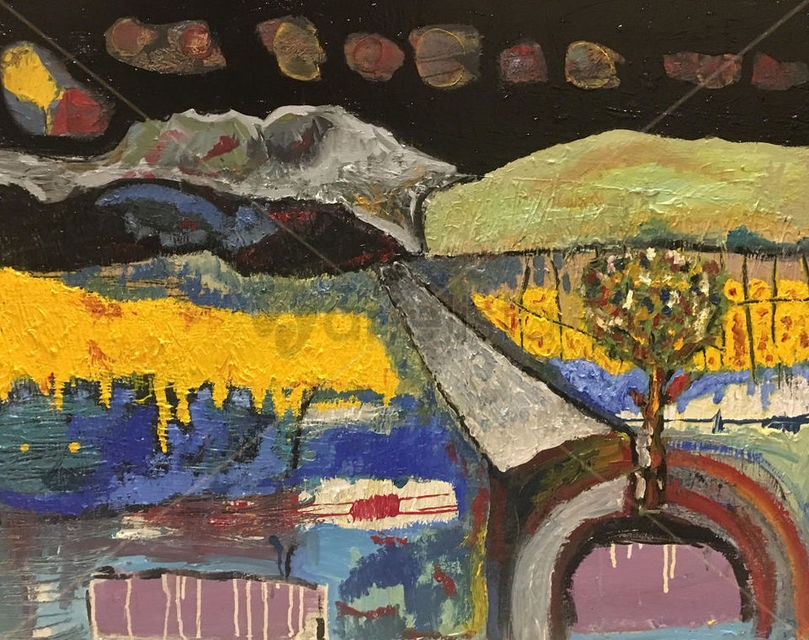
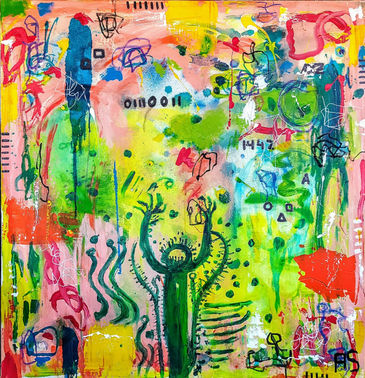
It's the same world, though even more dreamlike, that rules Tree of Dream. The colours are set down with the soul and the subconscious, in search of a compositional harmony that breaks free from any reflection of nature. We still see a tree here and a mountain there, but it's the drops of paint running down the canvas and the strong contrast between black, grey, yellow and blue that really catch the viewer's eye. A tree and a dream, a horizon of colour where everything is possible.
Luka Jikia (Rustavi, Georgia, 1994) starts from colour as the expressive element in his landscapes and in a good part of the rest of his work. It isn't hard to see, in both Gali Street and Tree of Dream, echoes of the experiments of the Nabis or the Fauves, that generation of painters who changed the way colour was used in painting. A horse could be blue and a river red. Colour is symbol, colour is poetry set on canvas as free verse.
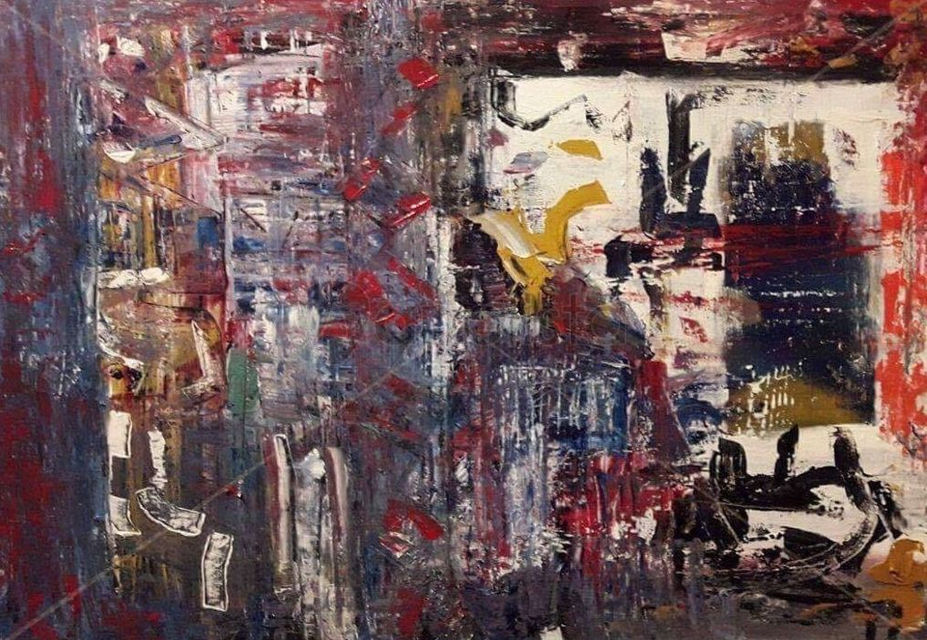
Luka Jikia's free verse experiments with abstraction in Broken City, an urban landscape with a different look and a different mood. What in Tree of Dream or Gali Street was dream and innocence, home and nostalgia, in Broken City turns into suffocation and alarm. The red tones scattered across the picture like knife slashes announce mourning, and the nervous layering of scratches and scraped colour smothers that broken city and its inhabitants.
And at the abstract end of Luka Jikia's landscape we find two artworks in which colour seduces the viewer again. Sunset is a heavy, dense picture thanks to the roughness of the material. Those bas-reliefs that dominate the canvas create a rhythmic sensation as you read the painting, starting from the red sun at the top, like a wax seal, and descending towards the blackest black with curious schematic figures in the lower part. Love in the Winter, for its part, is like the morning breeze of a spring love. The whites and pinks alongside that red dot ringed by a yellow aura take us back to the beginning: to the desire to go out, breathe and love.
Besides urban landscapes in which colour is the decisive element both compositionally and metaphorically, Luka Jikia also has artworks where the human figure takes the lead. But it's an elusive, dislocated figure wrapped in cubist and decorative patterns in which colour shares the spotlight with a thick line that underlines contours and pins down symbols. If in this Male & Female the intertwined human figures emerge from a grey frame surrounding them, in another Male & Female there is a greater sense of stillness in two figures with an ethnic air, reduced to geometric shapes, with yellows and blues prevailing among crosses and numbers. And that red dot ringed by yellow that we already saw in Love in the Winter…
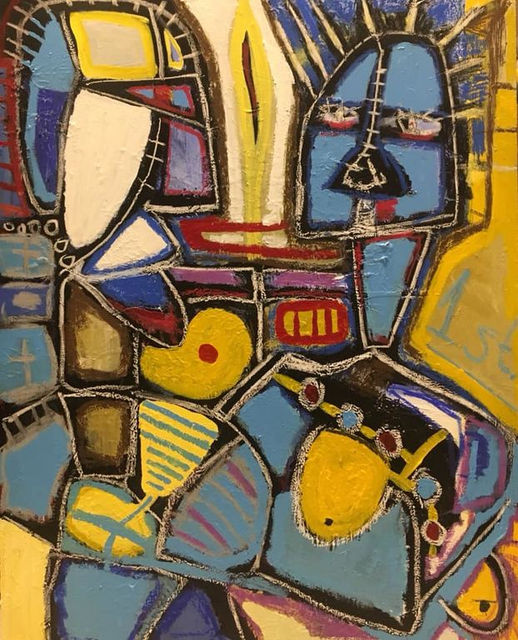
There's plenty of love in Luka Jikia's painting, even if there's also room for artworks like Emigrant, where the Georgian painter briefly sets aside his taste for harmonies of bright colours and cuts his palette down to barely three tones. The result, even so, is brilliant thanks to the arrangement in blocks, almost like comic panels. A story waiting to be discovered, like the rest of young Luka Jikia's painting.

Comments (0)
Log in to leave your comment. Log in