
«I'm my own reference». That's how the artist answered the usual question about influences in artistic creation. But that painter wasn't Monique Van Steen (1976, Breda, Holland), it was just a role in a short film. Monique warns us: «careful, it's a horror movie about art, I'm not like that».
We don't think the artist uses blood as an ingredient in her artworks the way her character does in that unsettling short, but she has indeed become a reference for herself. Her career shows confidence and command of her creative resources. She's on the right track, and she knows it.
Disproportionate beauty
The expression of the human face, the emotion carried by eyes and gestures. The main motif of Van Steen's artwork couldn't be more classic. As in Reina de Picas 2012, where the Barcelona-based artist turns to one of the most popular faces of the 20th century: Grace Kelly. The actress turned princess was for years the paradigm of beauty. And for Van Steen there is no beauty more expressive than the one that comes from the face.
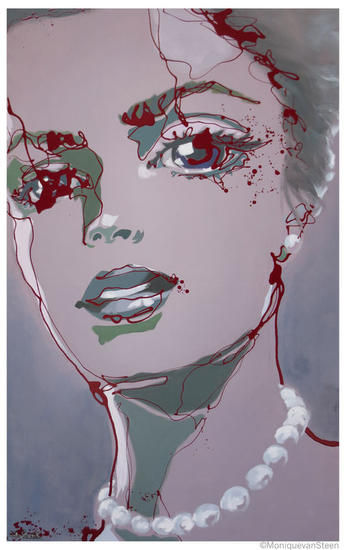
Haven't you ever come across one of those faces on the metro or the bus that you just can't stop looking at? That's the seduction of beauty, the nutrient that feeds us in dead moments. Monique Van Steen's artwork aims to seduce us (and does) through the representation of the harmony of women's faces.
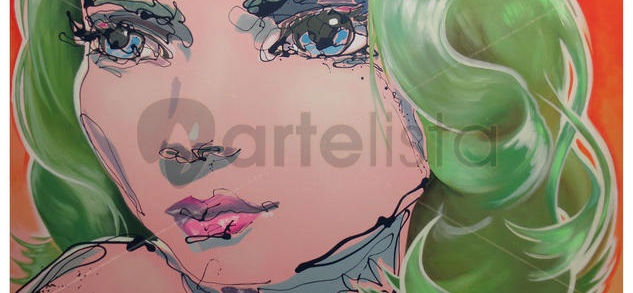
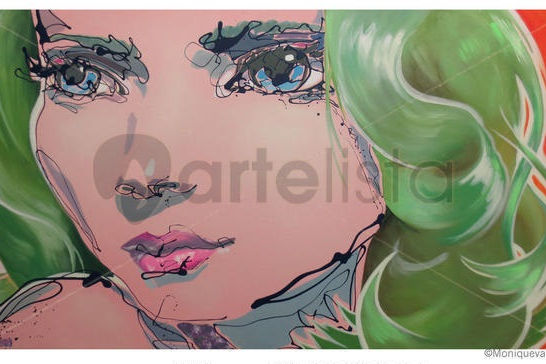
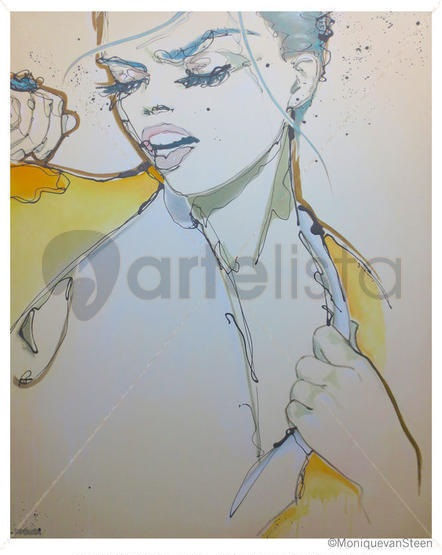
The Beauties series looks into the model of beauty put out by the mass media. But the Dutch artist takes the clippings from fashion magazines onto her own ground. She brings in touches from comics, as in Escila 2012. The disproportion of the face (those huge eyes) not just goes unnoticed, we take it as necessary. The hands and the head of Michelangelo's David are disproportionate too and it's still an icon of male beauty… Beauty doesn't have to be proportionate.
Dripping over models
Technique is a fundamental element for any artist, and no less so for Van Steen, who has managed to shape a creative formula that works both aesthetically and commercially. Her paintings could decorate any city apartment or fashionable bar.
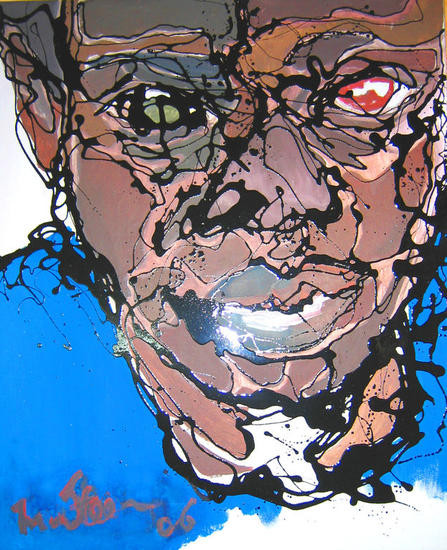
Already in Rostro de África, a canvas from 2006, the Dutch artist showed her fondness for dripping, a technique that became popular with the abstract expressionism of artists like Jackson Pollock, but that Van Steen applies to her figurative pop. If we look at a more recent artwork such as Peleiade 2014 we'll see that the dripping is still there, but in a subtler way.
The Dutch painter starts from photos taken out of magazines. Sometimes it's a look or the gesture of a mouth that draws her in. She uses these photos as the base for the skeleton of the canvas, which she builds through fields of acrylic colour. And then comes the dripping, those drops of synthetic enamel that shake up the expressions. This contrast of techniques between the stillness of the acrylic colour fields and the tremble of the dripping is what makes Van Steen's artwork tremendously effective from an aesthetic point of view. As if Pollock, Rothko and Warhol went out for drinks and ended up making an artwork six-handed. In any case, Monique has achieved something many artists never do: finding the right technique to express her creative universe.
Watching and being watched
At an exhibition by Monique Van Steen, a viewer feels stalked. It's a curious element of the Dutch artist's work. The extreme close-ups and the big eyes of her models question us while we enjoy their pop beauty, as happens with Pisitoa 2012 (although in this case, a single eye is enough to scrutinise us).
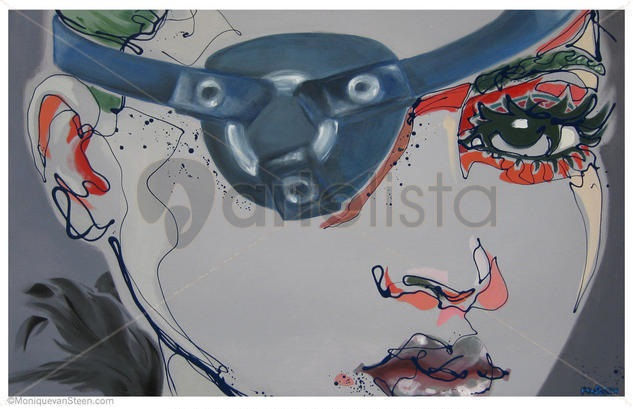
What Van Steen seems to question in her artwork (she was a runway model, she knows what she's talking about) is the world of fashion and beauty as broadcast by the media. It's like when we leaf through a fashion magazine, fascination and artifice fighting to saturate us. Meanwhile, Monique Van Steen keeps enjoying another kind of saturation, that of the Mediterranean light that dresses life in colour and changed her artistic path forever.
You can visit Monique Van Steen's full gallery here.
Comments (0)
Log in to leave your comment. Log in