
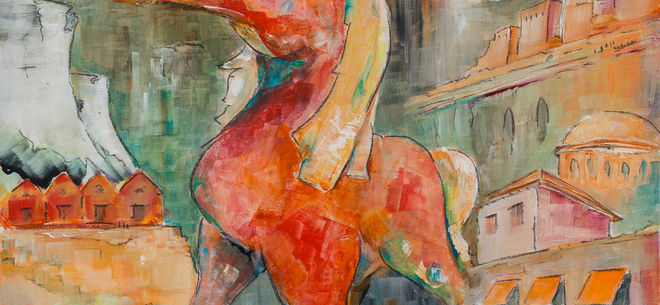
The child who watches, the balloon that flies, horses galloping under the watchful eye of the moon, the novel on the board, Che on the wall and the blue horseman on the horizon. What mysteries are hidden in Thierry Merget's canvases? Why do they give us warmth but also bewilderment? Let's leave our map of reality on this side and step through the frame to let ourselves be guided by the compass the Belgian painter offers us, and walk his roads to freedom.
Settled in Ciergnon in the heart of the Famenne, Merget enjoys his studio in one of the richest forest regions in Belgium. This is where you find the forest that gives its name to one of the artist's series (Forêt Royal). Ciergnon is also home to the Royal Castle. This spot has been linked to the Belgian royal family ever since Leopold I acquired vast tracts of land in the area in the mid 19th century at the request of his wife Louise-Marie.
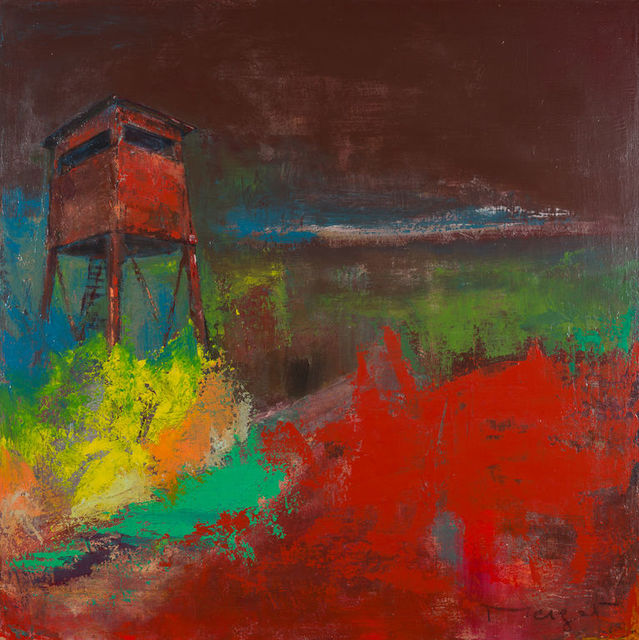
We don't think Merget set up his atelier in Ciergnon to be near royalty, but rather to live in a natural setting that offers serenity to the mind and inspiration to the brush. But the Belgian isn't (only) a landscape painter, even though nature is present in his work. Merget prefers to turn to symbol and dream to give free rein to his fantasies… of freedom.
Looking out over the roads to freedom
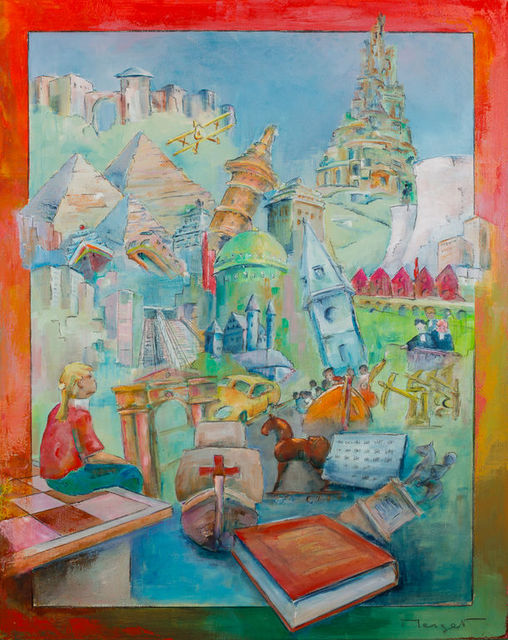
The first thing that strikes you about his series Les chemins de la liberté is the illusionistic frame, a kind of trompe l'oeil that turns his paintings into windows the viewer leans out of, accompanied by a boy or a girl sitting in one corner.
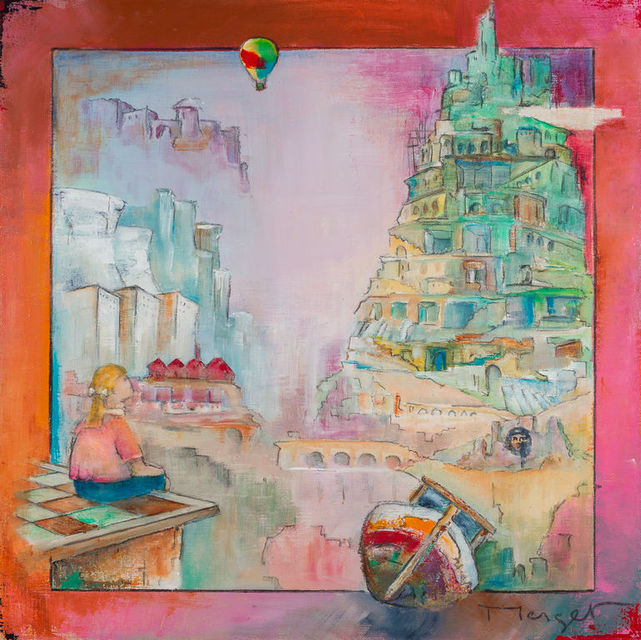
As in Les chemins de la liberté 1, the girl sitting on a board that juts out past the frame calmly watches a symbolist landscape in which several elements stand out that recur in much of the rest of the series and of his work: the fantastical medieval city like a tower of Babel, the bridge, the Che Guevara graffiti, the boat and the balloon, the last two also spilling out beyond the frame.
The sketchy technique and the harmonies of earthy colours give the painting a dreamlike atmosphere close to naive art, but the graffiti and the name of the series bring us back to contemporary reality.
Merget's scream
In Le Cris we come close to the city with no illusionistic frame. The horse, a regular animal in the Belgian's work, whinnies violently while some children joined by the hands seem to be bracing themselves to withstand the charge of the dark authority appearing through the city streets, packed tight and protected by shields. Horses were already screaming in terror with their sharpened tongues in Guernica. Times haven't changed all that much, Merget seems to be telling us, fear and the fight for freedom are still with us.
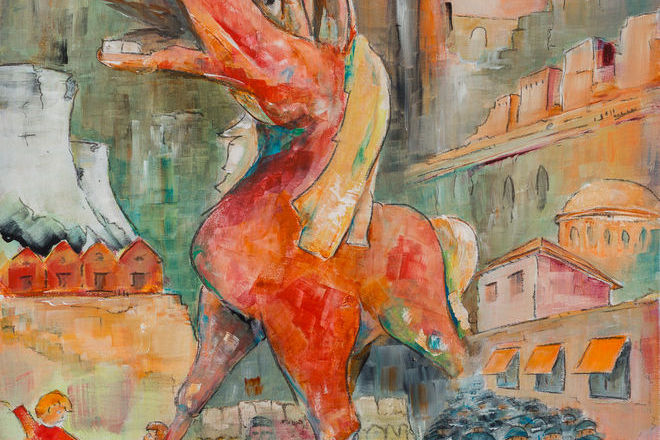
In Les trois fenêtres the parallel with Picasso's legendary work is even stronger and we can almost hear the howls of the protesters, among whom there is another figure everyone recognises. It's Munch's The Scream, still echoing in our brains more than a century on. In this artwork the point of view changes and we're thrown into the middle of the tumult, crushed by the weight of an authority whose presence stretches endlessly into the horizon.
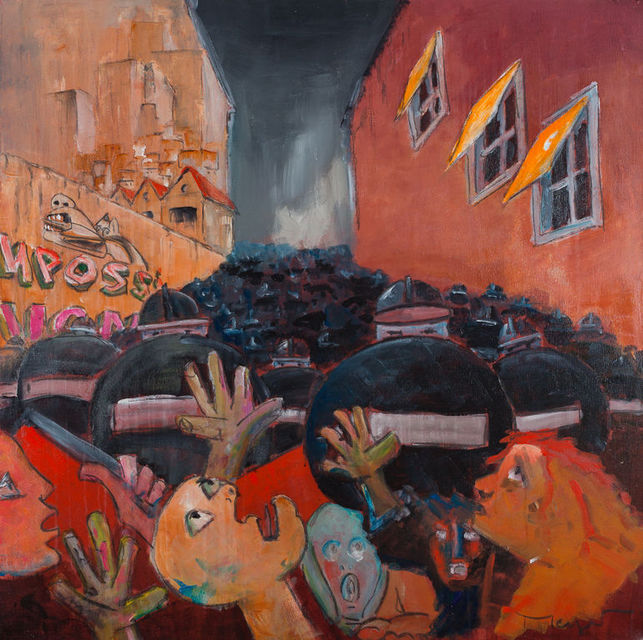
With an obvious political undercurrent, these artworks by the Belgian artist show the state of social alarm brought about in Europe by conflicts like the economic crisis or terrorism. Maybe the fault lies with the vanity of our times, as one of his most significant paintings seems to suggest, Des siècles de vanité.
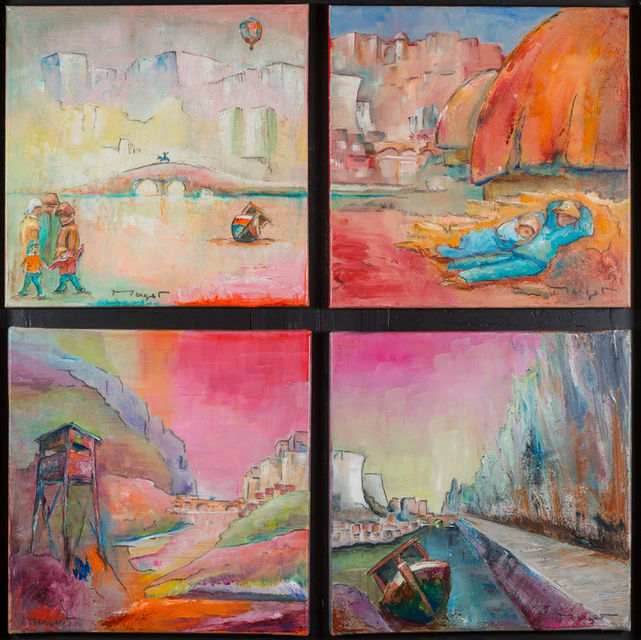
And if we're looking for references to other artists, we can't forget artworks like Les 4 saisons, in which the Belgian holds a conversation with one of Van Gogh's most popular paintings.
Sensory landscape
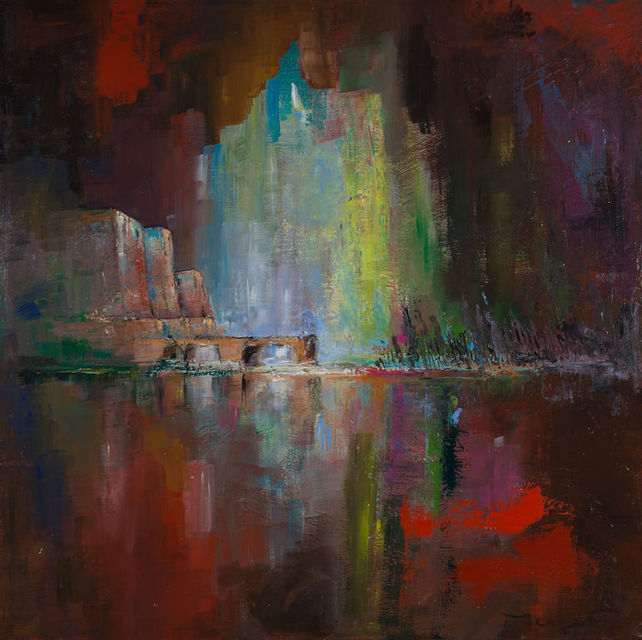
But the Belgian painter also shows us another side of his work in landscape series like the aforementioned Fôret Royal, where Merget experiments with colour, his handling recalling the Nabis, as in Fôret Royal 1 or Fôret Royal 6. The Belgian artist parks his symbolic expressionism in other landscapes that are highly stimulating on a sensory level, as in Le pont interrompu.
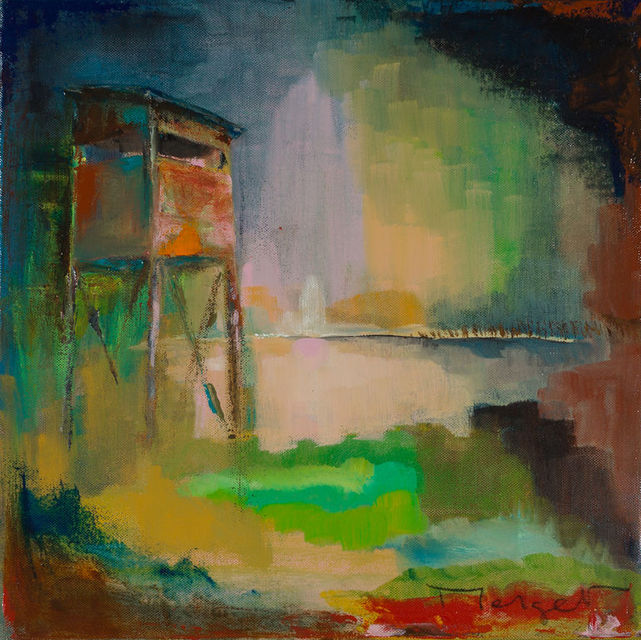
There are many roads that lead to freedom… creative freedom. Starting from a few totems of contemporary art, Merget has built his own universe combining protest and political demands with a style that ties the symbolic and the naive to figurative expressionism.
Visit Thierry Merget's full gallery here
Comments (0)
Log in to leave your comment. Log in