
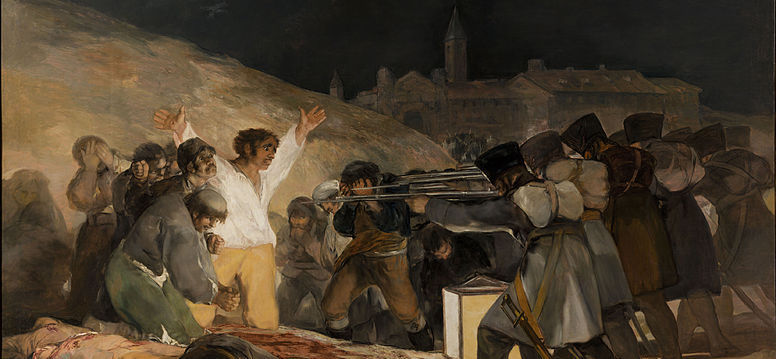
J. L. David, Goya and Delacroix, geniuses of painting and of reportage. All three lived through episodes of the most revolutionary chapters of world history and turned them into exquisite stories.
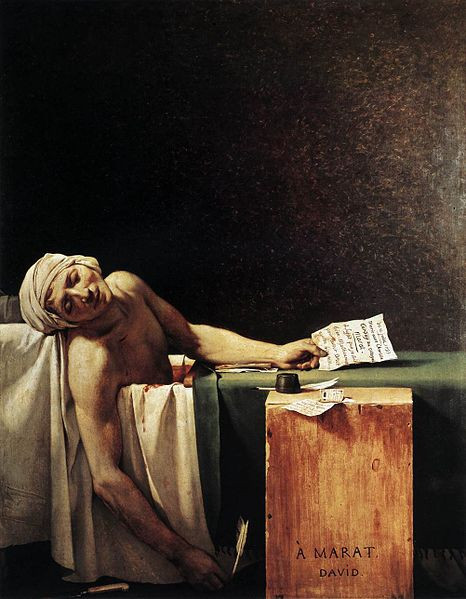
La muerte de Marat (1793)
Jean- Paul Marat, one of the Jacobin leaders of the French Revolution and a friend of Jacques- Louis David (Paris, 1748- Brussels, 1825), died on 13 July 1793, stabbed while taking a bath in his apartment. The French painter wanted to commemorate his murder as that of a revolutionary martyr through this forceful image, in which he includes only the essential elements of the story: the lifeless body, the wound, the murder weapon and the reference to the woman behind the killing, Charlotte Corday, in the letter he still holds in his hand. Details that stand out within the composition thanks to the contrast of light and the dark background.
This is one of the best known images in the history of the Revolution and one of the finest examples of its aesthetic: neoclassicism. David took an active part in it as one of the Jacobins, voted in favour of the execution of Louis XVI and was a fervent supporter of Napoleon, for whom he worked on many occasions.
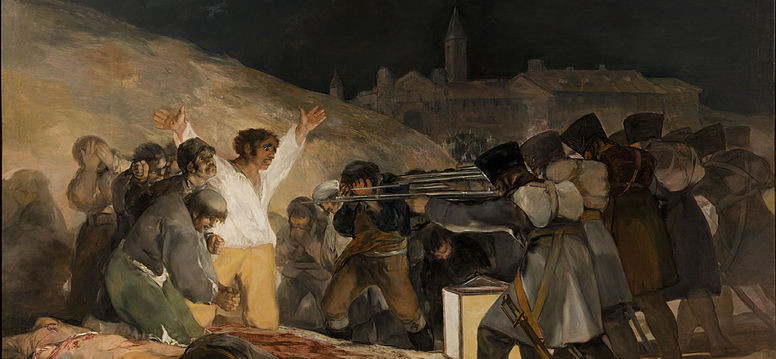
El 3 de mayo de 1808 en Madrid o “Los fusilamientos” (1814)
Together with its companion piece, El 2 de mayo de 1808 en Madrid o La lucha con los mamelucos (1814), it depicts the uprising of the people of Madrid against Napoleon's troops, which marked the start of the Peninsular War. In this painting, Francisco de Goya (Zaragoza, 1746- Bordeaux, 1828) paints the executions of 3 May carried out by the French soldiers as punishment for the rioters of the day before, the subject of the other oil. He set out to immortalise the resistance and the sacrifice of the Spanish “against the tyrant of Europe”.
Goya composed a very complex scene, recovering with realism the conventions of great Italian history painting, and in it he manages to portray the courage, the fear, the resignation and the despair of the victims. The soldiers, faceless, act within a rigid, mechanical structure. The captives, by contrast, are immersed in chaos. Among them, an anonymous hero, kneeling with his arms outstretched, once again faces senselessness in terror. Dressed in white, Goya makes his innocence plain and turns him into a symbol of all the victims of the invasion.
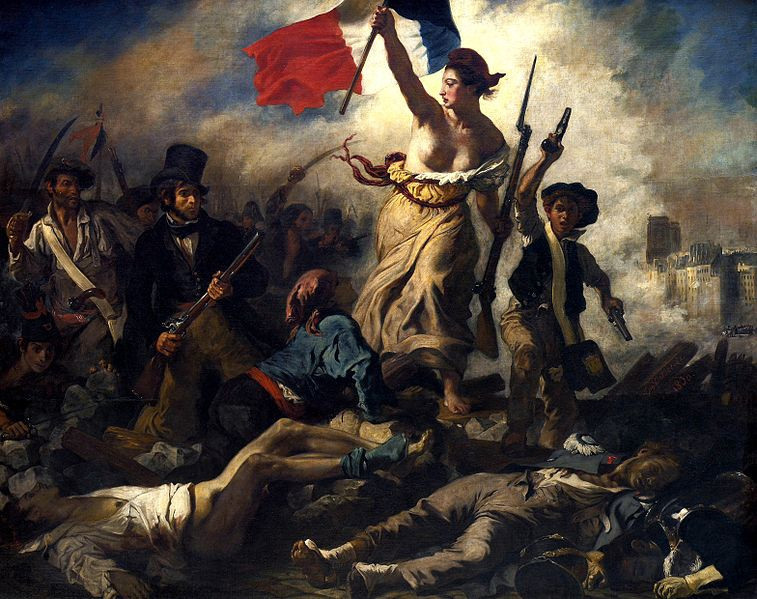
El 28 de julio: La libertad guiando al pueblo (1830)
In this canvas, a mixture of reality and allegory, Eugène Delacroix (Charenton-Saint-Maurice, 1798- Paris, 1863) captures a moment of the popular revolt in Paris of 27, 28 and 29 July 1830, also known as the Three Glorious Days. It was led by the liberal republicans against the monarch Charles X, accused of breaching the Constitution, and it opened up a revolutionary process that would spread across much of Europe.
The French artist personifies the liberty longed for by the people in a young, sensual woman. She wears a Phrygian cap and her yellow dress has slipped down, baring her breast. In her right hand she raises the red, white and blue flag; in her left, a bayonet. Delacroix expresses the dramatic and visual impact of the scene through the canons of Romanticism, with the crowd heading into its final assault. He conveys the spirit of victory by means of a pyramidal composition that recalls Géricault's La balsa de la Medusa (1818- 1819). Stirring, rebellious and victorious, she evokes the Revolution of 1789 and popular sovereignty.
Comments (1)
Oscar Ferreyra
February 18, 2015Log in to leave your comment. Log in