Aleksandr Dubrovskyy
On Artelista since 2019
0
10
Back to collections
Collection: Flowers in Light: Floral Paintings by Aleksandr Dubrovskyy
Flowers in Light: Floral Paintings by Aleksandr Dubrovskyy
A flower painting can begin with a single relationship: violet against yellow, a white blossom emerging from green leaves, or the cool blue of a vase beneath a warm bouquet. In this collection, I explore these relationships through original floral paintings in oil on canvas. Lilacs, mixed bouquets, wildflowers, and flowering mountain meadows become subjects through which I observe color, light, texture, and space.
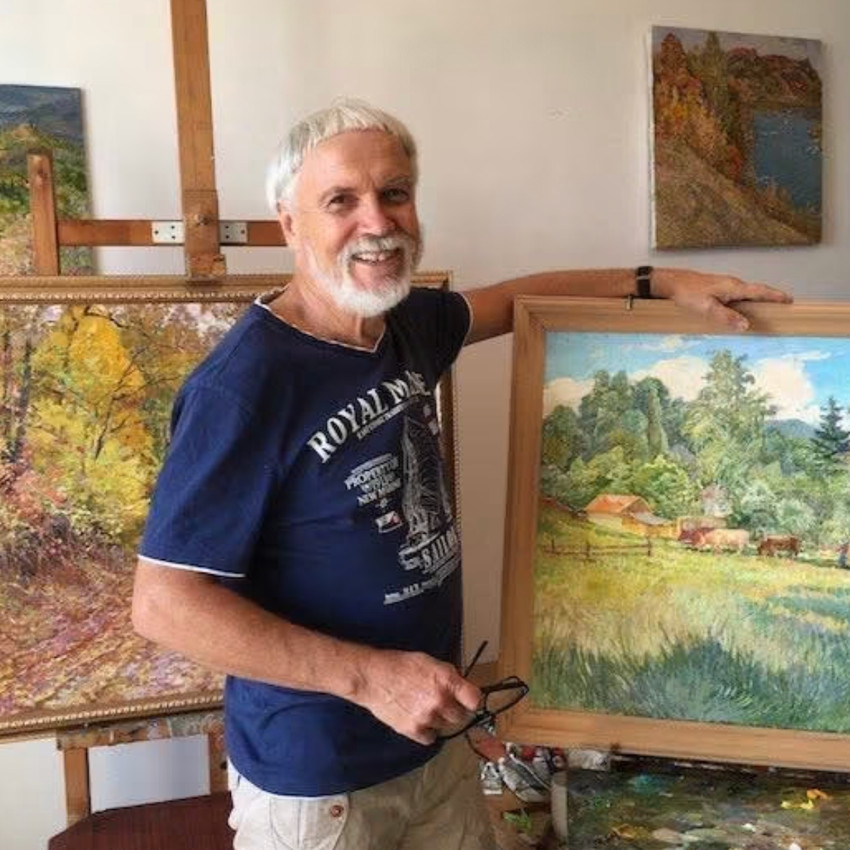
I am Aleksandr Dubrovskyy, a Ukrainian painter and monumental mosaic artist with more than fifty years of artistic practice. Nature has remained central to my work throughout this time. Flowers offer a particularly concentrated expression of its variety: a small arrangement can contain a remarkable range of shapes, colors, and contrasts.
FLORAL STILL LIFE AND THE OPEN LANDSCAPE
My flower paintings move between floral still life and landscape. Some compositions gather a bouquet, a vase, fruit, and fabric into a closely observed arrangement. Others place flowers before mountains or bring the viewer down into a meadow, where stems and blossoms fill the foreground.
These different settings change the way flowers are experienced. In a still life, the curve of a vessel or the fold of a cloth can influence the whole composition. In an open landscape, flowers share their colors with distant hills, grass, clouds, and sky. I am interested in both the intimate scale of a blossom and the larger natural world to which it belongs.
LILACS: WHITE, LAVENDER, AND DEEP VIOLET
Lilacs occupy an important place in this collection. Their clustered blossoms allow me to build a painting through many small touches of color. White flowers contain cool shadows and reflected tones; purple lilacs shift between lavender, mauve, blue-violet, and deeper shades.
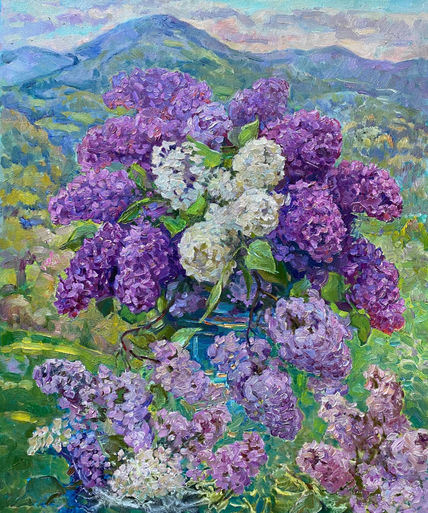
In Spring Bliss, a large bouquet of white and purple lilacs stands before a mountain landscape. The flowers occupy much of the canvas, with green leaves and glimpses of a blue-green vase appearing between them. Additional branches extend across the foreground. Behind this dense arrangement, the mountains introduce broader shapes and quieter transitions.
The painting connects the close presence of flowers with the distance of a mountain view. Related blues, greens, and violets carry the eye between the bouquet and the landscape, while differences in brushwork help distinguish their depth.
YELLOW FLOWERS, LEMONS, AND COLOR CONTRAST
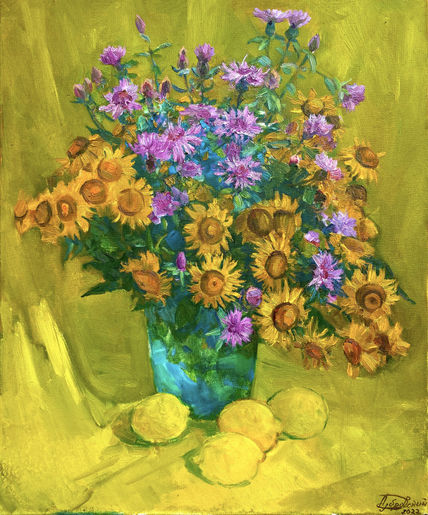
Yellow Flowers and Lemons explores a different kind of harmony. Yellow blooms, violet flowers, green foliage, a turquoise vase, and lemons are brought together against yellow surroundings.
Here, the composition develops within a predominantly warm palette. The lemons repeat the yellow of the flowers, while the blue-green vase provides a concentrated area of cool color. Violet blossoms interrupt the golden tones and give variety to the bouquet.
The rounded fruit, branching stems, and diagonal folds of fabric each contribute a different rhythm. The subject is familiar, but the relationships between its parts offer many possibilities for painting.
WILDFLOWERS AND MOUNTAIN MEADOWS
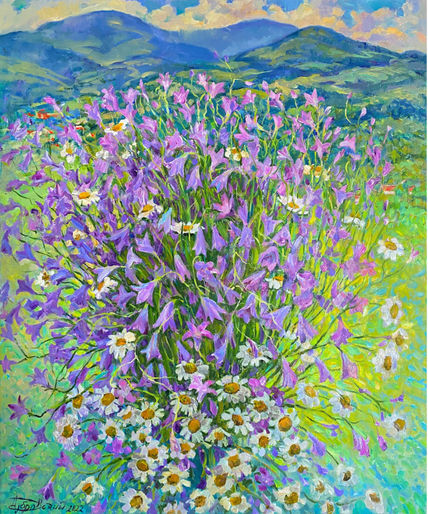
Flowers also appear growing within the landscape. In Mountain Meadow in Bloom, violet bell-shaped flowers and white daisies rise through bright green grass, with mountain slopes beyond them.
The foreground is filled with slender stems, overlapping petals, and small intervals of light. Farther away, the mountains are described in broader passages of green and blue. This change in scale allows a single painting to hold both the detail of a meadow and the spaciousness of the horizon.
These works bring attention to flowers that might otherwise be seen only as part of a larger view. Their irregular growth and varied directions become essential elements of the composition.
OIL PAINT, TEXTURE, AND IMPRESSIONISTIC COLOR
Oil on canvas allows me to explore the physical character of flowers through visible brushwork and layered color. A petal may be suggested by a short stroke, a cluster of blossoms by several contrasting touches, or a leaf by a broader movement of the brush.
My approach is connected to lyrical impressionism. Precise outlines give way to relationships between warm and cool tones, light and shadow, dense passages and open space. The flowers remain recognizable, while the painted surface retains the movement of the hand.
Across this collection, floral painting becomes a meeting point between observation and personal response. A bouquet, a flowering meadow, or lilacs against distant mountains each offers a different way to explore the same enduring interests: the richness of natural color, the presence of light, and the changing character of the world around us.
Aleksandr Dubrovskyy