
2. What time of day do you prefer for painting? How much time do you devote to painting?
I concentrate much better when evening falls and above all once night has set in, that's the point where time seems to have no measure and you lose your bearings with the world and nothing matters. Sometimes it's even dangerous.
Precisely because of that partial loss of awareness, the time I spend painting or sculpting is very variable and relative. Often the artwork itself and the materials condition how much you put in. In truth, for better or worse, artistic production isn't only inspiration and imagination, it's also a lot of other things that inevitably tie you to the world and are there, present.
3. Of all the paintings you've done, which is your favourite? Why?
It's a cliché to say that all your artworks are like your children, but to some degree it's true. I always feel very connected to three dimensions, to space, and even when I paint I criticise myself, convincing myself and arguing that I'm not obliged at all to bring out volumes, at least as far as painting goes. And yet looking at my artwork with some perspective, and maybe my past in dance has something to do with it, I tend to move around volume, spatial orientation and the line of movement.
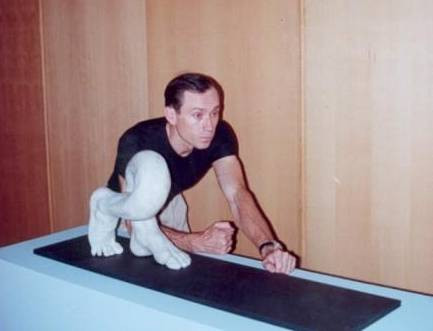
But anyway, to give an example of pieces I'm satisfied with, in sculpture “Ciclos” and in painting “Despertar de Apolo”
4. If you could be reincarnated as a master of art, who would you have liked to be?
I'd have liked to be many of them, from the Hellenic sculptors (Praxiteles for instance) to, in modern times, our unpredictable Picasso.
5. What is or are your sources of inspiration?
My source of inspiration is life, the counterpoint to what I do and the furthest thing from what I am, perhaps to understand from the perspective of distance, or at least that's what I believe. I think inspiration comes to me from something that surprises me, and in fact what surprises you is what is foreign to yourself.
6. Of all the artistic movements, which one has the greatest influence on your artwork?
I find it very difficult to see myself and pass judgement, because often what we admire and what fascinates us isn't what we put down or what ultimately influences us, though maybe we'd like it to be that way. The truth is that the question asks me to step outside myself, and that has its difficulty.
Artistic styles as a way of cataloguing artistic forms don't hold much interest for me, in fact I think that when it comes to my artwork it's something quite undefined, which is even a problem in terms of getting the word out and a negative when it comes to attracting buyers.
Labels, though necessary in the end, in my view have very little to do with what they claim to describe, and on many occasions I think we're guilty of not going deep enough in analysing artworks. The human figure tends to be a constant in my artworks, but I find it appealing to treat it differently in style, in format and even in genre each time I take it on. It is true that I think there's a game of moving closer to and further from the figurative and the abstract, but I think and feel that it's fairly anachronistic and changeable.
7. What does art mean to you? What role does it play in your life?
What art means…? That's a question I ask myself often.
Ultimately, in the end, I think art has no definition, and that doesn't justify or underline the typical phrase I don't share at all, “there's no accounting for taste”, it's not that. I love the discussion and argument about the artistic phenomenon, I feel or understand that in the effort to define it we'll find a tendency but not a conclusive formula.
The artwork justifies and defines itself in an internal game that is closed and at the same time open to the sensibility of whoever contemplates it. It's a paradox I think is inexplicable, but tremendously attractive and undetermined, and in my case, to answer the question, it plays a fundamental role in my life.
Discover Fernando's artworks here
Comments (0)
Log in to leave your comment. Log in