
Back in the 60s it was common for drawing class, as it was called, to consist only of copying, as faithfully as possible, a model that the teacher had either pinned to the blackboard, or the chalkboard as it was called then, or had drawn himself.
The thing was that we all had to get as close to that model as we could, usually something religious, right down to the shades of the colours, there was no room for mistakes and even less for imagination.
One day we were given the task of drawing and colouring an animal, now we were free to choose the subject, and in my case it was a wolf from one of the family's books. Well, the way I did that model, it came out almost identical. That was impossible, an "identical" had never happened and never could, so the verdict was that it had been done by an artist in the family. And so that wolf was my first fail in drawing.
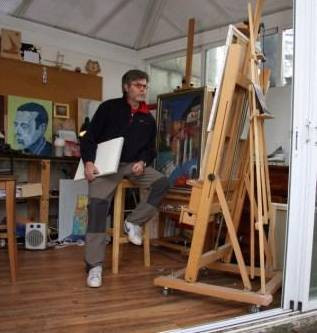
What I mean by this is that I had some notion of my knack for art as far back as primary school, even though I decided my professional career would head towards the business world. In 2007 I took up again what for me was a hobby and saw that it wasn't, that painting was a way of living, of understanding life and interpreting it, and of course a form of expression which in one way or another is a need of every human being, sometimes conveyed orally, sometimes in writing, and in my case through painting.
2. What time of day do you prefer for painting? How much time do you devote to it?
I don't keep strict hours, but I'm no early riser. I prefer the afternoon, the night and the small hours for painting. Mornings I spend preparing subjects, thinking about where my paintings are going, on research, and so on. I'll also tell you that for an artist there are no holidays and no Sundays.
3. Of all the paintings you've done, which is your favourite? Why?
Without a doubt the whole Composición con membrillo series. I hugely enjoyed the analysis stage (I still keep all the sketches, compositions, videos, photographs and so on from that series). It took months, many months, but I enjoyed them enormously, I felt very free and from the point of view of creation I sensed that something important was coming out of all that effort.
There have been others too, like El desayuno de Borja, where in one way or another I've felt rewarded by the process or the result. With that painting it was chance that led me to it, the still life and its composition weren't studied, it was how my son had set out his breakfast, when I saw it was a subject for a painting. Mind you, afterwards I did add elements and shapes that didn't belong to the model itself, but the starting point was pure chance, as so often happens in the artistic process.
4. If you could be reincarnated as a master of art, who would you have liked to be?
No doubts here either: Picasso. His influence on 20th century art is well known. He changed the way we look at a painting, the way we face the artistic act, so that you're not just a spectator but also an actor and an active subject in the paintings. It was a radical contribution to world Art. Since the Renaissance there has been no change in the history of painting as remarkable (and I'm not talking about progress) as the one Picasso brought about in the 20th century.
5. What is or are your sources of inspiration?
Life, and I say life in the sense of living, of letting the day go by but in an expectant way, as an observer, an analytical and critical contemplator of everything happening around you. An unusual backlight, a piece of news in the paper, a book you're reading, someone you've just passed in the street, so very many things.
6. Of all the artistic movements, which one has the most influence on your artwork?
I think all the post-war avant-gardes are behind me in one way or another. Not forgetting my admiration for Cezanne and El Greco: for me two brave men of their time as far as technique goes, and, along with the great Goya, forerunners of what came later, of what we have been and still are witnesses to.
7. What does art mean to you? What role does it play in your life?
Art is present in my life 24 hours a day. Intellectually speaking, I can't understand any other way of living than the artistic act, the magic behind every artwork, whether mine or someone else's. The debate, the perception of new sensations. I think those of us who are able to feel that are privileged.
Discover this artist's artworks here

Comments (0)
Log in to leave your comment. Log in