
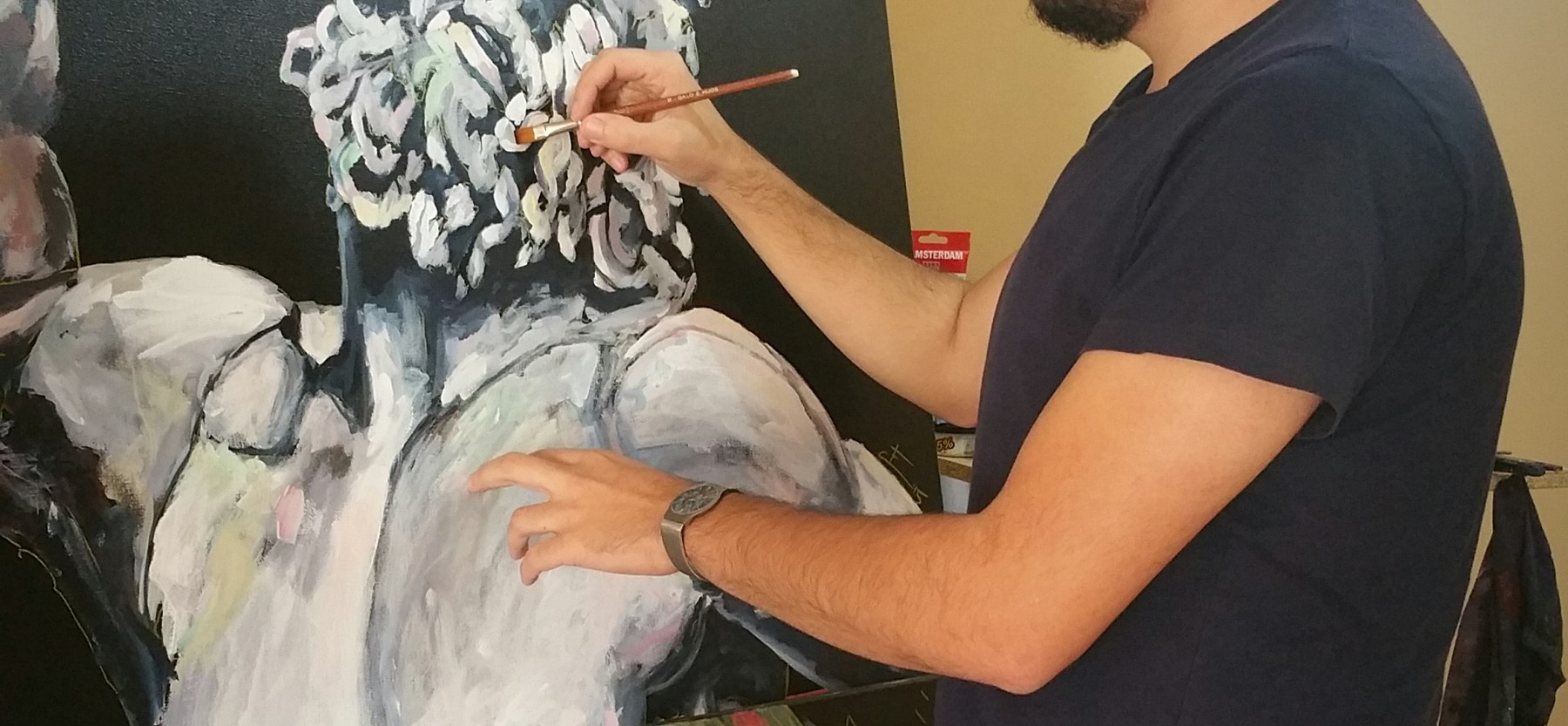
I was born in 1988 in a small village in the northeast of Jaén called La Puerta de Segura, right in the middle of the Sierra de Segura. I'm the older of two brothers. Ever since I was little I liked coming up with things, and I had no doubts when it came to choosing what to study. In 2006 I left my village to go to Madrid to study Industrial Technical Engineering at the Polytechnic University of Madrid.
When and why did you start painting?
From an early age I showed an interest in different branches of art. I've been a musician since I was 9, I started out playing the clarinet in the village band and after that, right up to today, the saxophone has been my instrument.
At school, drawing was one of my strengths, and I did it with no other aim than to surprise a friend, nothing more. It's true that I also won the odd children's drawing competition.
As for painting itself, it was something that was always going round in my head but that I didn't start to develop until I was well into my engineering degree. I painted my first artwork when I was 19. I was so happy with the result that it ended up as a Christmas present for my parents, who were also surprised when they saw it, not just because of the artwork itself but more because of how much they wanted to see me create. That was the trigger, and from then on the artworks kept coming without a break.
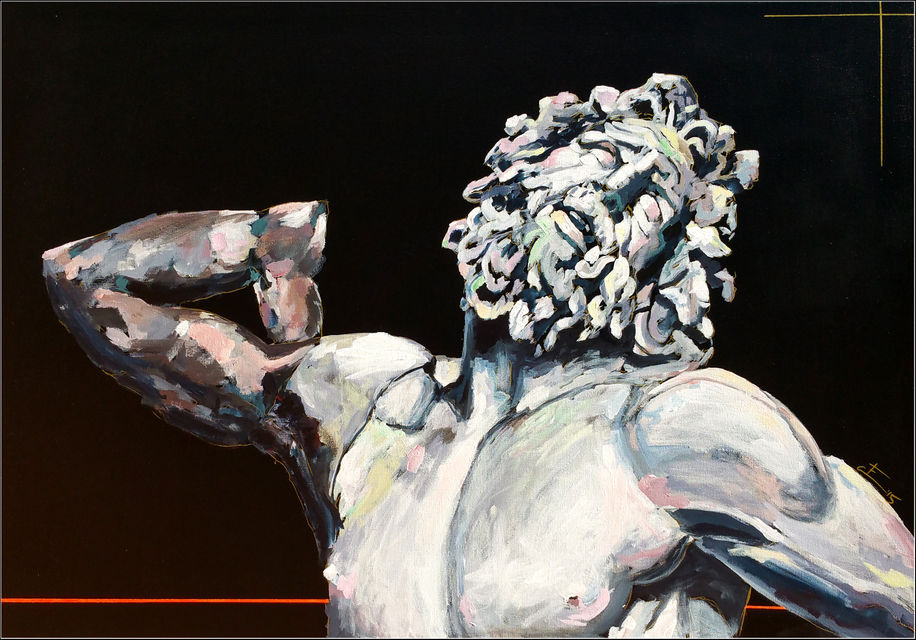
My first turning point in painting was meeting Paco Sánchez, a painter and painting teacher at the Faculty in Seville. From him I learned nearly everything I know about technique and handling painting materials. He was also one of the people who pushed me to study for a degree in Fine Arts and who made me seriously consider devoting myself to painting professionally.
In 2011, once I'd finished my engineering degree, I enrolled in the Fine Arts degree at the University of Granada. Although I never finished those studies, they did mean a big change for me and for my work, helping me shape the idea of art I have today and get to know this world and be a bit more curious about it.
How do you think a gallery and its artists should help each other?
The relationship between the two is nothing less than a symbiosis, and neither would make much sense without the other. An artist should spend their time creating, not selling, since they aren't a salesperson as such. So it becomes essential to have someone whose job is to spread the word about the artworks and sell them, and obviously they should make money from it. The relationship has to be very close, based on mutual trust and one in which each side's interests can be negotiated openly. In short, a relationship in which both sides feel they're getting the benefit they want and need.
What advice would you give artists who are starting to show their work?
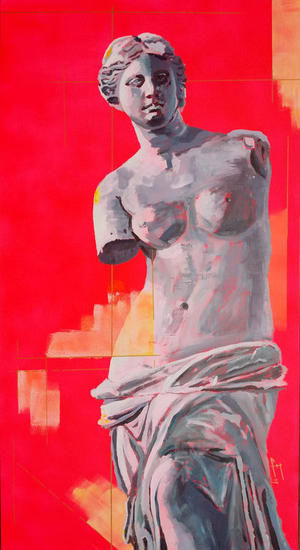
I think the important thing is to feel like an artist and a creator from the start, not to feel inferior or ashamed of your own artwork, since it's been made, supposedly, putting in all our effort and all of ourselves, so if we don't value our artwork, we don't value ourselves. That said, we always have to be very clear about our place in this field, having references to look to and to learn from. If at some point we stop having "idols" to look up to, we'll stop evolving and improving, and become an artist inside a bubble. In short, a dead artist.
How did you sell your first artwork? Is there one you feel a stronger connection with?
I sold my first artwork to a relative in 2009. I remember that moment fondly because it makes you see the situation differently, what had been a simple hobby stopped being one and turned into a job. Who wouldn't like to make a living from their hobby? That was my question. It's been going round in my head ever since.
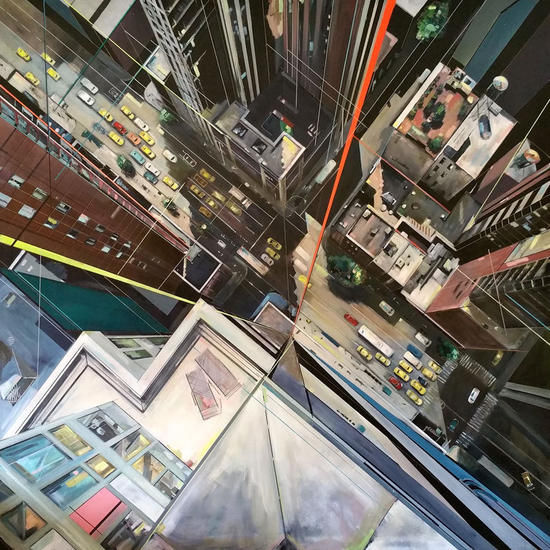
One of the artworks that has marked me most was Cenital I. The first in many senses. The first of a series of paintings with a lot of work behind them, a more considered and studied artwork. The first artwork I sold on Artelista. The first artwork that went abroad and a turning point in my short career as a painter that made me feel more professional. It boosted my self-esteem and filled me with confidence, pushing me harder than ever along the path of painting, the path of being a painter and being able to live off it.
What is art for you? What part does it play in your life? Do you make a living from art?
Art is hard to define. But if I have to pick one definition, it would be something my photography teacher in Granada said to me: "The artist is so powerful that they're able to decide what is art and what isn't." From that we can gather that the definition of art is tied to each artist.
Right now, art accounts for roughly 50% of my total income. The other 50% comes from the private tutoring lessons I give. Let's hope that percentage gradually shifts in favour of painting and I can do it full time in the not too distant future.
What are your sources of inspiration? Do you identify with any other artist?
Today we have the biggest means of spreading things that has ever existed, the Internet, and social media in particular. I find it very interesting to use, not just to show our own artworks but also as a way in to discovering countless quality artists, especially contemporary ones, who show us their work "live", you might say.
Thanks to social media I've been able to get to the work of countless artists, some of whom have influenced me a great deal. I could mention, for example, François Bard, Brett Amory, Alex Kanevsky, Jeremy Mann, Josep Frances, Santiago Ydañez, among others.
In your creative process, do you have any habit, practice or quirk that's peculiar or curious?
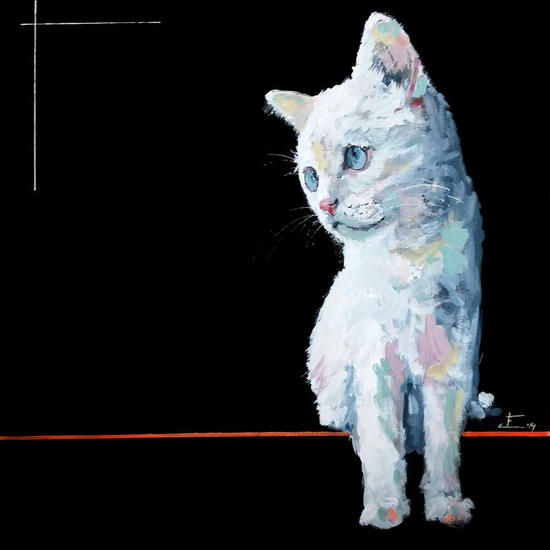
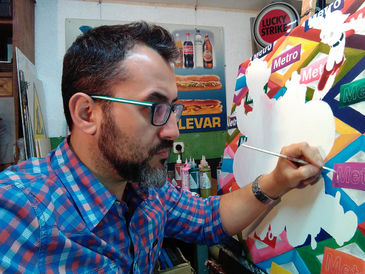
Whenever I paint my biggest admirer is my cat, Lola, who never misses a single detail of my painting, as you can see in a lot of the photos where I'm painting. I painted her portrait back in the day and it's one of my most visited artworks on Artelista.
Have you had an exhibition recently, what can you tell us? Do you have any project in mind?
My last exhibition was this summer at the Castle of Segura de la Sierra (Jaén), a magical place for art. The exhibition, called Aguadas, was made up entirely of small format watercolours, 32 x 23cm the largest of them. A kind of artwork I'm especially fond of because of the care and the intimacy with which I paint them.
My larger format paintings, such as Cenital I, Cenital II and Contrapicado I, have been my most successful artworks, with the last two being selected for the exhibitions of the Ibercaja Painting Prize 2015 and the Emilio Ollero Painting Competition 2015 respectively, and getting very good reviews from the public.
My main goal today is to keep taking part in painting competitions and contests and to fight to be among the best one day.
Could you recommend us:
An artist: François Bard. An artwork: Perro Semihundido, Goya. A book: The Little Prince by Antoine de Saint-Exupéry. A film: Everything by Christopher Nolan.
Thank you very much, Jesús.
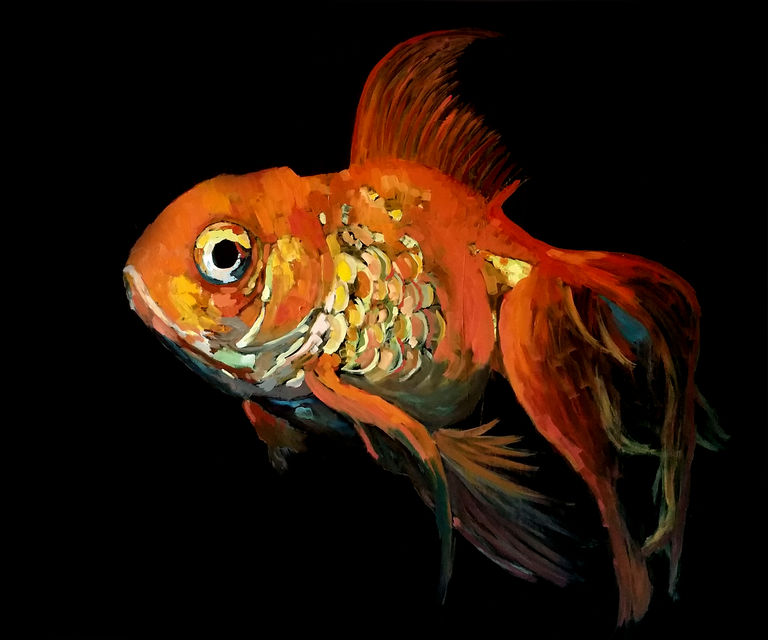
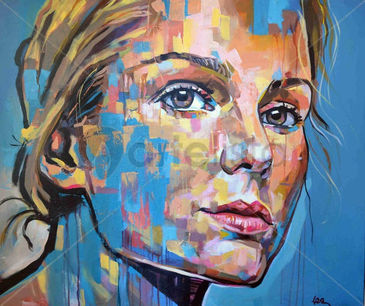
We invite you to visit Jesús Fernández Escobar's gallery on Artelista.
Comments (0)
Log in to leave your comment. Log in