
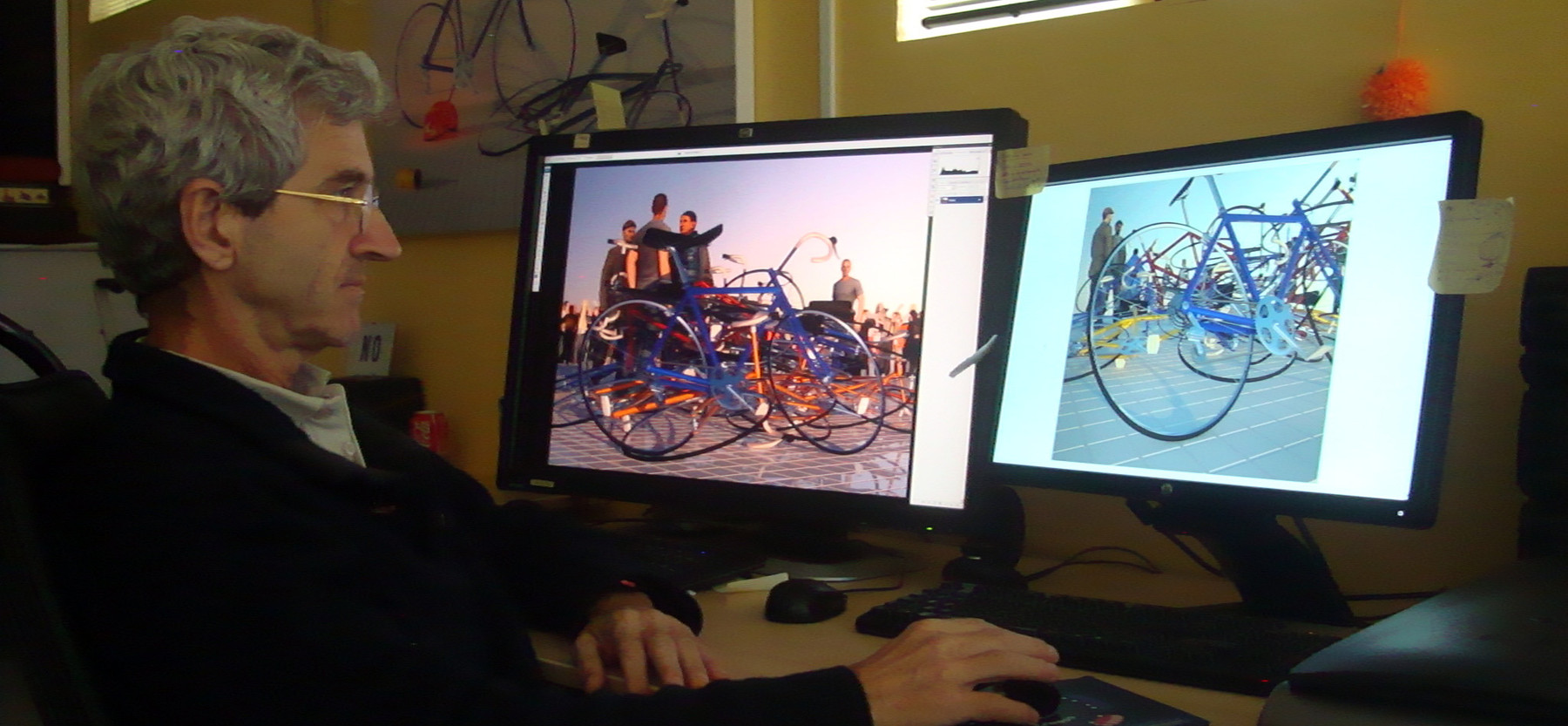
I'm an architect in my sixties who gets more and more pissed off with the world (whether it's my age or the direction civilization has taken) and who wants, more and more, to live far from the madding crowd and do whatever I feel like as long as it doesn't bother anyone else in the slightest. Basically I want to be left alone, and in exchange they can keep everything I make, if they're interested. Personally, my favourite colour is transparent, meaning that if I can pass through this world without anyone seeing me in person, so much the better.
In real life, apart from this pile of complaints, for about fifteen years now I've partly devoted myself to teaching. Analysis of Form, Graphic Expression, Composition, all of them to architecture students and to students at the Escuela Superior del Vidrio in La Granja, which is where I live.
When and why did you start painting?
I started painting as a child, at all hours and on every occasion, which doesn't mean I did it well, badly or so-so, it was simply something that kept me entertained and had me permanently absorbed. It took a few years before I even became aware of what the rest of the world thought about what I was doing, and I didn't care either. One curious thing is that I preferred colour to line, the patch to the stroke, and I was surprised to hear later on that the line was in fact an abstraction and that it really only existed as an imaginary boundary between areas.
How do you think a gallery and its artists should help each other?
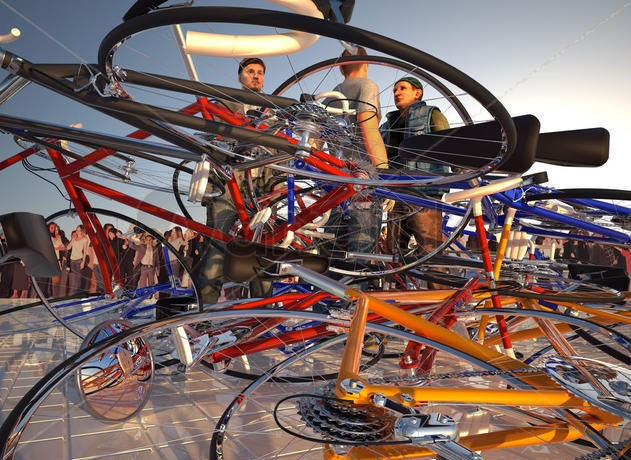
For me the gallery has a double face, art market and showroom. In that sense, and since I'm tremendously pragmatic, I think the artist should get on with producing and the gallery with placing what's been painted out in the world, whether as a commercial product or as a cultural fact. Besides, I think the gallery protects the artist somehow when he exhibits, in the sense that it shields him from that naked feeling you get when you face other people by showing them what you've produced.
What advice would you give to artists who are starting to show their artwork?
That they follow or strictly take on board Picasso's line (I'm not a hundred per cent sure it's his): "A painter is someone who paints what he sells and an artist is someone who sells what he paints".
How did you sell your first artwork? Is there one you feel a stronger connection with?
It was at a somewhat "atypical" exhibition in a restaurant where the paintings on show were a sort of "free extra" both for the customers and for those of us exhibiting. Since it wasn't even anywhere near my house, I left the paintings unsigned thinking it would be a kind of anti-theft insurance. To my surprise, when I managed to get away one weekend, a customer had bought the painting, taken it away and left a note with his address so I could go and sign it, which of course I didn't do, for having taken it off at such an ungodly moment.
What is art for you? What role does it play in your life? Do you make a living from art?
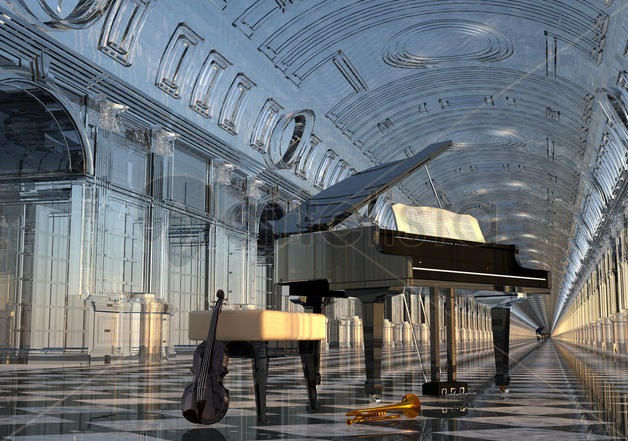
As a child (maybe around five years old) I was struck by something the religion teacher said. Only God could create, that is, produce something out of nothing. Man was limited to making things out of other things, that is, only to transforming them. I think that's where my first conflict with the religion teacher started, with religion itself and maybe even with God, for being a bully. Before long I realised, on the one hand, that I wasn't God and that not just me but anyone who wasn't a slacker could make things out of nothing with more or less success. And that's perhaps how my idea of what art was came about: more or less fortunate creation out of nothing.
For me art plays the role of a total escape so I can do whatever I feel like when I have time available and without answering to anybody, something that, given my profession as an architect, I need more and more often. Woe betide anyone who thinks an architect is an artist (in this century). He's a creator, sure enough, but one who gets pressured at all hours, from every angle and with no limits known to date, and there can't be anything more distressing than trying to carry out something creative, something that moves you, with so much pressure and so much racket.
And following on from that, if we consider today's architecture an art, then yes, I make a living from art, but I can say that for every minute of creation I spend about 200 minutes on side issues that are irrelevant creatively and that ruin that one simple minute of creative enjoyment. With modelling or painting, on the other hand, for every 200 minutes of free, pressure-free creation, I have to spend one on "non-creative" side issues.
What tool (or tools) do you use to model your artworks and how do you "print" them? What do you think it would take for work done as net-art to be more highly valued?
Since digital art is a product of computer technology, there's a temptation to distinguish traditional art from digital art by pointing out that the latter is technological and the rest isn't. Technology basically consists of an instrument that makes a creation possible, and in that sense there's no difference between a brush and a graphics tablet. Paleolithic man would surely have thought brushes were cutting-edge technology, and Renaissance painters would have thought the same of airbrushes. Like other people, I think the difference in tools is irrelevant as far as personal creativity goes, because artistic ability depends on deeper factors than the mere use of technological means.
Digital art (and here I'm transcribing literally what Wikipedia says, an opinion I share 100%) fits into a progressive process of dematerialisation of the artistic work that goes all the way back to the incorporation of photography into the arts at the end of the 19th century. Photography separated the moment of capturing or constructing the image from the process of manipulating or transforming the material elements of the work, a process later accentuated by the appearance of cinema, which brought in a new intangible space-time dimension, no longer to be found in the material support (the exposed film) but in the moment of projection. Television was later able to do without even this material support and the process culminated, provisionally, in digital simulation and representation techniques. Even so, the creation of synthetic images follows the creative process of any of the plastic arts, since it creates images from models that come out of their creators' imagination.
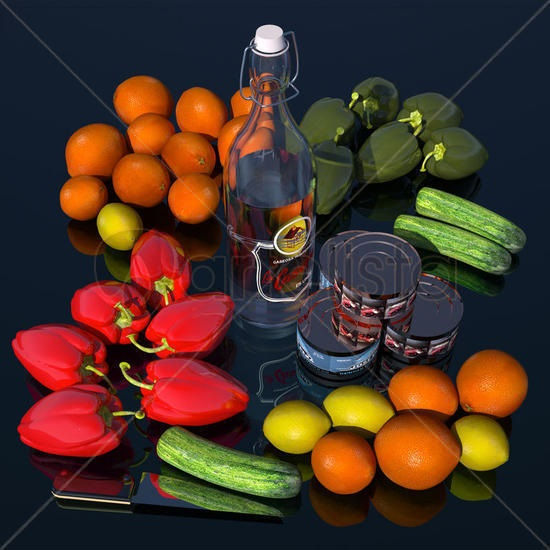
Although technically the term digital art can be applied to art made using other media or processes and later scanned, it tends to be reserved for art that hasn't simply been modified by a computing process (such as a computer program, or any electronic system capable of interpreting a digitised image). Text data, original audio recordings and digitised video aren't usually considered digital art in themselves, although they can be part of a larger digital art project. We speak of digital painting when the artwork is created with the forms, techniques and styles of traditional painting, but using the software of a computer platform. The resulting image can be viewed on any computer screen, or printed on different supports, such as paper or canvas.
There are different paradigms in creating images by computer. The simplest is 2D computer graphics, which imitate the way you can draw with a pencil and a piece of paper. The image is on the computer screen and the instrument you'd draw with would be a graphics tablet with a mouse. What's generated on the screen can look as if it had been drawn with a pencil, pen or brush.
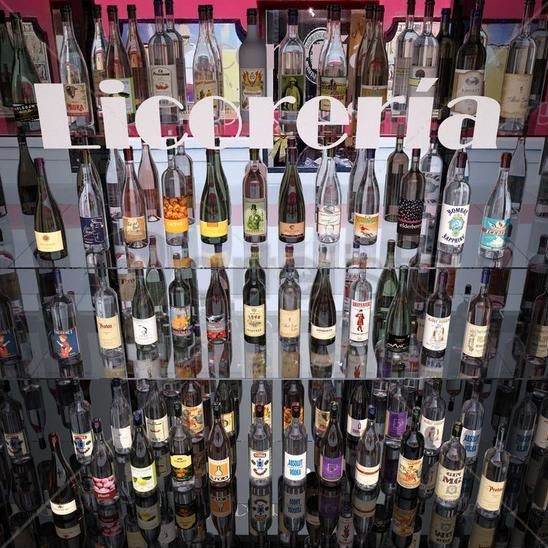
A second type, and this is what I do and teach, is 3D computer graphics. The screen becomes a window onto a virtual environment, where the objects that will later be photographed by the computer are "built" and placed. It's a modelling process whose result is a virtual model that can be photographed from different angles, but which we can also enter virtually with a camera that moves through the scene and "films" what we see for us.
So my tool is the computer and, to close a complete technological cycle, when I finish an artwork, as well as emailing it to you for the gallery, I send it to a printing company and tell them the finish I prefer (canvas, paper, etc.).
To avoid losing sight of the fact that there's a world outside technology, I usually keep a botijo or a porrón nearby to remind me what world I live in.
As for how digital art is valued, we're facing a problem that isn't new. I don't know who said "only a fool confuses value and price", but I agree.
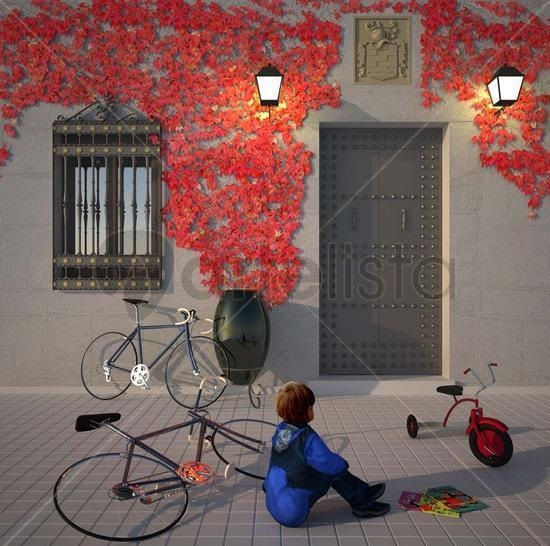
Can there be such a difference in price between two things that are almost exactly the same (for example an original painting by any Spanish Baroque classic and an almost exact copy by a good copyist)? Clearly the value (its usefulness) is the same, but the price isn't, and this is where the real secret of the problem lies. There's only one original. But the funniest thing is to hop over to architecture and to the art of music, for example.
Who are we applauding at the end of a performance of, say, Beethoven's 9th Symphony, the orchestra for how well they played it or, indirectly, the composer because the piece gives us goosebumps? What has more value and more price, the score or the recording of the performance? What has more value and/or more price, the Sagrada Família (a building in theory repeatable at any other point on the planet) or Gaudí's drawings?
I believe time and culture put everyone and everything in its place, and with digital art there won't be any exceptions.
What are your sources of inspiration? Do you identify with any other artist?
My favourite source of inspiration is my brain when I'm having a nice long bath or in a moment of relaxation. Everything comes together in that tremendous "hard drive" that is the brain and it comes out by itself. All you have to do afterwards is remember, once you've used the towel, to jot down the ten, twenty or thirty things that occurred to you so you can sift through them later and get them going.
I don't identify with any artist, but I know that all of them without exception have influenced what I do, for better or worse. Part of the creative process is precisely dodging these influences elegantly. But I do identify with a happy phrase from a painter who said "I paint whatever my soul's balls tell me to". I think it's Antonio López, but I'll take the idea over the artist (whoever said it, it's the essence of creative freedom).
In your creative process, do you have any curious habit, practice or quirk?
Without a doubt, meditating in the bathtub (the shower doesn't count, too much noise).
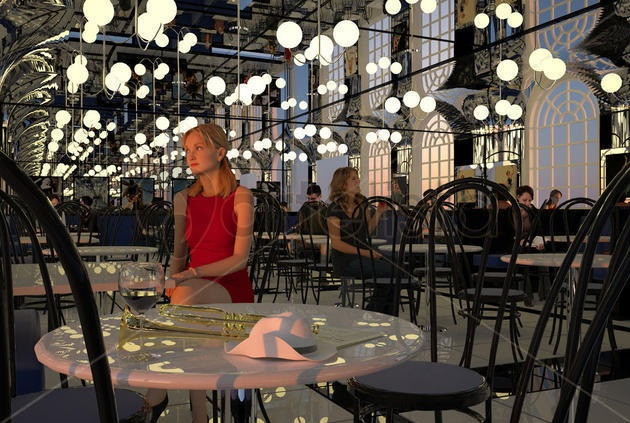
Have you had any exhibitions lately, what can you tell us? Do you have any project in mind?
I've done 2 group exhibitions and been to two fairs since I began this latest stage with painting. For better or worse, at the first of them I was the only one of the six who sold, and two of the six paintings on show at that, which made me see that maybe there was light at the end of the tunnel and that there was a sensible way of putting bread on the table (even if it was only a bit of bread) by putting hours into something fun. From that moment on I started painting like a madman in every gap of free time I have.
Next year I'll be having an exhibition in Madrid in a gallery in the Salamanca district whose owner doesn't know it yet (but I'll take bets).
Could you recommend us:
An artist: Antonio López, as well as being number 1 with a brush, every time he opens his mouth it's to say something that leaves you thinking for days and agreeing with him.
An artwork: Las Meninas by Velázquez.
A book: Uncle Petros and Goldbach's Conjecture by the Greek writer Apostolos Doxiadis.
A film: Dreams by Akira Kurosawa and Steven Spielberg.
Thank you very much, Juan.
We invite you to visit Juan Aguirre Vila-Coro's gallery on Artelista.
Comments (1)
santiago
December 10, 2015Log in to leave your comment. Log in