
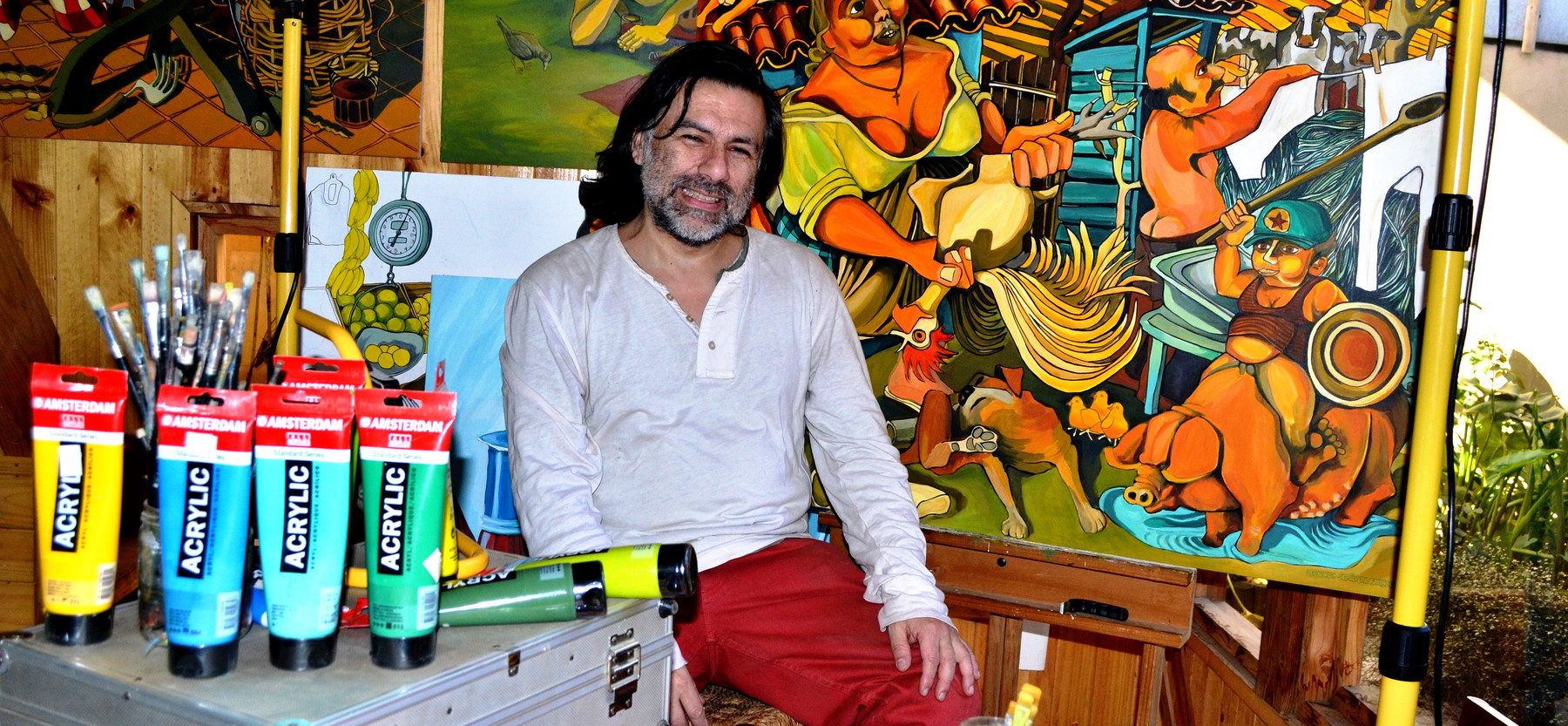
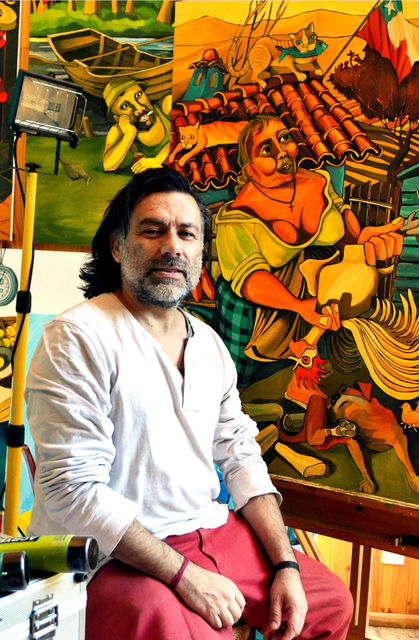
I was born in 1971, in the city of Linares, farming country in the south of Chile. From a very young age I drew and painted everything I saw around me, anywhere, on any surface I could find. The idea was to move the pencil and know that anything could be portrayed, but in my own way.
I trained as a painter and graduated with a degree in Art, majoring in Painting, at the School of Art of the University of Concepción, Chile, between 1991 and 1996.
I've exhibited many times in Chile, both in group and solo shows, and I've won several prizes and government-funded projects.
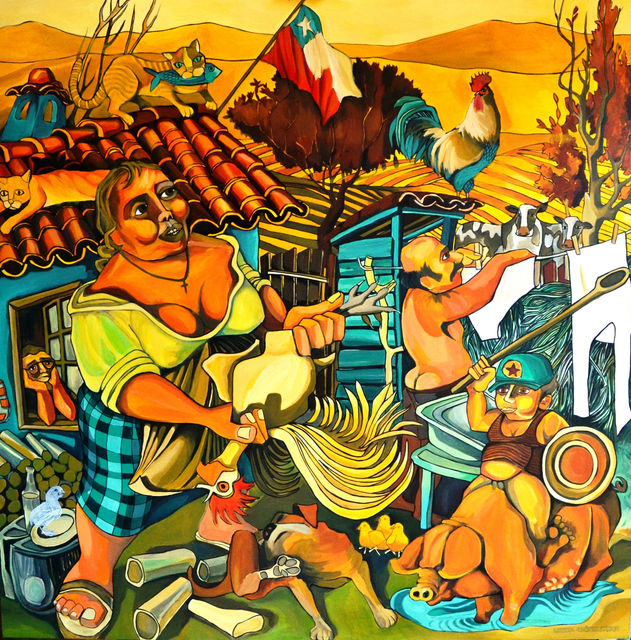
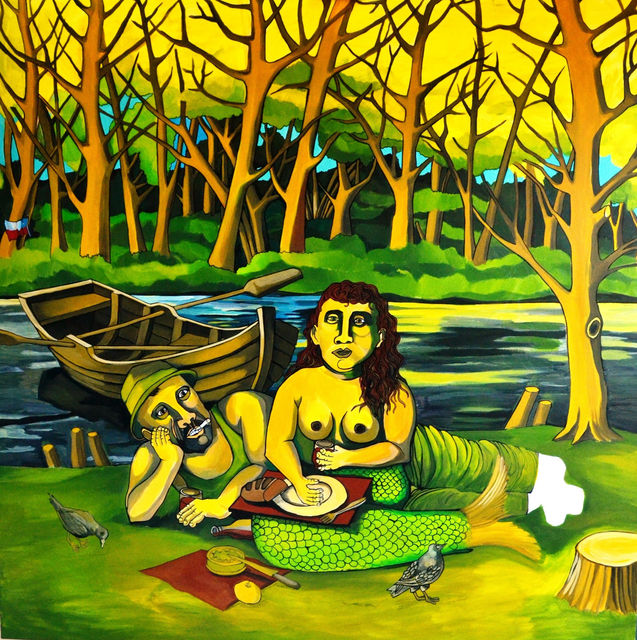
I work in acrylic on canvas, in a figurative, rural style dedicated to portraying familiar, popular subjects in a warm and emotional way, through a cheerful, folk vision, to rescue and share, in an entertaining and colourful way, the customs and traditions, the sayings, the proverbs, the morals, the tastes and flavours, everything that life in the Latin American countryside involves.
When and why did you start painting?
I don't really remember. Ever since I was little I've been interested in drawing and drawn to colour, I've never stopped drawing and painting, first with coloured pencils, then felt tips, watercolour, tempera, and then as a teenager I began painting in oils in the painting studios of two great masters of art teaching in my home town, Don Rubén Riquelme and Don Pedro Olmos, and at university I started using acrylic. It's as if in a previous life, if such a thing exists, I had been a painter and in this one I kept the taste for painting. Ever since I was small I loved everything to do with artworks, I remember spending ages looking at paintings in magazines and being fascinated by them, that feeling I imagine children have when they see a toy they like, only I wanted to own a Van Gogh, a Picasso, a Braque or a Warhol.
How do you think a gallery and its artists should help each other?
The help is obviously mutual and necessary for both, gallerist and artist, they need each other. The gallerist helps the artist get the word out, socialise the artwork, exhibit the paintings, produce the shows, promote the artist, make contact with the art market and meet the artist's need to be known and then valued. In my case, as a painter, I need my artworks to be hung in specialised spaces and seen by as many people as possible, and the gallery helps me with the visibility, I just concentrate on painting and painting in my studio. Now, the percentage the gallery and the artist take should be good for both of them.
What advice would you give to artists who are just starting to show their work?
That they have their style, their technique and their subject matter clearly defined, that they keep the information they give simple, that they know very well where they're going, and that they put together a portfolio with their best work to present to art galleries. Use good materials and be very professional and responsible as an artist. And if it doesn't work the first time, don't stop trying and believe in the talent you may have. For that it's essential to be constant and to keep working hours in the studio, the most important thing is to work and work, paint and paint, so that inspiration arrives while you're working and working, that way achievements land on a platform that's already solid.
How did you sell your first artwork? Is there one you feel a stronger connection with?
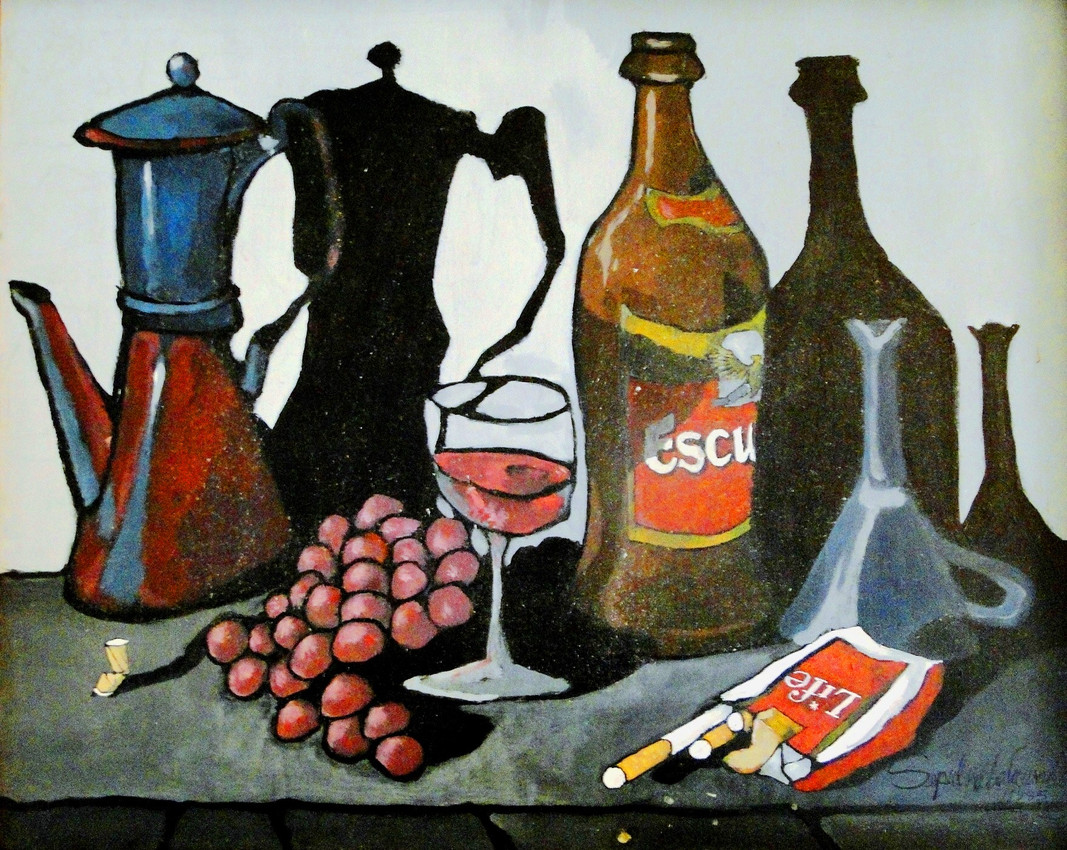
While I was studying Art at the university in Concepción, at the end of every year there was a big art fair where any painter, professional, self-taught or amateur, could exhibit small-format artworks. I was in my second year, 1992, and I made 10 bohemian, alternative still lifes. The first painting that sold was one with a beer bottle, a glass, a funnel and cigarette butts around it. I was so happy that I celebrated all night, I thought I was the best painter in the world and I spent the money for the painting before they'd even given it to me. The next day at the fair they told me it had been returned, and I felt like the worst painter in the world. That very artwork is the one I've felt closest to, because it was the first painting I made as a professional artist and it set a way of painting in me.
What is art to you? What part does it play in your life? Do you make a living from art?
Art, and painting above all, fills absolutely everything in me, I live and sleep thinking about painting, I live always imagining the next painting, and that doesn't wear me out, quite the opposite, it fills me completely, and when I'm in the middle of making a painting we have a flowing conversation in which it keeps asking me for more and, as I paint it, it gives me signs or hints of the next painting to create. I've had the chance to exhibit in many places and my paintings have been very well received by the public. In Chile I'm represented by Galería Montecatini, which promotes and sells my artworks, and up to now, ever since I left university, I haven't stopped painting and I haven't stopped having exhibitions, that's kept me motivated and active as a painter.
The subjects you work with, around Chilean rural culture, have usually been handled with nostalgia and distance, whereas you turn them into something cheerful, warm and easy to look at. Do you think this different way of treating the same subject can bring greater acceptance from the public?
When I was studying Art I went to a lot of painting exhibition openings, first to get familiar with the art scene in Concepción and see what the painters were proposing, and second because I was waiting for the painter's talk so I could understand their work. I realised that when they tried to explain their paintings they got more and more tangled up and you, as a viewer, were left confused. Seeing that happen so many times, I decided to have a proposal that would be so simple to understand that I wouldn't have to try to explain or justify it. I set out to make paintings that everyone could understand and that viewers could identify with, that they could step into as if they were their own, with no intermediary to explain them. I try to make my paintings tell viewers true stories of the countryside, so they remember moments from their own lives, and with that I'd feel paid.
What are your sources of inspiration? Do you identify with any other artist?
I love painters who put out unmistakable honesty and identity with biting, ironic but at the same time subtle criticism, who convey a commitment to the pain of ordinary people, painters like Oswaldo Gauyasamín from Ecuador, Fernando Botero from Colombia, Diego Rivera from Mexico, Rafael Zabaleta from Argentina, and Eduardo Ossandón from Chile. Brave painters who go straight at it with their proposal, who make known the suffering of the society they live in or had to live in, turning their colours into weapons to protect the most helpless from the powerful.
In your creative process, do you have any habit, practice or quirk that's peculiar or curious?
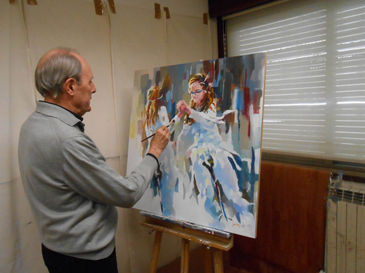
I always focus on rural subjects and I try to research everything to do with the theme. Once I've researched it I start making sketches of how the painting will look, composition and good drawing are the key in my artworks. I usually paint at night, and when I paint during the day it has to be with artificial light, I look for even lighting, natural light bothers me. And, like every painter, having a studio made to measure, with everything that makes us feel comfortable and calm so we can put what we've imagined onto the canvas.
Have you had an exhibition recently, what can you tell us? Do you have any project in mind?
My last exhibition was thanks to the Montecatini art gallery, organised by Carmen Gloria Matthei, and it took place in Viña del Mar, Chile, in August 2014. The show was called “Folclórico” and it was held in the beautiful Castillo Wulff on the city's seafront. And this year, 2015, again with the support of Galería Montecatini, “Folclórico” will be shown at the Corporación Cultural de La Reina in Santiago de Chile, in the Nemesio Antúnez house, throughout September.
Could you recommend us:
- Un artista: El pintor chileno Eduardo Ossandón, por toda su obra campesina maravillosa y sencilla.
- Una obra: Cazuela del extraordinario pintor chileno Bororo, una obra llena de fuerza, color y vida.
- Un libro: Obra gruesa del fantástico antipoeta chileno Nicanor Parra.
- Una película: Violeta se fue a los cielos del director chileno Andrés Wood.
Thank you very much, Leonardo.
Thank you, Artelista
We invite you to visit Leonardo Sepúlveda's gallery on Artelista.
Comments (2)
Cincinnati Dispensary
August 14, 2017Manuel Briceño
July 12, 2015Log in to leave your comment. Log in