
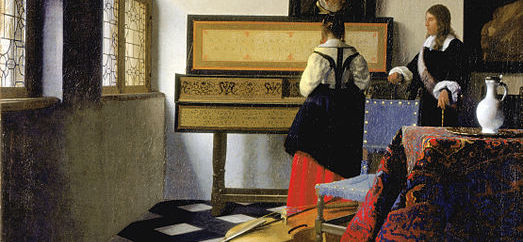
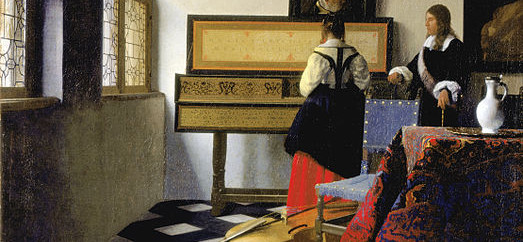
On the lid of the harpsichord in La lección de música, the Baroque painter Johannes Vermeer left an inscription in Latin: “Music is the companion of joy and a balm for sorrow”. This attachment to music was not just a matter of Vermeer's personal taste, it answered to a feeling shared by the elites of 17th century Dutch society.
At that time music was already in charge of livening up those events with a certain positive character, such as the signing of a contract, or a festive one. That is why it was common for both Vermeer (Delft, 1632- 1675) and his contemporaries to record music scenes in much of their work. Many of them starring women playing an instrument or taking master classes. In this way beauty and the art of love and leisure came together, symbolised in music.
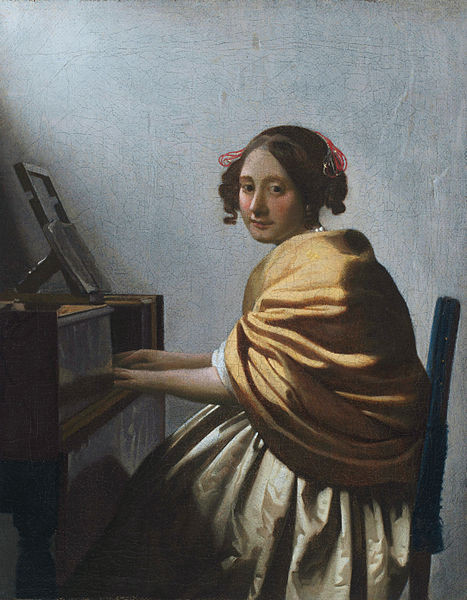
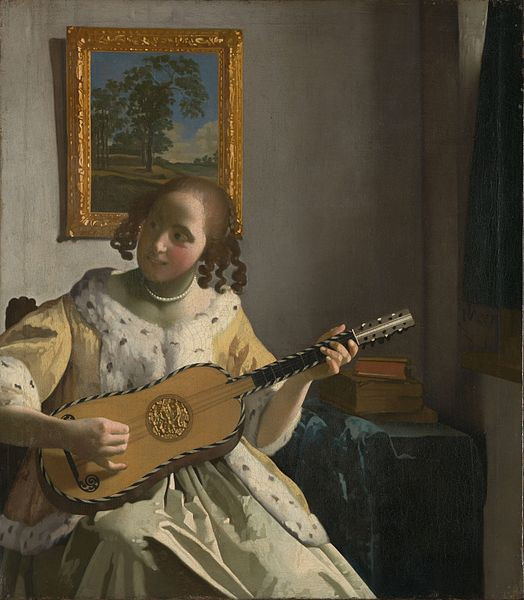
Out of his small output, 35 artworks in total, we single out five paintings by the Baroque artist that deal with this subject. Two very different versions of a young woman playing the virginal that he painted around 1670- 1672, La lección de música (around 1660), part of the personal collection of Queen Elizabeth II of England, Muchacha joven tocando el teclado del virginal (around 1670- 1672) and La guitarrista (around 1672).
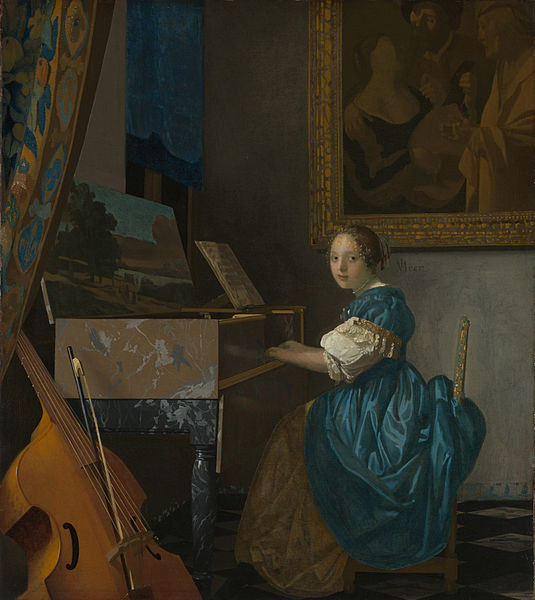
In them he recreates intimate scenes that echo in detail the luxury of the rooms he depicts and the dresses and accessories of the women who make the instruments sound in his canvases. These bring into the artworks a universe that seems to uncover fantasy and affectionate feelings, taking shelter in the warmth and candour the pieces give off. Because, as we say, whoever plays the instrument is usually a young girl of ingenuous appearance. A sweetness and innocence that grows in La Lección de música when all the girl's attention falls on her teacher, showing in this way, too, her great admiration.
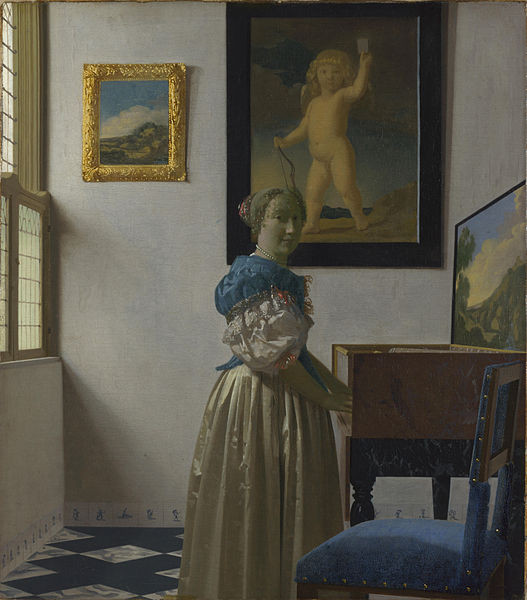
His chromatic intention, in particular the golden yellows or the silvery blues, so full of light and so characteristic of Vermeer's work, exalt these masterpieces in which music and light complement each other to share the baton of the composition. The Baroque master also sought to play with geometric forms, something that fascinated many artists in northern Europe and that, in this painter's day, was closely linked to music, both guided by the same cosmological principles. Specifically the string instruments, which he also found ideal for achieving the harmony of his pieces.

Comments (0)
Log in to leave your comment. Log in