
«If photography is allowed to supplement art in some of its functions, it will soon have supplanted or corrupted it altogether, thanks to the natural alliance it will find in the stupidity of the multitude». Charles Baudelaire was a distinguished modern, a 19th century hipster, always one step ahead of the ‘stupid multitude'. But when you spend your life blazing trails, your chances of tripping up go up too.
Baudelaire wrote bitter texts denouncing photography as a demon of progress that had come into the world to finish off poetry and painting, to finish off the beauty of art. He fell flat on his face. The arrival of photography woke painting up, freed it from the tedium of representing reality and opened new paths for it. Without photography, there would have been no avant-gardes. The most lucid painters embraced the daguerreotype as a tool and an influence: «photography represents, painting paints; let photography do the dirty work, let's get back to art».
Colour and form
Elena Márquez Bonny (1974, Las Palmas de Gran Canaria) laughs at the Baudelaires of this world through artworks that establish clear links between photography and painting, an increasingly popular tendency in the art of the 21st century.
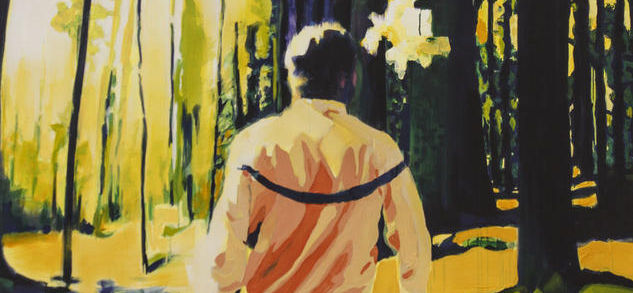
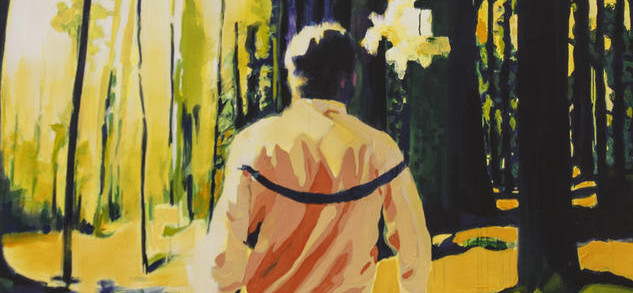
In Bosque, a boy walks purposefully among the trees, heading towards the light. We easily spot the photographic framing but we're won over by the colour and the form. Because painting is neither more (nor less) than that, a game between form and colour. Like many of the greats of contemporary painting, Márquez Bonny has understood that those two elements are the foundation of painting, the shortest and surest route for getting emotions and ideas across to the viewer.
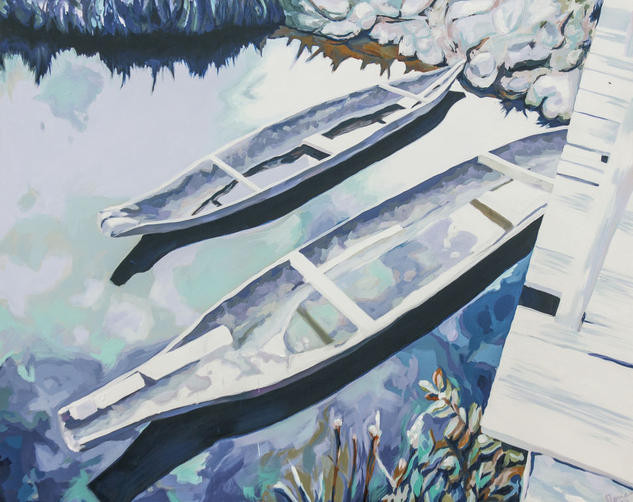
Textures, the roughness of the pictorial material, the play of transparencies and the symbolism of colour are the leading characters in the bulk of the Canarian artist's work. If in Bosque the viewer follows the walker, drawn by the yellows and greens that stir our desire, in Canoas or Amanece the cold tones force us to draw back and look at the scene from a distance.
A photo, a painting, a story
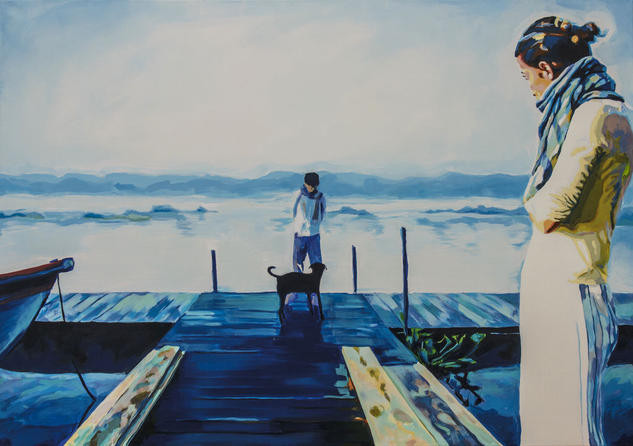
Another aspect Márquez Bonny's work shares with photography is its ability to tell stories, to present a scene and narrate a past and a future. We see it in Amanece too. We have two people and a dog. The woman, in the foreground, huddled up, watches the boy with the dog, in the background. If in Bosque an illusion of movement is created, in Amanece both the colours and the position and attitude of the figures convey an icy stillness: «who are they? what's the relationship between them? what will happen next?».
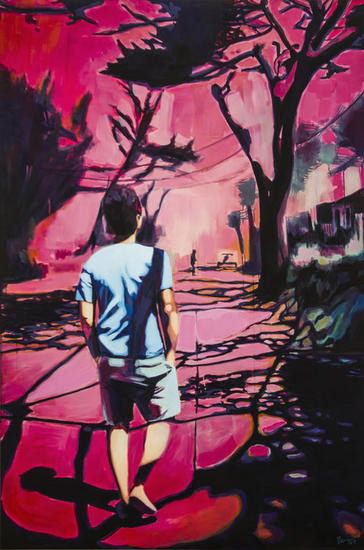
Now let's look at Sombras, another large format painting, the artist's preferred size because it lets the viewer immerse themselves more effectively. Seen from behind again, another figure walking among shadows. But Márquez Bonny changes the colours and the walker's attitude. There's no hurry here, the figure strolls and the electric pinks radiate a twilight feeling.
The transit between photography and painting
With a degree in Fine Arts from the University of Barcelona in 2000, Elena Márquez Bonny put her art on hold to teach in various secondary schools in her home city. But from 2015 on she took up her artistic activity again with enthusiasm, and in March of this year she held her first solo show at El Club La Provincia under the title ‘Tránsito'.
Transit as passage or communication, in this case, because some of her figures are walking, but also because of the creative transfer she carries out between her photographs and her canvases. Márquez Bonny lets us in on her method: she starts from her own snapshots, which she retouches digitally. The base is there, but the key to her work lies in the free interpretation of colour, far from faithful representation. Colour as a carrier of emotions alters how her artworks are read. In fact, the Canarian painter also points out that in some cases she starts from black and white photographs so that the real colour doesn't interfere with the move to the canvas.
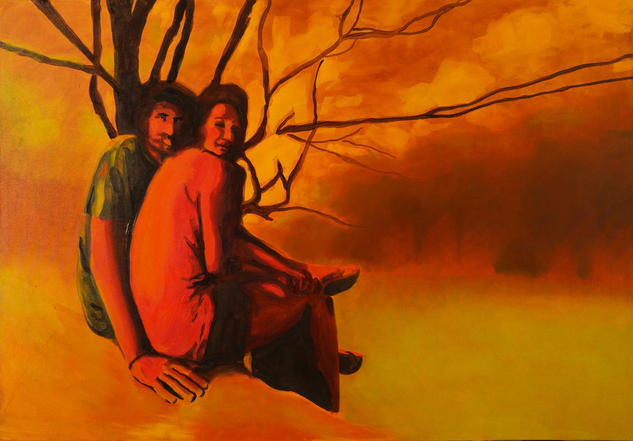
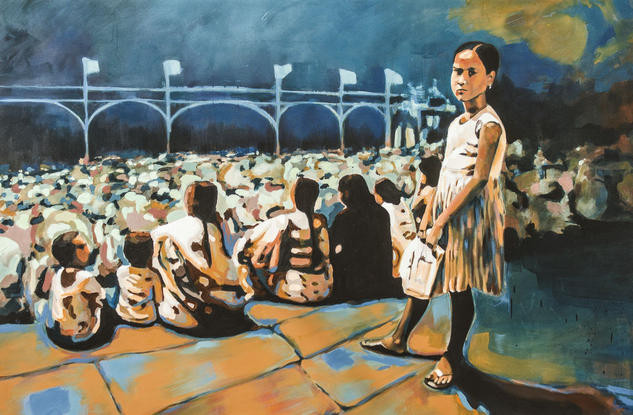
We can see all of this in artworks such as Pareja, where the yellows and oranges radiate an almost blinding heat. In Alrededor del árbol, once again a story is suggested to us, a friendship, a game. And in Niña, Márquez Bonny goes for a more orthodox solution, with the meaningful weight of the artwork resting on the girl's concentrated face.
Photography didn't supplant art, as the hipster of Spleen feared. Quite the opposite, it saved it. Márquez Bonny's work is a new chapter in this fruitful union between two ways of rethinking reality.
Visit Elena Márquez Bonny's gallery here.

Comments (0)
Log in to leave your comment. Log in