
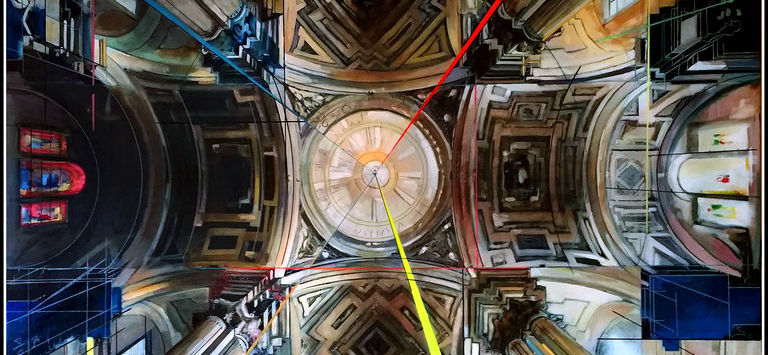
Cenital I is the artwork that has cemented the career of Jesús Fernández Escobar, a young Andalusian artist (La Puerta de Segura, Jaén, 1988) who enjoys alternating large-format paintings of forced perspectives and photographic framings with portraits, animal paintings and studies of classical works.
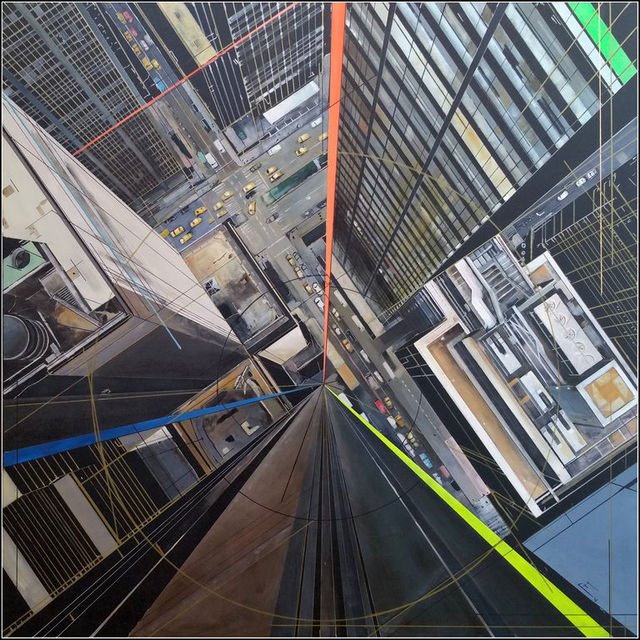
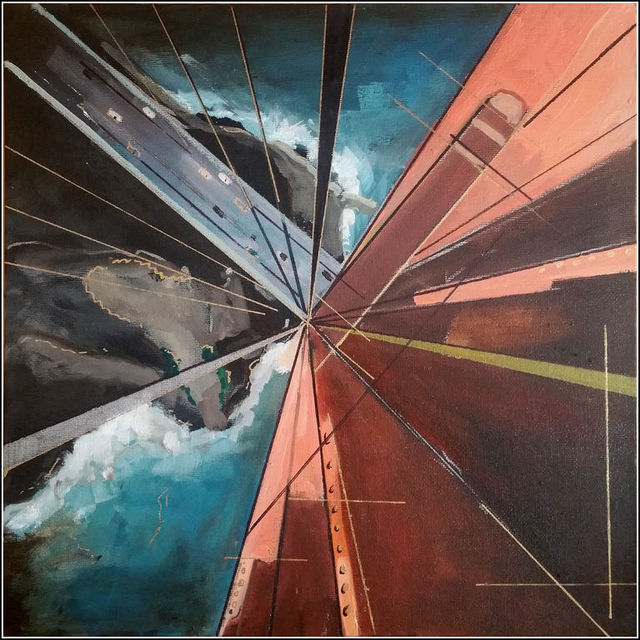
Under the watchful eye of his cat Lola, Fernández Escobar is deep into his ambitious series of urban landscapes, which includes artworks such as Cenital V, where, as is by now the artist's trademark, he adds technical drawing details that push the cone of perspective of this overhead view even further. The viewer walks across the sky of the most dizzying New York like a tightrope walker held up by vanishing lines in pure colours.
Engineering art
Fernández Escobar's great discovery in this series of urban landscapes is nothing other than giving away the trick. When Renaissance artists began applying scientific, rationalist criteria to their works, they found a way to bring the third dimension onto a two-dimensional surface. The deception was pulled off by applying the theories of geometric drawing to painting. Theological perspective was abandoned in favour of linear perspective.
But the 21st-century eye has little to do with that of the 15th century. A viewer today isn't awestruck by the perfect rendering of a temple in perspective. That's why Fernández Escobar shows the lines converging on the vanishing point, playing down the illusionism but gaining personality in exchange, since that interplay of straight lines and circles takes on aesthetic qualities. And yes, they also crank up the sense of vertigo…
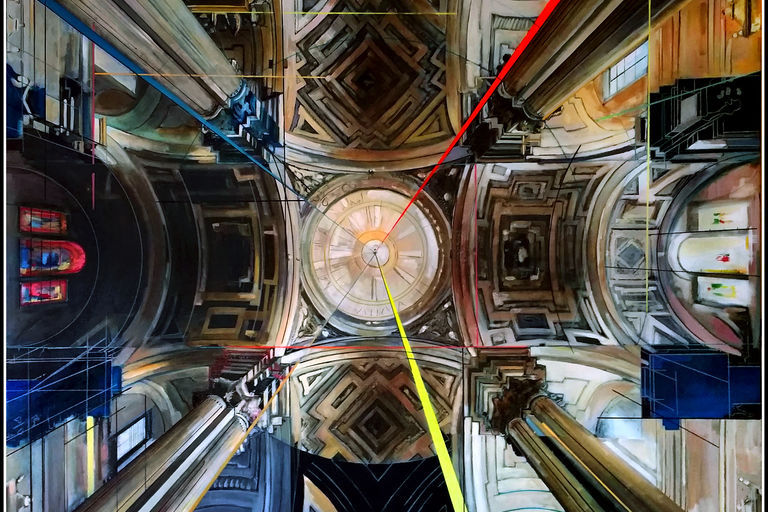
But you don't have to go all the way to the Big Apple to enjoy these head-spinning large-format paintings. In Contrapicado II we lift our eyes towards the south tower of the Basílica del Pilar in Zaragoza. The «non finito» of artworks like this one reinforces their technical character, keeping them well away from hyperrealist tendencies. Something we also see in the spectacular Contrapicado I, from inside Jaén Cathedral.
The thing is, Fernández Escobar studied Industrial Technical Engineering, so he knows a thing or two about technical drawing. Although he painted his first picture at 19, he preferred to finish his degree while painting took a back seat. Once his studies were over, the hobby turned into a profession and what was going to be his profession has ended up as one more ingredient in his artistic style.
Fish, saxophones and Bruce Willis
Although the Andalusian painter devotes much of his time to large-format urban landscapes, his collection also holds curiosities that reveal other leanings of his. In Pez Amarillo, Fernández Escobar converses with the most traditional realism, which lets him play with brushwork and colour through the use of the palette knife. Carpa Naranja is an oil on board along the same lines, though the Jaén artist doesn't forget to include the geometric lines.
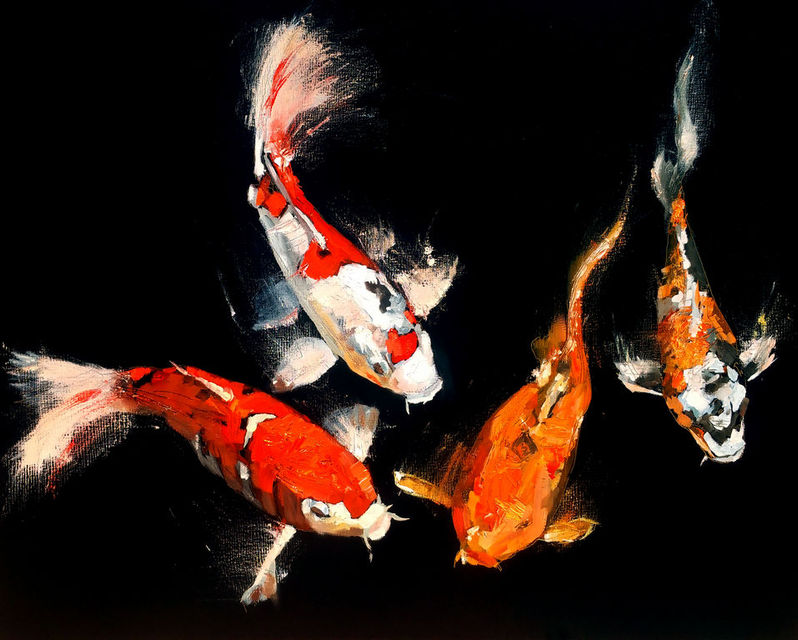
In the Pez con líneas series, meanwhile, Fernández Escobar turns to watercolour, a technique he handles with care and enthusiasm. In the painter's «geometric bestiary» there is also room for vultures, marabou storks, parrots and toucans. And, of course, for Lola, his tireless companion in the studio.
In Autorretrato con saxofón, Fernández Escobar revealed another of his passions: music. Among his portraits we also find nods to the cinema, as in the portrait of Bruce Willis or the one of Malcom MacDowell in character as Alex DeLarge in A Clockwork Orange.
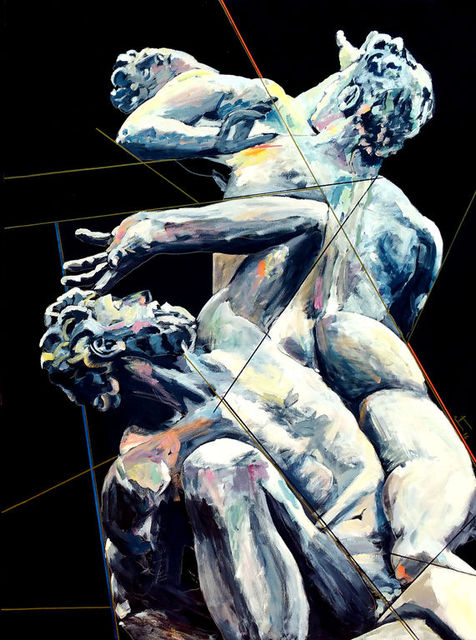
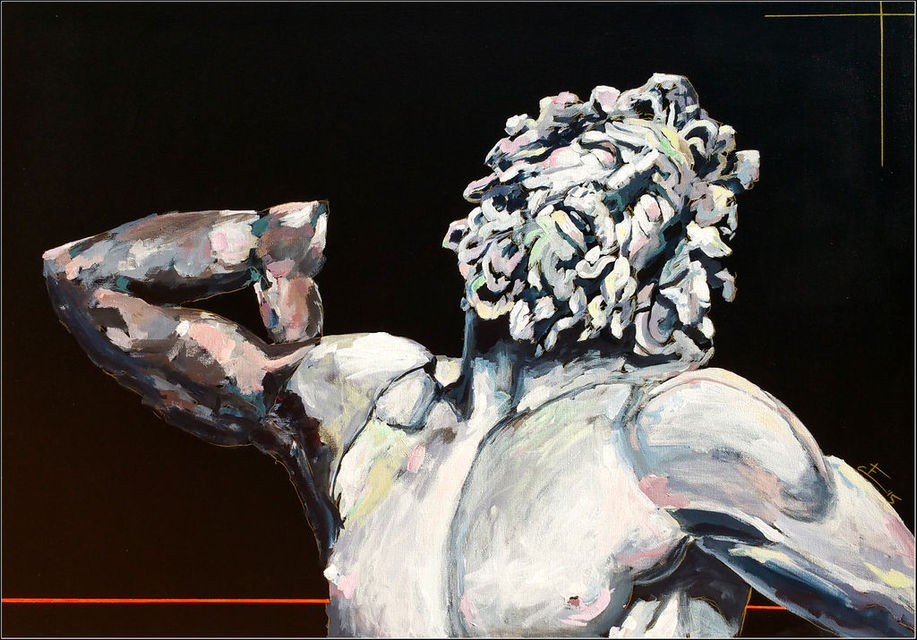
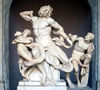
His studies of classical works from a personal angle are just as appealing, combining his interplay of geometric lines, forced perspectives and pure colours with the most academic kind of study. Fernández Escobar reinterprets the great classics such as Miguel Ángel (El David), Donatello (El David) or Giambologna (Rapto de las Sabinas). He even has no qualms about offering his personal take on the Laocoonte, the Hellenistic work whose discovery changed the history of art forever from the Renaissance onwards.
Looking to the future
What will Fernández Escobar's next step be? The artist admits an affinity for artists like François Bard, Brett Amory and Alex Kanevsky. All of them share clear influences from photography, but also from cinema or literature, always within realism or even hyperrealism, as in Bard's case.
While Fernández Escobar looks to the future, we're left hanging over the Puente Colgante, a fantastic small-format artwork in which the artist gives his style another twist by playing with the relationships between the real cables and the imaginary vanishing lines.
You can see all his artworks on his page on Artelista. You can also read this interview we did with him and get to know one of the most outstanding artists better, Jesús Fernández Escobar.
Comments (1)
Casilda de la Hera Jáudenes
June 23, 2016Log in to leave your comment. Log in