
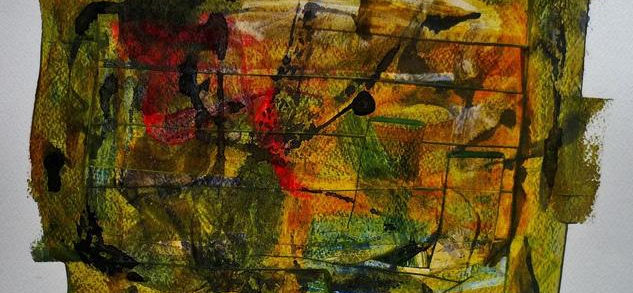
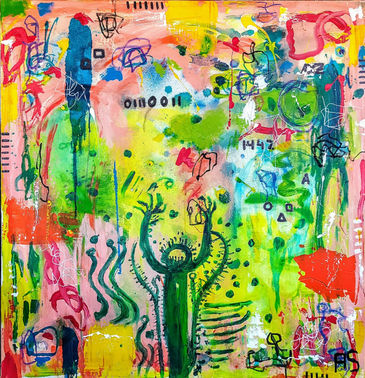
It isn't hard to picture Miguel Robledo Cimbrón in his studio, drifting through the mystical chords of Eastern music and letting shapes and colours flow to build his spiritual latticework, artworks with a foot and a half in abstraction that nevertheless refuse to let go of visual reality through subtle figurative anchors.
Miguel Robledo (1956, Mora de Rubielos, Teruel) was an early traveller, moving first to Ávila and then settling in Catalonia while still a child. Academic studies weren't his thing, but drawing and painting were, and he took them up from the mid-70s onwards. First in oil, through traditional figurative motifs, and later discovering the possibilities of abstraction and Art Informel.
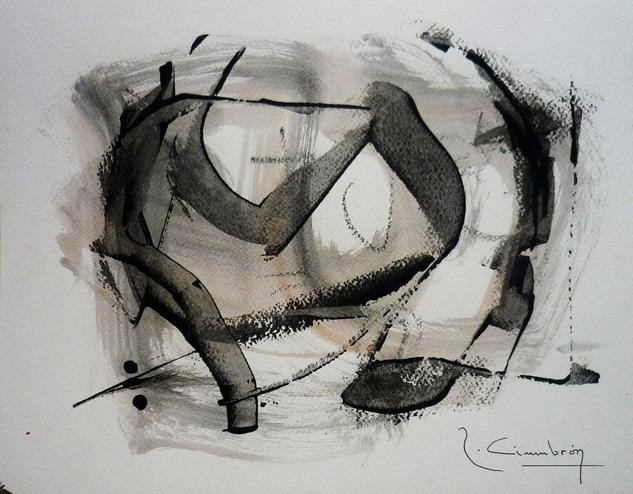
Small doors that open
Robledo's painting comes out of a spiritual appetite, of a need to dig into the first substance. For many people art is a process of mental hygiene. The act of painting itself, beyond its aesthetic or practical aims, produces a moral catharsis that cleans and regenerates. Like running the vacuum over your soul and getting rid of the accumulated dust. But no matter how much dust you clear away it always comes back, which is why painting, and art in general, is a process that never ends…
And the viewer, what part do they play in all this? Their job is to look and to try to feel, to get closer to the painter's motivation, but also to surrender to their own spirit. In that sense, Robledo's artworks are visual poems that point us down a road towards ourselves, towards a sensory and psychological experience that seeks to mirror the artist's own catharsis in the viewer. They are, ultimately, small doors that open… Maybe once you cross the threshold you'll find nothing at all, or you'll understand everything. It's up to you, up to each person. It depends on the day.
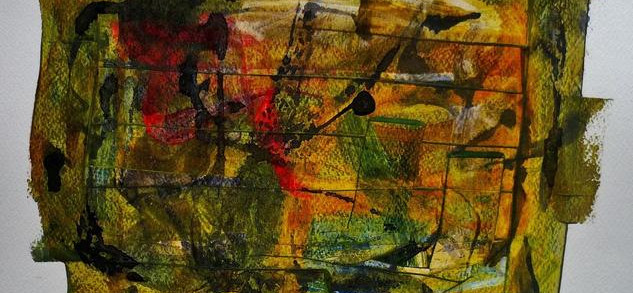
The flow of chance
Miguel Robledo has named among his references some of the greats of 20th century Art Informel, such as Antoni Tàpies, the ill-fated Nicolas de Stäel and Asger Jorn. The Catalan painter is perhaps the influence most easily traced in his output, but in general the work of this Teruel-born artist has managed to acquire a personality of its own through years of labour and progress, both theoretical and purely pictorial. Robledo has created a style of his own, and that's the best thing you can say about an artist.
His work falls into four types according to support and style: paper, oil, abstract on board and abstract on canvas.
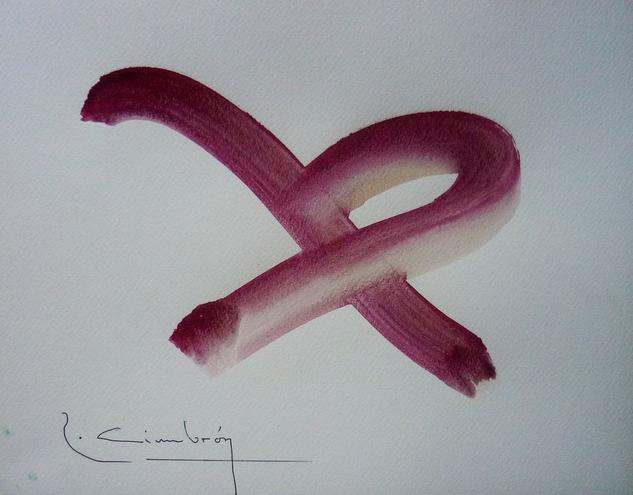
His Informel drawings are the best way to cross that threshold into his output. Almost all of them share a few formal notes. Robledo leaves the edges of the paper free, so they act as a frame. A good solution to keep the viewer's eye from being overwhelmed by the play of colours and shapes the artist puts forward.
In some cases the painter goes for something more pared down, as in Art.Gest 145 or Art.Gest 635. We come close to Eastern calligraphy, where every gesture, every nuance counts. The effect is powerful despite the economy of means.
In other cases Robledo prefers a richer Informel indulgence, as in Art.Com 320 or Art.Com 235, rounded off by his Art.Inf series, where his style moves closer to Tàpies, with more aggression, bringing in calligraphy and a profusion of dark tones.
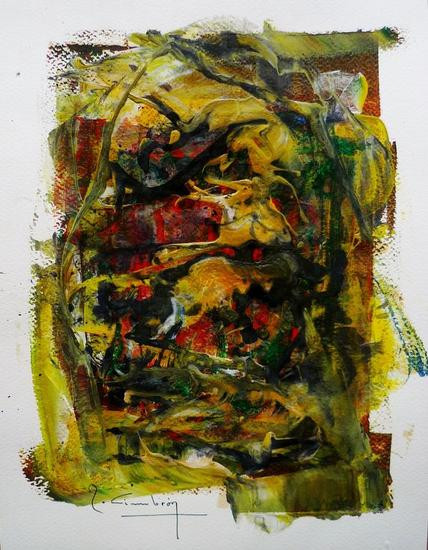
It's the «flow of chance», as the artist himself puts it, letting himself be carried along by the pictorial gesture, which is ruled by a force that's hard to make out.
This flow of chance also takes shape in the canvases of his Fashion series, where, unlike on paper, Robledo can play more freely with the pictorial material, creating rich reliefs and juicy webs of colours and shapes.
This tendency perhaps finds its best expression in his abstract artworks on board, such as the pair Libertad. The artist plays with the roughness of the material and also adds other textures through components that aren't strictly pictorial.
Paper, board and canvas are the three supports that make up Miguel Robledo's small doors, doors that are always open, and if not flung wide, at least showing a faint light that invites you in… and to flow.
Comments (0)
Log in to leave your comment. Log in