
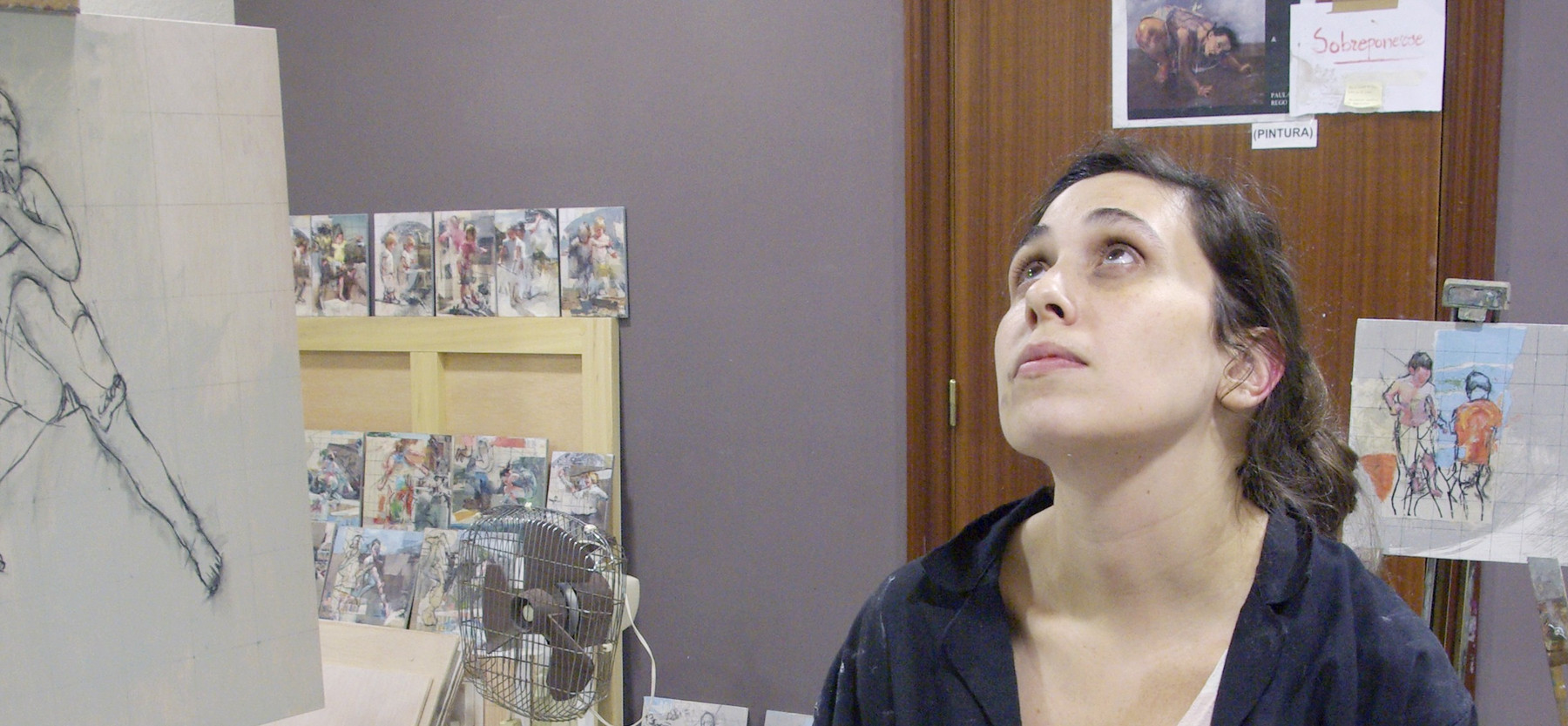
First of all, can you tell us a bit about yourself?
My name is Pilar López Báez and I've lived in Aranjuez all my life. I'm a painter and also an illustrator, although supposedly I'm also an art historian. I'll tell you a few little things about myself.
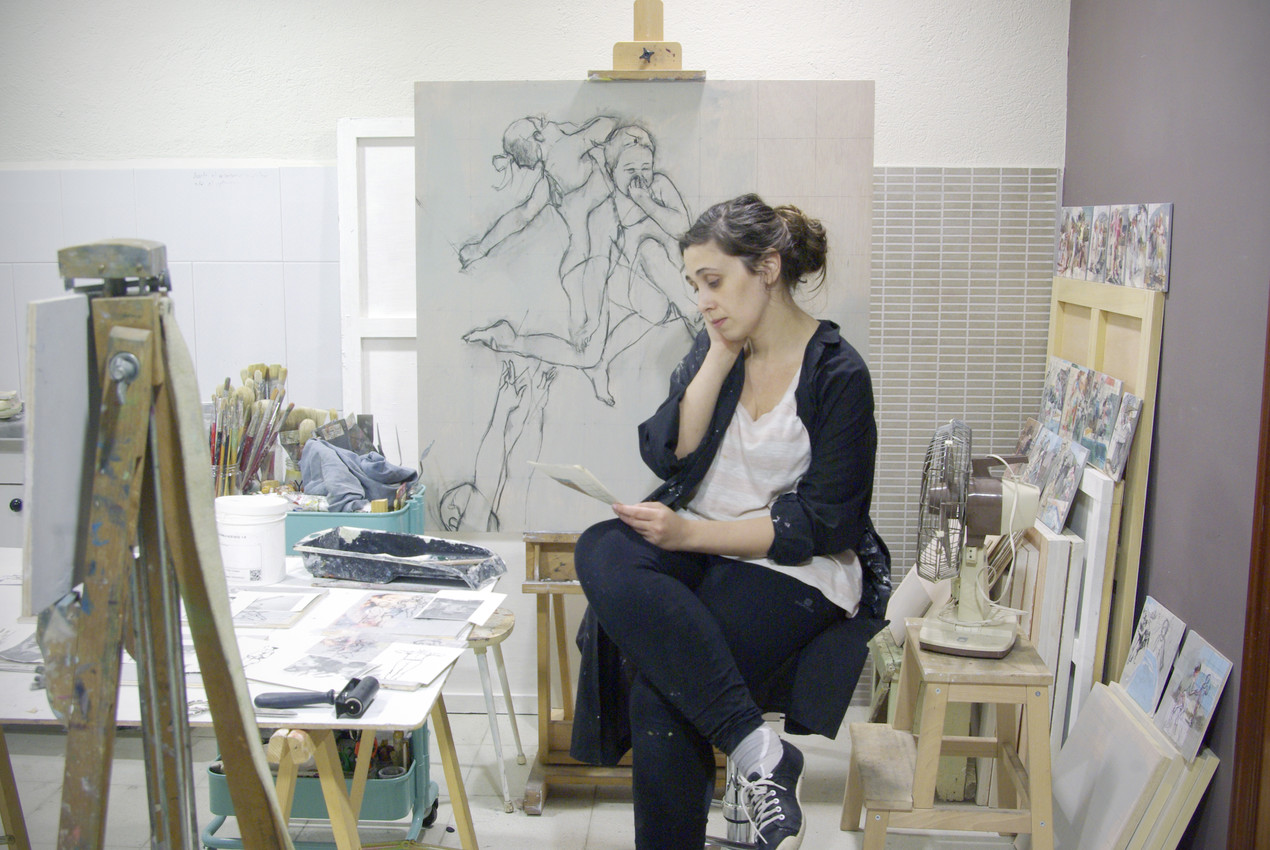
When and why did you start painting?
When I was little, very little, I wanted to be a painter. But my calling went through many phases: the Egyptologist phase, the astronomer one, the marine biologist one, and so on. I was very good at studying and I felt that to be an artist you had to have enormous talent. When the time came to choose what to study I went for Art History. At some point I realised I wasn't a historian, I loved history, but nothing more, and on top of that the way Art History was approached at university put me off. Dissecting the corpse of Art wasn't for me, but I finished the degree anyway. In that last year I knew that making art was my thing and that I wanted to be a painter, and I enrolled in Fine Arts. It wasn't until the fourth or fifth year that something clicked in my head, and I don't think I'd have made it without the right teachers: Juan Gallego and Norberto González. Since then, despite my moments of doubt, I haven't stopped painting.
I didn't start painting because my calling was crystal clear, it revealed itself little by little, through trial and error, and I think I had the courage I needed to redirect my path. I didn't have a need to express something... I simply felt, as I feel now, that I have to do it. Painting is unavoidable.
How do you think a gallery and its artists should help each other?
I think the gallery is hugely important, especially for painters. They need someone to represent them, support them, promote them and find buyers so they can concentrate on creating. Certain artists are very good at finding a market, but there aren't many. These days the gallerist can look like an obsolete figure, the client can decide to contact the creator directly and get a better price, but it's worth bearing in mind that if the gallerist does their job well we shouldn't be shooting ourselves in the foot. In my case I'd rather have a gallerist find clients for me and pay them a percentage of the sale than sell on my own and have to build up a channel of buyers, something I feel I have neither the time nor the tools for. On the other hand, a lot of clients feel that if a gallerist backs an artist there must be a reason, because they're good or whatever, and they feel more confident buying through them.
For some years now “galleries” have been springing up that charge money to exhibit or just to look at your dossier. Artists, numerous and full of hope, can fall for them and for similar open calls. These galleries let you “build a CV” and create the false sensation that you're doing something, or even that someone might turn up and see you. They play with the hopes and difficulties of artists who are starting out, and they're not interested in their artists, they don't need to sell artworks, because it's the artists, with their money, who keep these galleries going. I honestly think that we artists should be aware of these practices and not support them, so they don't spread like a cancer.
What advice would you give artists who are starting to show their work?
Well, the truth is I don't feel in any position yet to give advice. I can only offer a few very obvious pointers.
First and most important: being an artist is very hard, you face failure every day, but even if you don't win that prize, don't get into that competition, even if that gallery says no, keep working. Your artworks will keep getting better, and so will your composure. This is a long-distance race and you'll end up finding a place for yourself, that's for sure. Fortunately art today is very plural, and that, controversies aside, benefits us all.
A few more little things you probably already know: put together a good dossier, physical and digital, look after the presentation and above all the photos, make sure they match reality. If you can build yourself a website, all the better, and if not, look for online galleries where you can upload your artworks.
Look after your social media, you never know where an opportunity is going to come from, it's very important that if someone takes an interest in you they can find you. Don't underestimate the power of Facebook or Pinterest.
Look for open calls that suit you, spend your time (and your savings) only on the ones you fit, make yourself a calendar. Look for galleries that carry work similar to yours,
If you have successes, don't rest on your laurels, even if you think you've painted the best thing of your life, it's not true, what you paint tomorrow will be better.
Build a circle of artist friends, you'll feel less alone and they'll be a big help.
How did you sell your first artwork? Is there one you feel a stronger connection with?
I sold my first artwork through a landscape painting grant, in 2010. It was something very special for me because it was a landscape, a genre I don't feel comfortable with, and painted from life on top of that.
I've felt a lot of connection with all my paintings at the moment of thinking them up and painting them, but there's one series I'm especially fond of because for me it was the beginning of everything, the click I mentioned earlier. It's the series El espíritu de la Navidad, where I reflect on memory, I talk about myself, I make pictorial discoveries I couldn't have suspected before... from then on I feel able to generate a world of my own in my paintings.
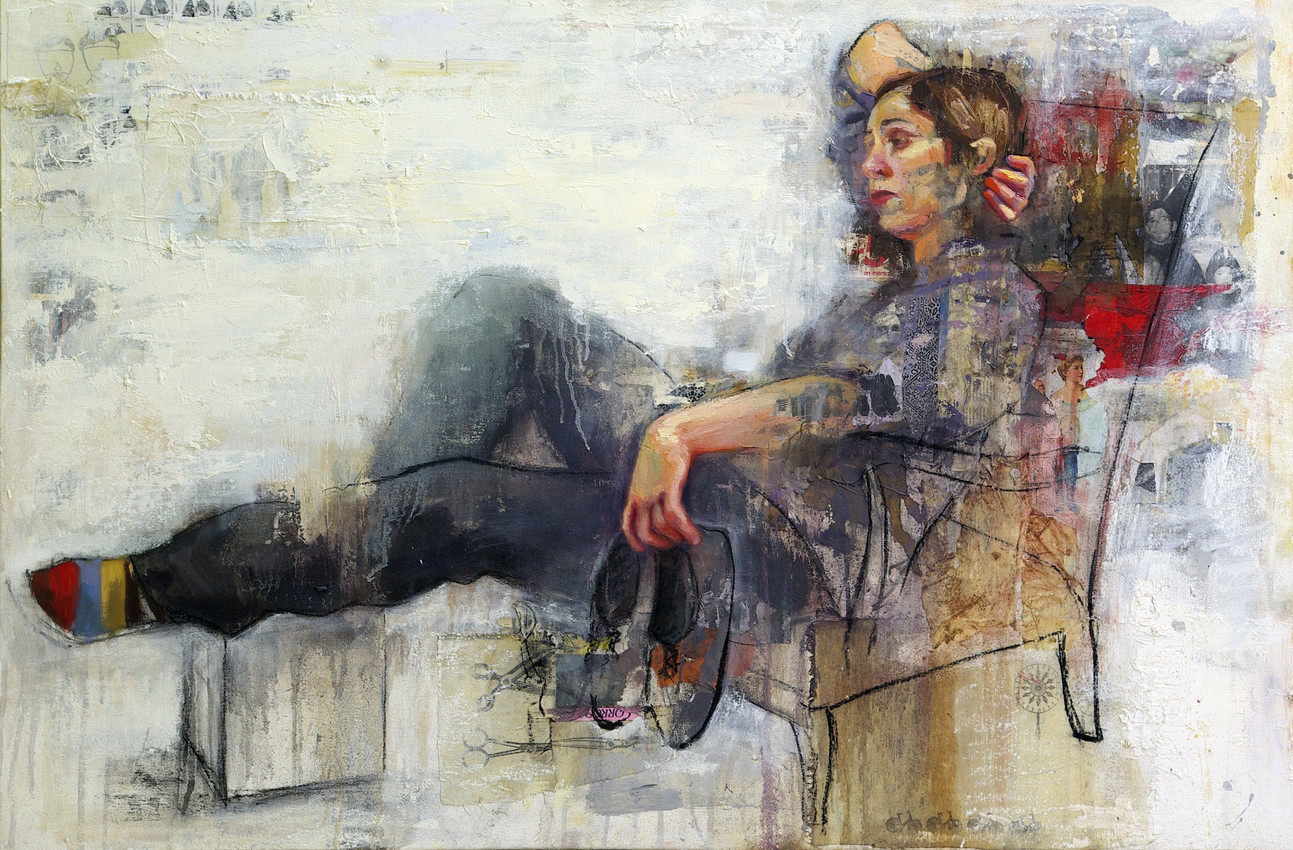
What is art for you? What part does it play in your life?
For me art is a way of living. I suppose we call art those human expressions full of beauty that move us while often being useless. I think art is an attempt to emulate the beauty of the world. Creation moves us, it silences us and lifts us up, and seeing art or making art is, in a way, something similar. It makes us aware of the mystery of the world, of the beauty it has and of its “senseless” sense. I don't know if I'm making myself clear, but I think art has the capacity to make us understand something incomprehensible, to be aware of its beauty and of how sublime it is.
I also feel as if I were tied to painting with an invisible chain, sometimes it demands a lot of sacrifice, almost like slavery, but it's simply what I have to do.
One of the recurring subjects in your work is children and family scenes. Why these subjects?
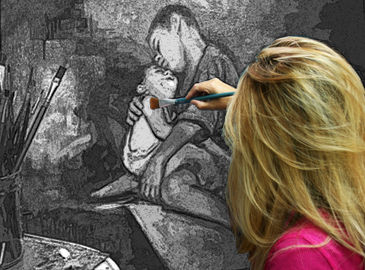
Why you paint what you paint is quite hard to explain. Sometimes I think that talking about memory is an excuse for me to paint, but other times I think that without that “excuse” there would be no paintings. It's very complicated for a painter to find a starting point they feel comfortable with to express their inner world. By the time I realised I wanted to talk about memory and remembering, I had already made a number of self-portraits where I included cuttings from places I'd been to or papers referring to things I'd lived. So it seemed a natural development in me to end up raising that subject. Approaching memory seemed to imply autobiography, but I wanted to go further and achieve the viewer's empathy. Thinking it over led me to consider collective memory as inseparable from individual memory. Looking for memories common to almost everyone in Western societies I arrived at photo albums, all of them full of fairly similar pictures of the summer holidays, of Christmas. Childhood revealed itself as a shared moment of splendour, a past so memorable that it even seems to be the last to disappear in degenerative illnesses. Paula Rego, a truly great painter, says that it's in childhood that everything happens and that from the age of 20 death begins. In childhood we discover life and fear, and the context in which that discovery begins is the family.
Although memory is fundamental in all my work, in series like El contemplador or El muro the children who star in them look at the world without quite understanding it, their bewilderment is shared by that inner child we all carry inside, who every now and then is amazed again or simply feels overwhelmed by how sublime existence is. In the series Los dobles the evidence of the inner child shows an identity that isn't single, and so memory reveals itself as something constructed.
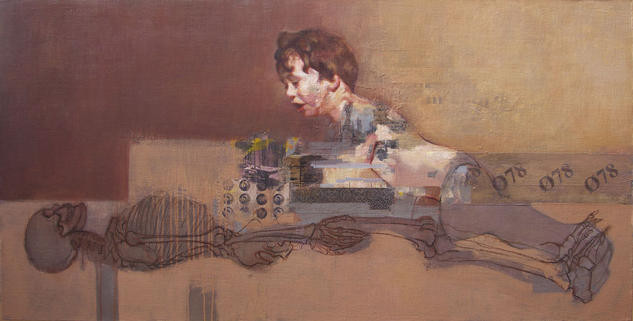
Identity, strangeness, memory and even the sublime feeling in the face of life and death. My paintings aim to go beyond reality and appeal to other realities, lived, felt or barely imagined, revealing our experience of being in its intense complexity.
What are your sources of inspiration? Do you identify with any other artist?
My sources of inspiration are varied, anything happening around me can be the spark. A few of them:
Going out for a walk, family photos, old photos, repeated photos with slight variations in gesture, moments when someone is there without being there, ruins, old walls, papers, found objects, old prints, random stains, certain phrases taken out of context, talking with painter friends, and so on.
As for artists, I'll name a few: Paula Rego, Sorolla, Freud, Jenny Saville, Alex Kanevsky, Christos Tsimaris, Nathan Ford, Miguel Coronado, Golucho, Sophie Jodoin, and many more.
In your creative process, do you have any habit, practice or quirk you can share?
I suppose something peculiar in my creative process is that, although sometimes I work with photos taken specifically for that, other times I work with photos that were taken for other purposes. I look very closely at everything going on in family photos and I take figures, compositions, details out of them. Something I love about them is that they're photos of real moments, the people in them aren't posing, they're simply being themselves.
Have you had any exhibitions recently, what can you tell us? Do you have any project in mind?
Not long ago I was selected for a course on figuration with Antonio López and Andrés García Ibáñez in Olula del Río and it was a wonderful experience in every sense. This summer I'll be exhibiting in Tenerife, at the Círculo de Bellas Artes, in a group show. And in September I'm taking part in a fair in Ordino, Andorra, for which I'm preparing quite a lot of work.
Could you recommend us:
- Un artista: todos los que he nombrado antes son magníficos, aunque podría reducir la lista a mis tres imprescindibles: Paula Rego, Sorolla y Freud.
- Una obra: es imposible escoger sólo una. Pongamos la Ofelia de John Everett Millais y Gran Interior. Paddington 1968-1969 de Lucian Freud.
- Un libro: cuando era adolescente no podía vivir sin La insoportable levedad del ser de Milán Kundera y sin los cuentos de terror de Poe, Lovecraft y Maupassant. El Libro del desasosiego de Fernando Pessoa me ha acompañado siempre, y ahora adoro a los clásicos rusos.
- Una película: no sé si es mi preferida pero me encanta y la he visto muchas veces La vida secreta de las palabras de Isabel Coixet.
Thank you very much, Pilar.
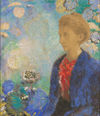
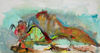
Enjoy Pilar López Báez's artworks on Artelista, and you can read the review we wrote about her.
Comments (1)
Dr. Atilio Laurence Almagia
June 25, 2015“Cómo crear conocimiento si éste proviene de las entrañas mismas de la naturaleza, celosa por sus secretos y dadivosa por la bondad sempiterna y nunca valorada por la humanidad” Dr. Laurence
Log in to leave your comment. Log in