
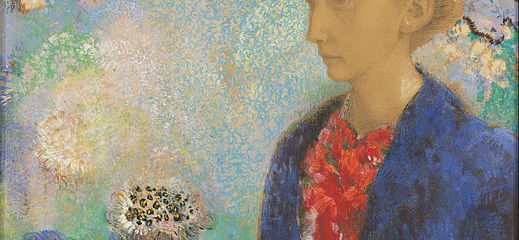
Although Odilon Redon was a contemporary of the Impressionists, he developed his painting far away from them. Unconcerned with the light that Monet's friends praised so highly, his dark creative world looked for another kind of inspiration. The work of Edgar Allan Poe, for instance, which filled his compositions with severed heads, spiders and eye-shaped polyps. A repertoire of images that links him to Symbolism, to the Nabis and to Surrealism.
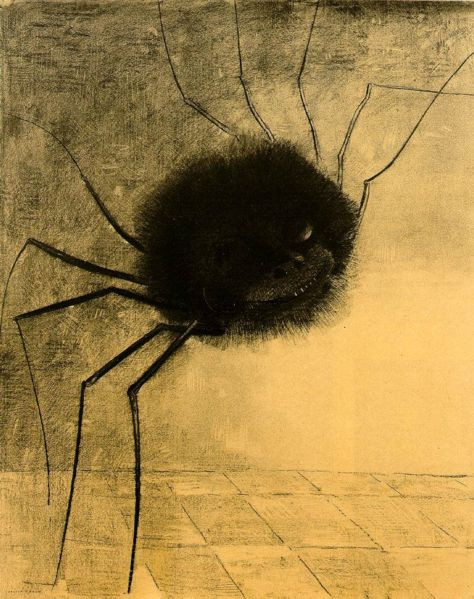
For a good part of his career Redon (Bordeaux, 1840 - Paris, 1916) was known for his work as an engraver. Lithographs with blacks of an intensity, a gravity and a velvety quality that were immediately associated with his hand and that contrasted with startling, incandescent whites. In large scenes he gathered strange beings, amputated heads, fallen angels, black suns, microscopic life and the world of dreams. These unsettling pieces came out of the influence of writers such as Baudelaire, Poe and Darwin and artists such as Rembrandt and Goya. For the latter he confessed a great admiration, and he was especially interested in his series Los Caprichos (1797-1799), los Desastres de la guerra (1810-1814) and las Pinturas Negras (1820-1823).
Like one more of the many enigmas surrounding his life, all of this changed radically around 1900. Redon swapped the darkness of his palette for glowing colours and an ornamental purpose. In those years he decorated the castle of Baron Robert de Domecy, the music room of the Paris mansion belonging to the widow of the composer Ernest Chausson, and tapestry cartoons for Gobelins. Even so, it was the project for the library of Fontfroide that became his great achievement in decorative matters.
The commission consisted of decorating the large square room, close to ten metres on each side. He designed two panels facing each other on the side walls and a third, smaller one above the door. He had complete freedom to choose the subject and decided to create the artworks that best reflect his complex artistic career, both in their thematic and their formal opposition: El Día (1910) and La Noche (1911).
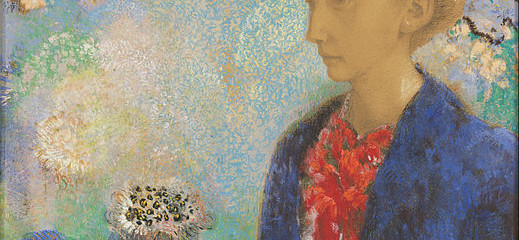
On the one hand, the bright yellow and the floral exuberance that dominate the panel of El Día, with a chariot driven by winged beings at its centre, a tribute to Delacroix, are characteristic of the Redon of the second period, the one who fell in love with colour. As for La Noche, he lets black awaken every possible fantasy. Here he brought back forms that were frequent in the years 1870-1880, though less unsettling than his creatures of old.
The third panel, the smallest and the one placed above the exit door, he called El Silencio. In it he depicts a mysterious figure with a shadowy face who places his index finger on his lips, in the middle of golden haloes. As the title suggests, it invites the viewer to the serenity proper to a library. This mysterious, dreamlike character, inherent to all of Redon's production, is in tune with the contents of the library, full of works dealing with the occult and esotericism.
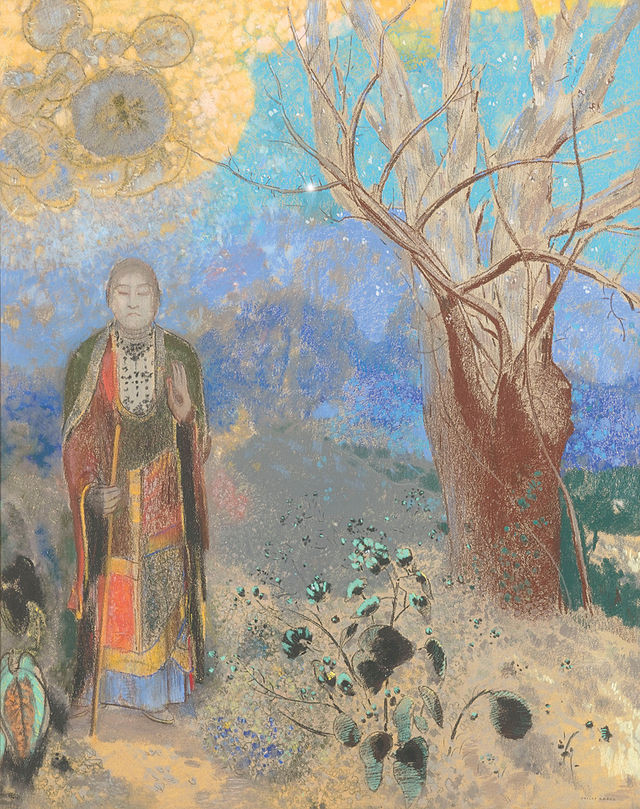
Little by little Redon turned his art towards the cult of nature, beauty and colour. He forged a painting that acknowledged the intrigue nature itself offered him and still attended to the hidden play of shadows and to the rhythm of the abstract line designed in the mind. Besides Rembrandt and Goya, he also looked at Dürer and Da Vinci, and he plunged into the ocean depths and into oriental art in search of new paths of inspiration. Dark or colourist, what he never stopped being was a builder of harmonies that were penetrating and rare in their subtlety.

Comments (0)
Log in to leave your comment. Log in