
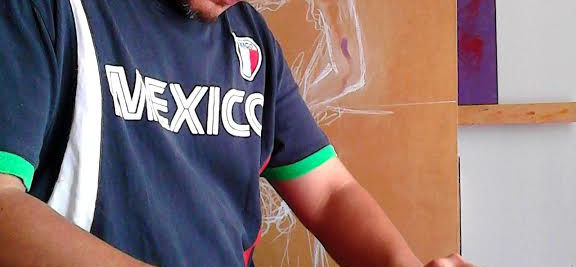
Born in Mexico City around 1982, when the days were less grey and the peso had three more zeros, Ricardo Cruz Fuentes spent the first 25 years of his life in the State of Mexico and now lives in the city of Pachuca, Hidalgo. With only a few years devoted to painting he has managed a considerable number of sales across Mexico, as well as in the United States, Spain and Colombia, and he is currently represented by Art Fusion Galleries in Miami, USA.
When and why did you start painting?
To be honest I don't really remember when I started painting, but I do remember that I've loved drawing since I can remember, it was (and still is) a need I have. When I was little I remember sitting down at the table with a notebook and a pencil, dying to draw something, but it frustrated me that I didn't know what. I'd spend long stretches thinking about what I could do until finally something came to me and I drew it, but there were times when nothing came into my head and in the end I'd close the notebook and give up. Discovering comics certainly changed everything, I loved the drawings, especially the superhero ones, and I became a fan mainly because of the images filling the pages, which I loved copying all through my childhood and teenage years. Of course, with time that got left behind and I started making my own images, mostly out of my own head.
How do you think a gallery and its artists should help each other?
I think both sides, artists and galleries, should be more responsible about what they do. It's not that everyone gets it wrong, but some don't do it the way they should. What I mean is, collectors go to a gallery assuming that what they find there is good art, because they trust the judgement of gallerists and curators, but I've come across galleries that are only looking for "material to sell", without the artist having any grounding or any discourse about why they make their art or what they want to convey. I think artists need to have a clear idea underpinning their art (not just painting for the sake of painting, or worse, painting in order to sell), and while it's true that this idea and this discourse will change over time as they evolve as artists, at every stage of their development they should always be clear about what they want to communicate with their work. In the same way, galleries should be responsible about looking for artists whose artworks have that same grounding, and not just artists who paint pretty things whose artworks are more profitable. That, in my opinion, is how a gallery can help artists develop, and in turn how artists can help galleries with work that is strong both visually and conceptually.
What advice would you give to artists who are starting to show their work?
From my own experience I can say that when you want to show your artworks with the aim of making a living from it, first of all you have to believe in your work, believe that what you're doing is important and valuable, because in the end each artwork is a part of you, it's that fragment of our imagination, our time, our talent and our love for art. You also have to be a great promoter of your own work, and that's the most laborious part (even more than making the artworks themselves), because that's how you get to find not just places to exhibit but also the right people to help you push a career in the art world forward, and eventually make a living from it.
How did you sell your first artwork? Is there one you feel a stronger connection with?
I sold my first artwork (an oil) online, on a Mexican site for buying and selling all sorts of things, around 2008. My first drawing (if I remember right) I sold in secondary school when I was about 13 or 14, around 1993... though back then it was a hobby, of course. It wasn't until 2011 that I started to consider the possibility of dropping everything and trying to do this for a living. As for an artwork I feel more connected to, it's odd, it turns out that when I finish painting (and while the artwork is drying), even if I like it a lot, little by little I lose my connection with it and it stops being so "mine", I lose that sense of belonging with the artwork.
That must have made things easier when it comes to selling your artworks, since there are artists whose attachment to their work makes it hard to let go of it.
Honestly, yes, I find it pretty easy to part with them, I'm really not interested in being a collector of my own artworks, even when I've liked them a lot or they were complicated to make (the sort of thing that makes some artists get attached to their work). I find it more satisfying for my paintings to be with someone who likes them, someone who builds that connection with the artwork and values and enjoys it.
What is art for you? What role does it play in your life? Do you make a living from art?
For me art is the expression of our being in relation to the world around us, which we try to give an outlet to through the tools of the arts as a craft (dance, painting, sculpture, printmaking, music, literature, etc.). The role it plays in my life is fundamental, because it's the foundation that (even without my knowing it) has governed my life and brought me to where I am today, and it will take me to bigger things in life too. Although I still can't afford the luxury of living entirely from art, I know this is the path I have to follow and I know that eventually I'll live from my work in art.
Your artworks are carefree and funny. Do you think your art can be therapeutic? Does society need more art like yours?
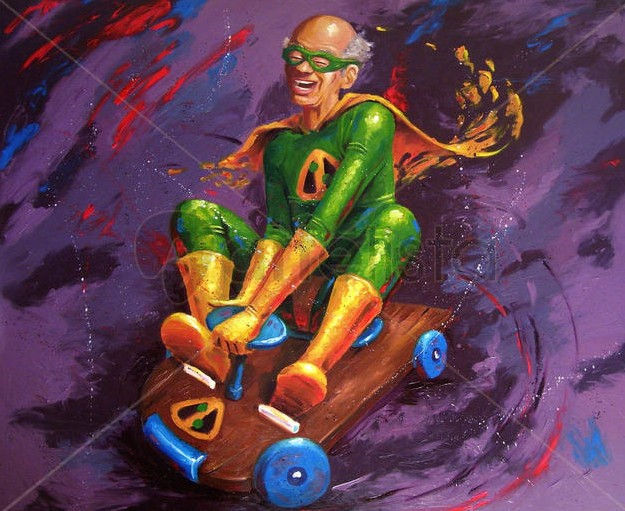
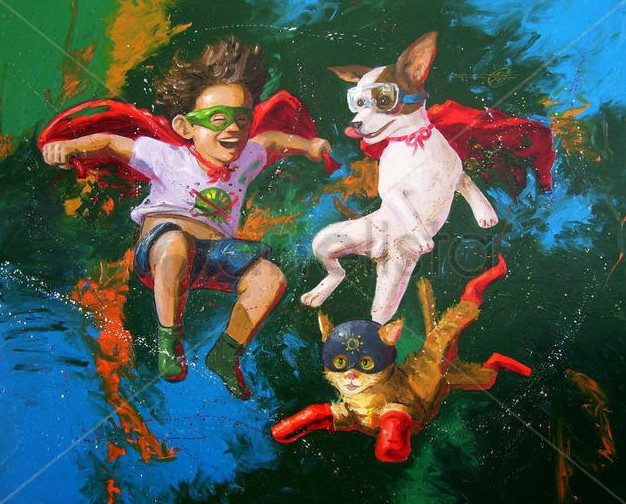
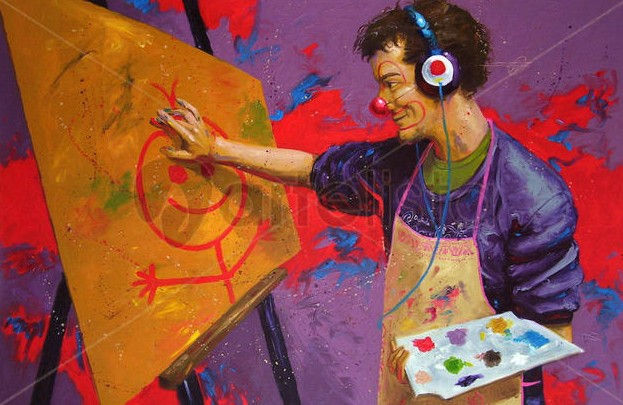
Therapeutic maybe for whoever makes it, in my own case I have a lot of fun painting that kind of painting, even though they're not the classic artworks with a deep or philosophical concept, nor the rebellious socialist artworks that try to capture the bad times society is going through. They're artworks that are an escape for me, a distraction from all those unpleasant situations that bombard us mainly on the news, constantly reminding us that we're not exactly living our best moment as a society. That said, I also think what my artworks reflect is that desire that drives us, the rebellions, the complaints, the demonstrations of outrage, none of that happens just because. Those social struggles aren't fought for fun, I think they're fought to have more moments in our lives like the ones you see in the artworks: happy people of all ages, cheerful, having fun, others who aren't having so much fun but are still funny for the viewer, and in the end I think that's what we're all after, the joy of living fully and with dignity.
What are your sources of inspiration? Do you identify with any other artist?
My inspiration comes from all those relatively everyday situations that I find funny (even when I've never done them myself), ideas, comments, conversations, phrases, and everything I see or hear that strikes me as funny or amusing. I tend to be somewhat sarcastic with my sense of humour and that's something I also try to show in my work, sometimes subtly, sometimes more forcefully, but it's always there. One of the artists I find most inspiring is Picasso, though curiously not so much for his work as for his philosophy about art and life, his basic idea of "enjoying it like a child".
Have you had any exhibitions lately, what can you tell us? Do you have any project in mind?
Recently I took part with eight artworks in the group show "Beyond reflections" at Art Fusion Galleries in Miami, and next month a new exhibition opens there called "Passion and Allure". Unfortunately I haven't been lucky enough to travel to our neighbour to the north to see the exhibitions in person, but I've been able to see them through videos and photos on their fanpage. At the moment I'm promoting my work so I can put on new exhibitions here in Mexico that let me keep pushing my career in this field.
Could you recommend us:
- Un artista: Picasso, Monet, Goya, Frida Kahlo.
- Una obra: Las dos fridas, de Frida Kahlo.
- Un libro: Conversaciones con Picasso, de Brassai.
- Una película: Forrest Gump, El gran pez (no tienen temática sobre el arte, pero son buenísimas).
Thank you very much, Ricardo.
Thank you for the interest and the space. Best wishes.
We invite you to visit Ricardo Cruz Fuentes' gallery and the review we wrote about him on Artelista.


Comments (0)
Log in to leave your comment. Log in