
"Like long echoes that mingle far away, in a dark and profound unity, vast as the night and as the light, perfumes and colours and sounds answer one another". These lines from Baudelaire's famous sonnet Correspondances, which work as an introductory key to the whole Symbolist movement, can also serve us as a heavily loaded preview for defining the work of Louis Welden Hawkins (Esslingen, 1849 - Brittany, France, 1910).
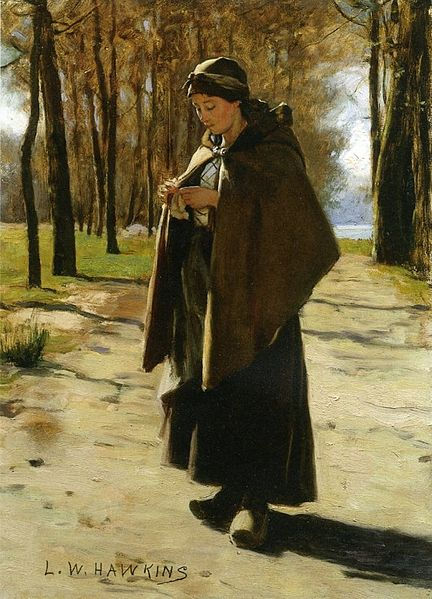
Born in the German town of Esslingen, he left his home town at a very early age to spend his childhood in Great Britain, his father's country, and later left that behind too, in order to train at the banks of the Seine. In prestigious Paris academies such as the Académie Julian, or later, under Gustave Boulanger, at the Academy of Fine Arts, he grew up and grew ever fonder of the bristles of a brush.
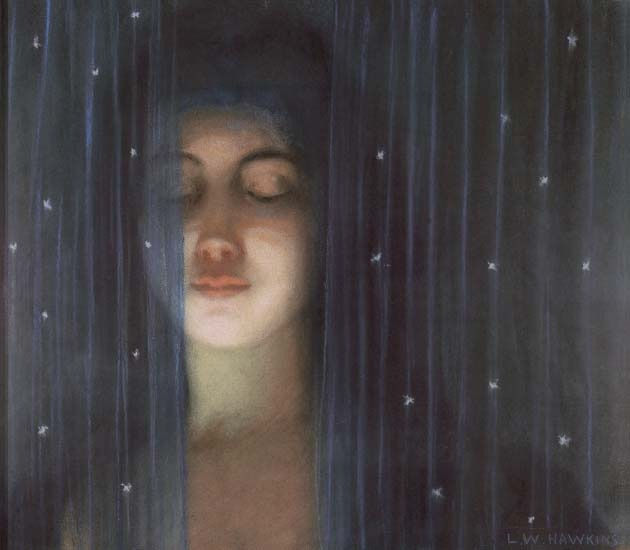
Like any good son of his time, belonging to the second half of the 19th century, Louis Welden Hawkins was drawn to the Symbolist current that was beginning to dominate the scene in the City of Light. Jean Moréas' manifesto laid the foundations for a new twist, yet another one, on the Platonic concept of forms as an esoteric memory of the immutable idea. And mysticism soaked into the canvases of numerous artists, Mallarmé or Verlaine as its highest expressions, who knew how to carry off that synaesthesia, that correspondence announced by Baudelaire between things that are, apparently, incompatible. This was Louis Welden Hawkins' terrain too.
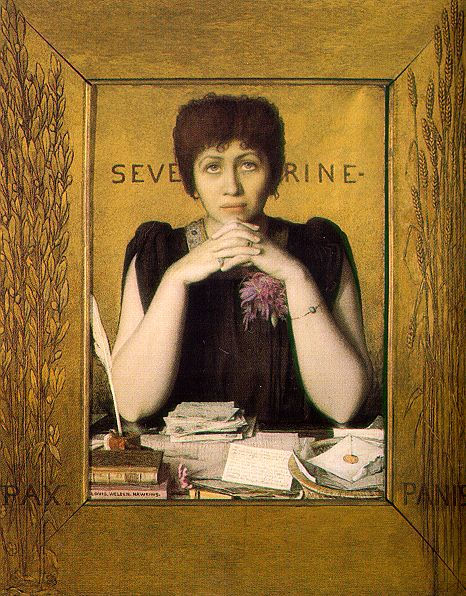
Female portraits dominate his work, and in them the enigmatic poses adopted by his models stand out, captured with expressions full of mysticism that carry us off, with a careful, drowsy line, to the borders of the unreal. Among his best known pieces is Séverine (around 1895), one of the painter's most remarkable creations. It presents us with a scene that was unusual for the time, a woman devoted to writing and intellectual matters. The model, the journalist Séverine, took part in various publications defending the workers' cause, and even became the editor of the newspaper Le Cri du Peuple. The gold background against which the portrait is framed recalls Italian Renaissance painting. A constant reference for the painter.
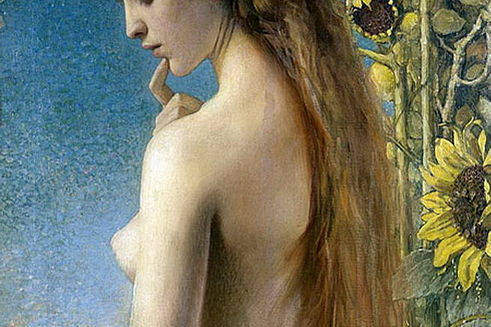
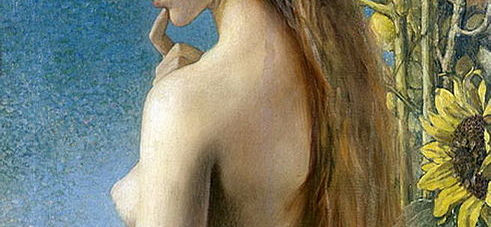
Another of his outstanding canvases is Clytie (around 1890). Perhaps one of the finest expressions of that attempt to capture synaesthesia. The confusion and blending of colour and gesture, which takes us towards sounds, and even towards smells. In this artwork we can see the depiction of a feminine perfume, one that starts out intensely in the upper part and then blurs away into the brushstroke, under the sidelong gaze of its protagonist, and once it has caught us, evaporates and leaves us from top to bottom.
Comments (1)
Arsenal
August 23, 2015Saludos. Atte: Arsenal Le Comte Arts.
Log in to leave your comment. Log in