
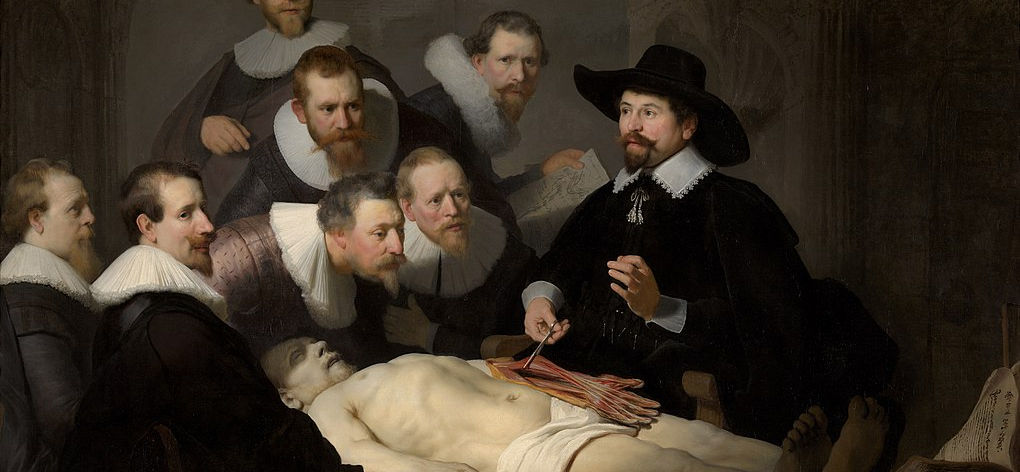
As the saying goes, "beauty varies according to the eyes that look at it", and maybe it's right. So far we know that Monet was short-sighted and that this mattered more than any other factor in his leaning towards Impressionist art. It seems his natural talent, combined with this different way of seeing the world, helped shape the genius. For some time now we've also known that Leonardo Da Vinci may have had strabismus, but today we won't be talking about that master, we'll talk about another one. The tenebrist par excellence, Rembrandt, had a squint in one eye and, far from hindering his genius, it pushed it along until he became a true master in the art of creating effects in which figures seemed to emerge from the darkness.
A defect that generated perfection in Rembrandt
The Dutch Golden Age wouldn't have been the same without him. His paintings and drawings had a huge influence both during his life and afterwards. Among all these artworks, some were analysed with rather picturesque conclusions: Rembrandt had a squint in one eye. It was during the late 19th century and the 20th century that his entire body of work was gradually analysed. Only recently did researchers at the prestigious Harvard Medical School realise that Rembrandt could have had strabismus. This is because, in his paintings, the painter was able to perceive the world "as a flat image", as the team of neurobiologists claims. Also, "while one eye looked straight ahead, the other looked outwards, which means he could only see the width and the length of an image but not the depth, since it is the perfect alignment of the eyes, known as stereoscopic vision, that allows us to see in three dimensions".
Rembrandt, (dominio público, vía Wikimedia Commons)What does all this mean? Well, we need an example from beginners' painting to understand it. When you study painting, seeing figures in three dimensions makes it hard for students to pull off their first artworks. So painting teachers usually recommend closing one eye so that they can see a flat image. Rembrandt had a head start, don't you think?
Is Rembrandt's strabismus so unusual in painting?
The truth is probably not. It has been discovered that in Da Vinci's case it may also have had a lot to do with the development of his art. In fact, this came to light some time after we knew Rembrandt had it. Curiously, what should have been a disadvantage wasn't, since guessing three dimensions from the two dimensions of a single eye is easier. In painting terms, a prior disadvantage ended up becoming one of the many ingredients that made up his genius. And how thankful we have to be to that "defect" for leaving us two great geniuses!




Comments (4)
Jose
July 14, 2023Interesanteocurrente
Bravo
Libe de zulategi
May 12, 2022Velvet silvers
March 25, 2023jORGE LEOPOLDO VILLALBA
February 19, 2022Log in to leave your comment. Log in