
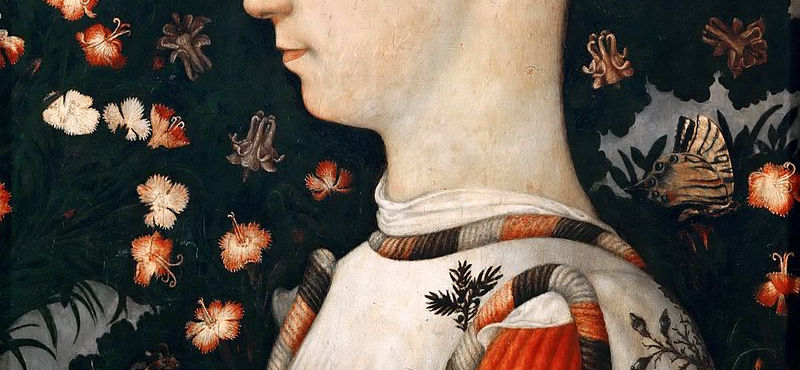
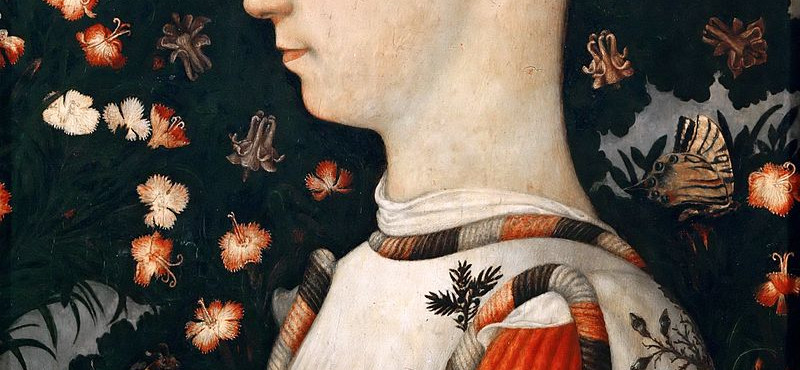
A girl in profile, her hair pinned up, dressed in a richly embroidered gown, stands out against a neutral background decorated with flowers and crossed by three fluttering butterflies, like a tapestry. This is the Retrato de un Princesa de la Casa del Este (around 1436) by Pisanello (Pisa, 1395 - Naples, 1455), an essential artwork by the Italian.
Like many portraits of the period, the artwork holds the enigma of the sitter's identity. Some have seen in the little sprig of juniper (ginevero in Italian) an allusion to her name: Ginevra. Others have also linked the three colours (white, green and red) of her gown to the virtues, faith, hope and charity, and to those of the Gonzaga family in Mantua.
Even so, although the details pointed out tie the girl to the Este and the House of Gonzaga, her identity remains unclear, since these clues fall on several princesses: Ginevra d'Este, wife of Sigismondo Malatesta in 1434, Lucia d'Este, sister of Ginevra and Leonello, married to Charles de Gonzague, or his sister Marguerite de Gonzaga, who married Leonello d'Este in 1435.
Beyond the identity of the young woman, in painterly terms Retrato de una Princesa de la Casa del Este leaves us a masterly reinterpretation of the coin portrait. Influenced by a taste for the ornamental and for the simplification of form, taking it to the very edge of drawing, Pisanello fills the portrait with an emblematic character, capturing the effect of something taken from a bas-relief or a medal.
Pisanello also painted from life, with particular scientific care, both the floral elements and the insects that appear in the portrait. So much so that their species are perfectly recognisable, to the point that he left us the first identifiable butterflies in the history of art: Vanessa atalanta, Colias croceus and a Papilio machaon.
A curious detail that brings out Pisanello's precocious fondness for realistic observation and for painting from life. Aspects that would be of great interest to artists of later generations. As we know, in the 18th century for the scientific and documentary side of it, and well into the 19th, for painting from life.
Comments (0)
Log in to leave your comment. Log in