
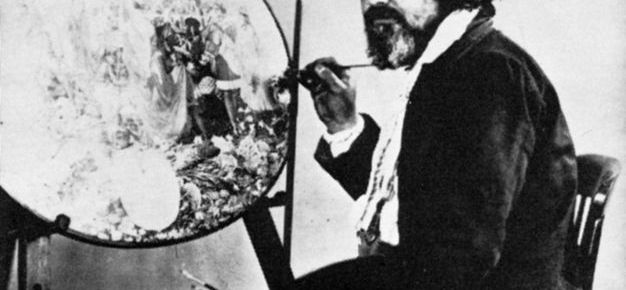
“It isn't hard to draw imaginary forms, monstrous figures, hallucinatory apparitions; what's hard is to catch a glimpse of something invisible that inwardly animates the beings and things of the visible world”, said the Japanese painter Hokusai, a master at portraying flowers, demons and ghosts. That very difficulty, making explicit the hidden forces that lead us, perhaps not to justify, but almost to understand the motives behind the macabre, is especially reflected in the artwork of the painter Richard Dadd and, more sharply still, in his famous painting El golpe maestro del duende leñador (1855- 1864).
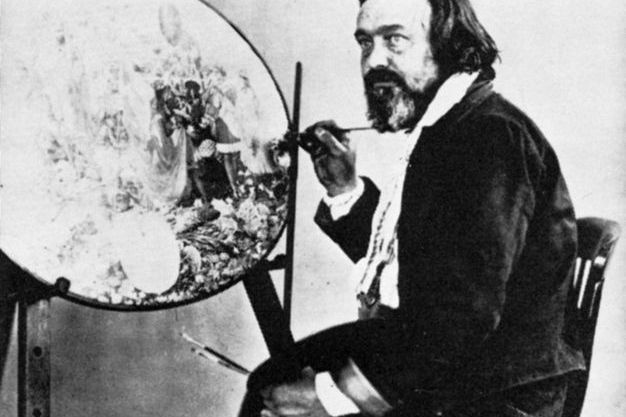
Richard Dadd (Kent, England, 1817-1886), son of a highly regarded local chemist, had eight siblings, half of whom suffered various mental disorders that ultimately determined how their lives ended. Given that family background, it's hardly surprising that Richard also suffered severe psychotic disorders. At eighteen he moved to London with his family to study art at the Royal Academy. From the start he showed great talent for drawing, and went on to found a group of Pre-Raphaelite painting called The Clique. It was within that association that he became obsessed with the subject of mystery, fairies, elves and supernatural creatures.
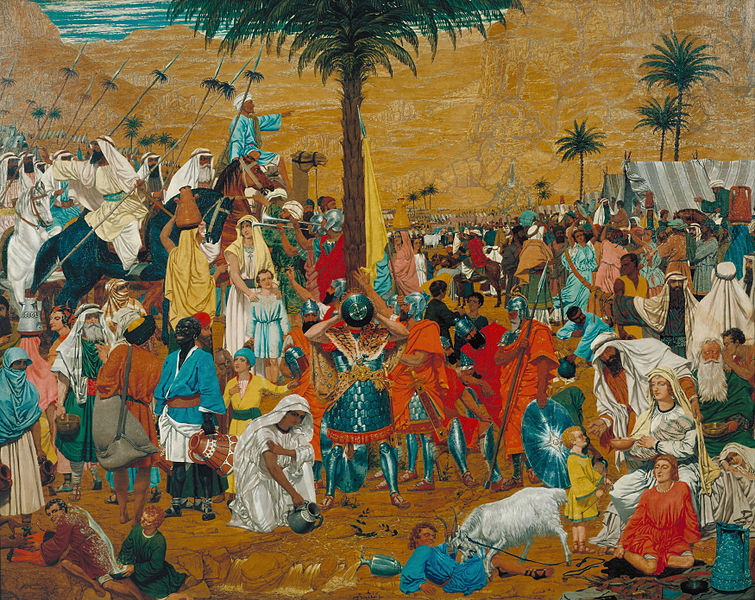
By 1842, at the urging of the former mayor of Newport, a personal friend, he set off on a trip to Greece, Turkey, Palestine and Egypt with the aim of drawing and throwing himself into all kinds of excess. The artist had the chance to take in mystery and beauty, but he also had to face the harshness of the extremely hot climate and disease. There's a well-known episode of severe sunstroke he suffered in Egypt, which left him at death's door and after which he began to hear the messages of Osiris. Richard supposedly communicated with the Egyptian god through the bubbling of hookahs. And the god asked him to do away with the incarnations of his enemy, Seth.
Back in London, where doctors had already warned his father about the irreversible mental disorders his son was suffering, Richard arranged to meet his father in his home town, and on one of their supposed walks to help him recover his faculties, he struck his father on the head with an axe, then stabbed him repeatedly in the chest and ended up cutting his throat, dismembering him and throwing him into a ditch. Fleeing by train towards France, he tried to slit the throat of one of the passengers, and was arrested. Richard Dadd, sent by Osiris, had a long list of enemies to annihilate, among them the Pope, the emperor of Austria and, at the top of the list and grievously done away with, his own father.
After the parricide, Richard Dadd was extradited to England and committed to the State Criminal Lunatic Asylum, and he would never enjoy freedom again during the forty-two years of life he had left. It was inside psychiatric hospitals, and after the aggressiveness of his paranoia gradually subsided, that he produced most of his painting. Among it, his masterpiece, El golpe maestro del duende leñador, now held at the Tate Gallery in London. Of this artwork, which fascinated the Nobel prize winner Octavio Paz, he said that it is “the painting of absence and of waiting”. The woodcutter never lands the blow of the axe on the nut, he stays frozen in the attempt, and so the spell will never be broken. And he isn't the only artist struck by that artwork, the rock band Queen dedicated a song of the same name to it in 1974.
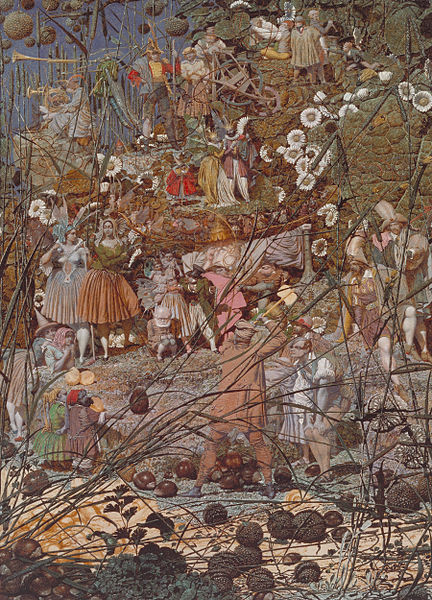
So this is a painting of a dreamlike character, almost three-dimensional, in which the layers pile up almost obsessively. The absence of perspective and the baroque, saturated accumulation of figures and forms produce a certain visual fatigue that demands enormous attention from the viewer in order to take in all its details. All over the painting, even in the most unlikely corners, a multitude of fairies, gnomes, elves and goblins are depicted with mocking and in some cases even merciless expressions. All of them watch with interest the centre of the scene, where the woodcutter, who could well be Robert Dadd himself, is about to land the axe blow that will crack the nut and destroy the spell. But that blow never comes. And the axe is unfinished. The tip isn't drawn. What you see there is the canvas of the painting itself. And everything is frozen. Without paint. And waiting.

Comments (0)
Log in to leave your comment. Log in