
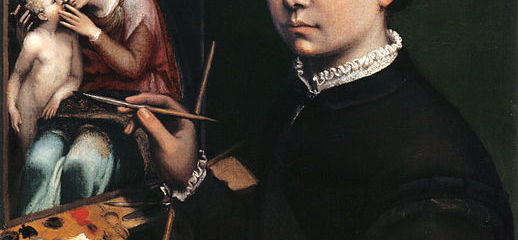
There's no artwork without its painter and no painter without his brush. Let's begin, if you'll allow us, with the obvious. Once the artwork is finished, the colours survive on the canvas and there they go on being the protagonists, whereas the vehicle that carries them, the tool that gives substance to the imagined forms, expressing the artist's skill through its movements, is the brush. The accomplice, the one that gives faithful service and then keeps quiet when what it has produced succeeds and keeps quiet too when it fails, is a vital instrument for the painter. So let's take on a few thoughts about how to choose it and the care it deserves.
We're not exaggerating when we say that the brush is one of the oldest tools ever devised by man. Looking into how it came about gives us prehistoric evidence of some early attempts made with frayed plant stems, and by the Palaeolithic there is proof of bird feathers and tufts of hair being used for cave drawings. We also know that in Egyptian, Greek and Roman murals and paintings on wood, alongside the "cauterium" and the "caestum", the spatulas used by encaustic painters, there was the "penicillus", the Latin name from which our word for brush derives.
We know, on the other hand, that the scribes and painters of Iran, India and China used the brush very early on. To take just one example, the Chinese bamboo brushes still in use today haven't changed significantly in construction or shape over the centuries. Well into the 17th century, the apprentice painter in European studios was still learning to tie his own brushes at the same time as he was taught to grind pigments.
And it wasn't until a few years later that the first manufactured painting brushes appeared. We have to place ourselves in the late 18th century to find the European painter using brushes he hadn't made himself but had bought from a craftsman. A new trade appeared this way, that of the brush maker, now with a studio of his own, as a result of the specialisation and rationalisation that led to the division of labour.
The brush's main job is to hold a certain amount of paint and let you spread it the way you want, ideally sharp in the case of oil painting, or wide and diffuse as often happens in watercolour. How well a brush carries out these tasks obviously depends on the type and quality of the material as well as on the properties of the paints being used.
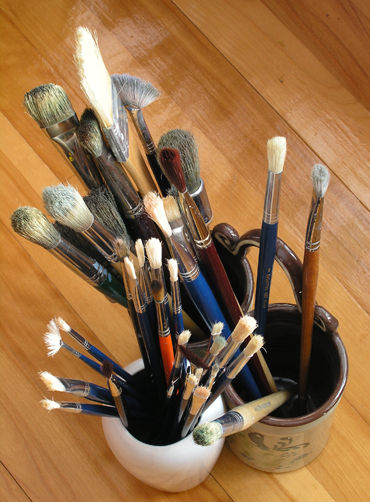
This main capacity for holding paint gets better the longer the bristles or hairs are and the more micro-rough their surface structure is. Since the paint rises and stays between the capillaries and flows downwards through pressure in contact with the surface, it's understandable that the rough surface of natural bristles and hairs works better than the smooth surface of synthetic materials.
Biologically there is no difference between hairs and bristles. It's only everyday language that calls the stiff hairs of pigs and boars "bristles". Natural bristles are wider at the root than at the tip, and that tip has a very useful branching that makers try to preserve during processing, because it's what largely allows colours to be applied evenly and without streaks.
As for hairs, like bristles, they aren't exactly cylindrical but slightly conical in shape. What they don't have, and this is the main difference, is that branching at the end, instead they finish in a fine point. The synthetic fibres most used in brush making, cylindrical by nature, are those made from polyamide fibres, better known by their trade names Nylon or Perlon.
Let's take a quick look at the type of material used to make brushes. Let's start with hairs. The most prized for brush making come from the red sable, whose pelt hunters call "kolinski", an exotic name that manufacturers have also adopted to sell these brushes. These hairs are very elastic and resistant to pulling and taper to a very fine point that allows a very precise stroke.
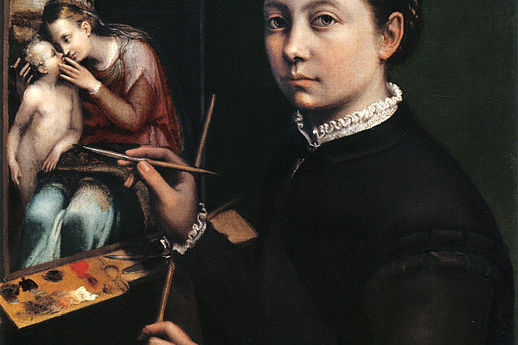
They're the most expensive, but no doubt irreplaceable for their quality. It's worth remembering at this point that a gold stamp on the handle reading "genuine superextra kolinski" doesn't turn a mix of sable, weasel and ox ear hair into a superior brush. A little further down the scale we'd find polecat hairs, which give acceptable quality for oils and watercolours; ox ear hairs, long-tipped and often dyed in an attempt to imitate sable; grey squirrel hairs, especially Siberian or Canadian, also fine but less elastic and used in simpler mid-range brushes; and pony hairs, cheap and easy to come by, used in low-end watercolour and school brushes.
As for bristle brushes, the best and best known are hog bristles from China and Russia, and among them the "Chunking bristle", which comes from there, has practically become a mark of quality. Black bristle is used to make coarse brushes, while white bristle is used for artists' brushes. A curious fact about this material is that the longer the pig lived and the lower the temperature of its habitat, the greater its elasticity. Although it's true, all the same, that most bristle isn't used for brush making but for house-painting brushes and lacquer brushes. Much further down we'd find, as we've already mentioned, synthetic brushes whose only advantage is perhaps how easy they are to clean, even when the colours and acrylics have dried, thanks to their smooth surface.
And let's end this short tour of the brush with some advice on buying one. On that point, it's a good idea to go for the highest quality you can whenever possible, because the difference between using, say, a cheap brush and a sable one gives completely different results even in the same hands of a seasoned painter. So apply the rule of saving not on the materials but on their meticulous care.
The following are basic points, but always worth keeping in mind: never let the paint dry on the brush, don't stand them or rest them on the bristles or hairs, clean them thoroughly until the water you're using runs clean, don't leave oil brushes sitting in turpentine or white spirit, since these solvents strip the excess grease from the bristles and make them brittle. Watercolour brushes should be cleaned the same way, and their tips carefully combed. Following this advice will extend the life of your main companion in the work of a painter: the brush.




Comments (2)
eduardo zoteranis
November 23, 2019Carmelo González Gutiérrez
June 16, 2016Log in to leave your comment. Log in