
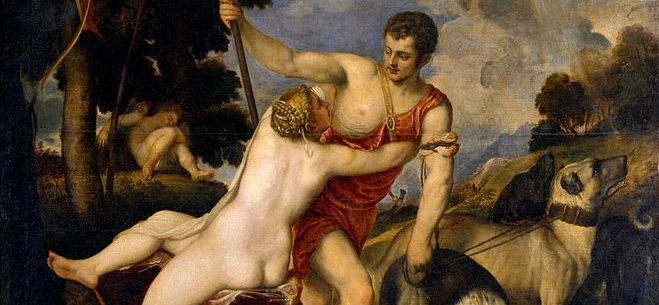
The Prado Museum uncovers the hidden story of the most influential mythological series in painting.
King Philip II commissioned Tiziano Vecellio (Pieve di Cadore, around 1489- Venice, 1576) to paint a series of mythological canvases. Artworks that longed for the poet's freedom to interpret the written sources. And, inspired by Ovid's Metamorphoses, the Venetian master produced six paintings, in which he showed his most sensual side and which he called poesie.
These are Dánae (1553), Venus y Adonis (1554), Perseo y Andrómeda (1556), Diana y Acteón (1559) Diana y Calisto (1559) and El rapto de Europa (1562), conceived in pairs. Along with other risqué paintings, Philip IV placed them in one of the rooms of the Royal Alcázar of Madrid, known as the Bóvedas de Tiziano, for his personal enjoyment.
The separation
On his first trip to Italy, Diego Velázquez, court painter to Philip IV, acquired another Dánae (1565). A highly erotic and explicit version, which replaced its namesake in the Bóvedas. Meanwhile, the one commissioned by Philip II was moved to the Buen Retiro, thus separating the poesie.
Sensuality became inappropriate for the Bourbons, even in private, and Philip V got rid of some of Titian's paintings.
The theft
During the Napoleonic invasion, Joseph Bonaparte plundered the Spanish royal collections, making off with 250 artworks, among them the poesia Dánae. The English, led by the 1st Duke of Wellington, seized the loot and, as a reward from Ferdinand VII, kept what they had found.
The discovery
None of this was known and, until now, it was thought that the Prado Museum held two of the poesie: Dánae and Venus y Adonis. However, research carried out by the Madrid gallery corrects that.
The lyrical Dánae is the one belonging to the Wellington Collection in London, which was not on public display, and the one owned by the Prado is the 1565 version. The rest of the poesie are in Great Britain and the United States. So the only painting from the prodigious mythological series left in Spain is Venus y Adonis.
Until 1 March 2015, the Prado brings the three paintings in question together in the exhibition Dánae y Venus y Adonis. Las primeras poesías de Tiziano para Felipe II. This is the reunion of the Venetian's first mythological pair, shown alongside the other Dánae of 1565, the one that caused the confusion.
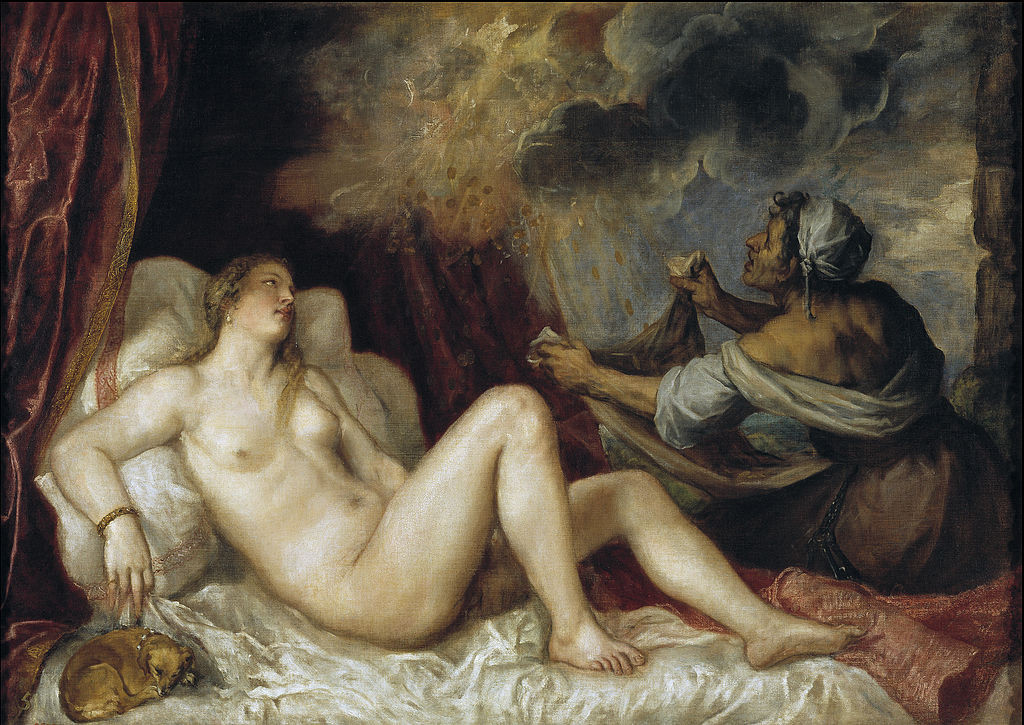
Dánae recibiendo la lluvia de oro
The painting tells how Jupiter takes the daughter of the king of Argos in the form of golden rain. The version Velázquez bought is the more sexual one. In fact, the Dánae of the poesie has a cloth between her thighs. A garment she does without in the Prado's, where she is also painted in ecstasy.
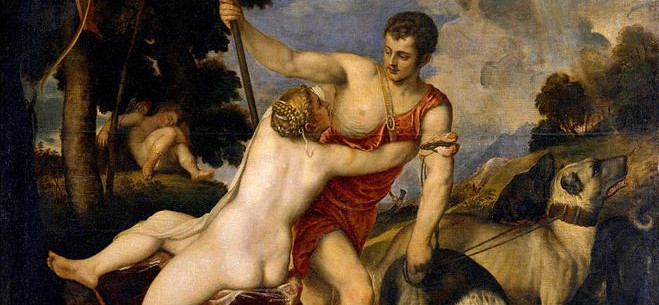
Venus y Adonis
In Venus y Adonis, on the other hand, he deliberately illustrates that longed-for freedom of interpretation. It is an episode that does not exist in Ovid's work: Venus trying to hold Adonis back. He also seeks to put painting on a par with sculpture. The goddess turns her back to show, through a combined view with its companion, Dánae, painted frontally, that canvases can offer several points of view too.



Comments (0)
Log in to leave your comment. Log in