
Romanticism let artists express their inner turmoil through sublime visions of nature. Joseph Mallord William Turner (London, 1775- London, 1851) invented landscapes resolved only in the imagination, becoming a portraitist of sensations.
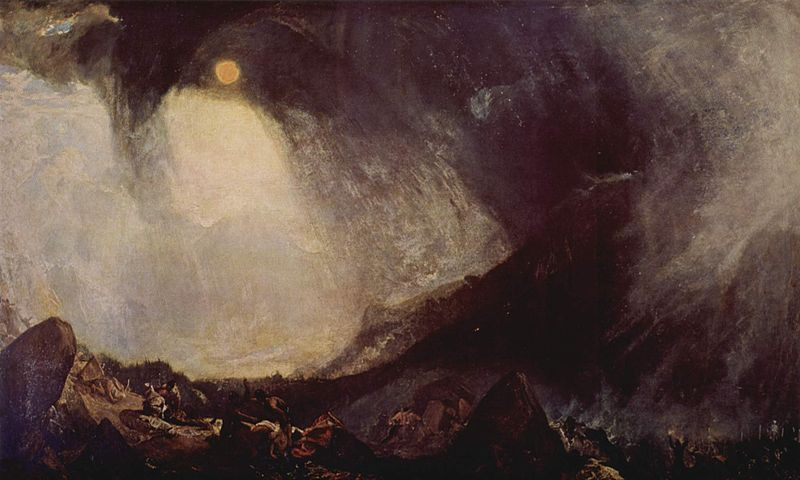
Watching a storm at first hand impressed him so much that he made a detailed study of its components. Two years later he had created Aníbal cruzando los Alpes (1812). On this canvas he builds a whirlwind of lights and darks to reproduce the force unleashed by nature. This would be the starting point towards his genius.
It seems to be the norm that when an artist strays from the norm, his contemporaries diagnose him with some sort of mental decline. That was also the case with William Turner when he proposed landscape as an interpretation of the emotions stirred by the natural elements. Starting from the concept as his foundation and abstraction as his aim, he arrived at Impressionist touches that caught the accidental in ever looser brushstrokes.
The English painter had the unconditional support of his patrons and never had money troubles. So he was always able to paint what he wanted, and the sea was his fascination.
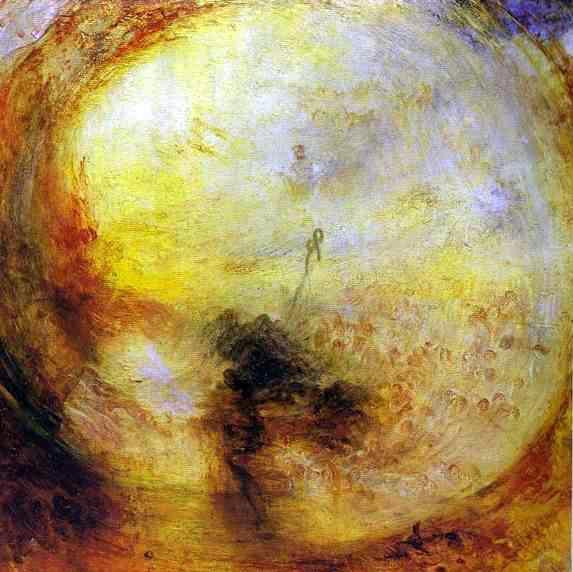
His prodigious technique wore out the possibilities of watercolour to build impossible blurred, vaporous, bodiless atmospheres, a skill he also displayed in oil. Goethe's Theory of Colours (1810) had a powerful influence on his painting, and his analysis of light and colour effects appears, for instance, in Luz y color (1843), where he executes a yellow swirl balanced by overwhelming dark tones. Black was leaving behind its link with the absence of light to become just another colour.
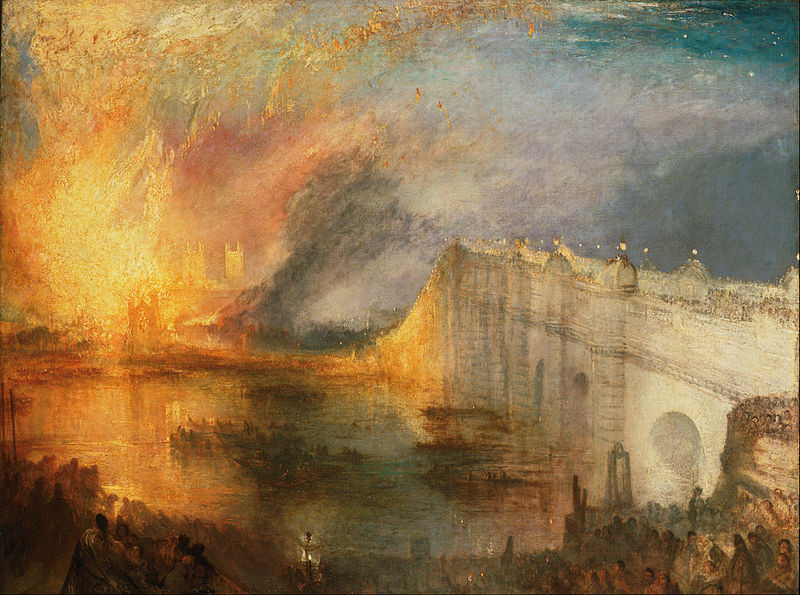
In the same way, Turner used his ingenuity to offer chronicles of his time. That is the case with Incendio en la Cámara de los Lores y los Comunes (1834), in which he portrays the blazing scene of the disaster, focusing on the effects of the fire on the water of the Thames.
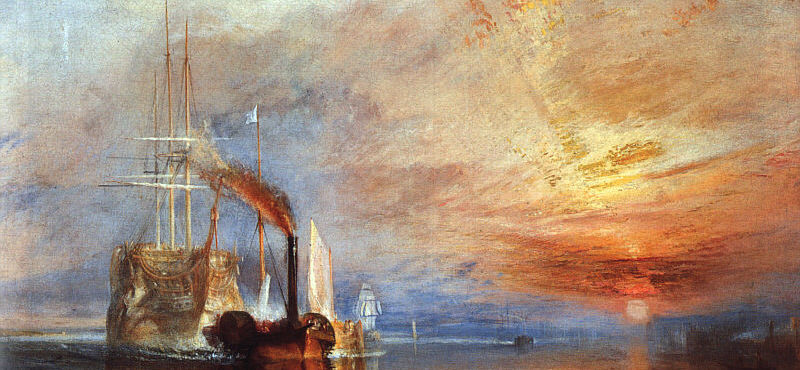
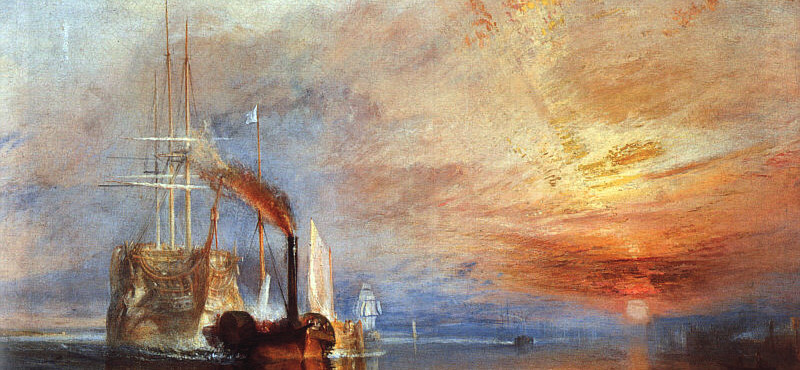
Or with Temerario remolcado a dique seco (1838). In it he records the nostalgic retirement of the glorious warship. Hinted at in the sunset, whose light is reflected placidly on the sea, next to the imposing figures of the ships. The steam engine drags the obsolete vessel towards its abandonment, setting tradition against modernity.
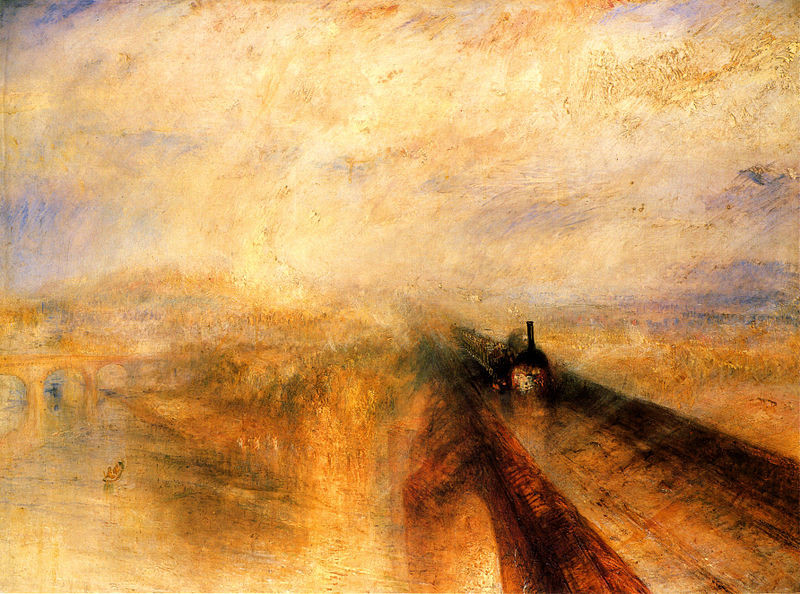
In his most emblematic artwork, Lluvia, vapor y velocidad (1844), he recreates a locomotive in a hazy, thickly painted atmospheric perspective, where light dematerialises the forms and only the straight lines tell us what we are looking at. Turner simulates the speed of the train as if it were moving and about to leave the canvas. He also adds the figurative detail of a boat, giving a dizzying contrast that reaches a disturbing and pleasurable duality. On the left, calm, and on the right, fleetingness.
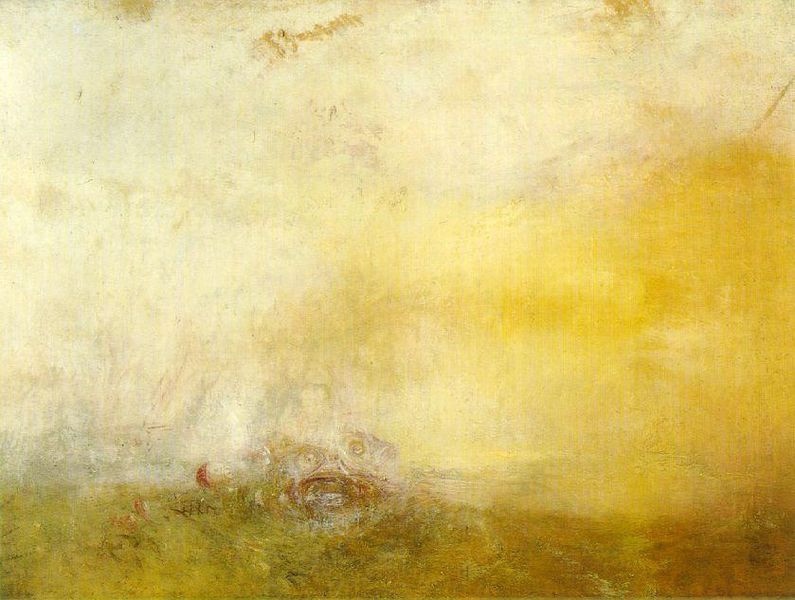
Little by little his brushwork would tend towards dissolution and he would compose artworks that move between the real and the dreamlike, as in Amanecer con monstruos marinos (around 1845), where the setting turns magical. The choppy sea holds the ochre tones of the sky and, in the centre, two grotesque heads emerge. A figurative touch in an almost hallucinated landscape, loaded with ethereal effects achieved through the sensory drive of colour.
Comments (2)
Daniel J Vega
May 28, 2020Daniel J Vega
Erick Valencia
December 1, 2014Arterick
Log in to leave your comment. Log in