
One of the most tedious tasks for many new artists, and for plenty of others with some experience, is putting a value on their artworks.
It's very important to keep in mind at all times that the art market is still a market and that, despite its reputation for being unchanging and the idea that art is a good investment, it's subject to the ups and downs of the global economy, so prices have to adapt to those movements too.
Putting a price on an artistic creation can be complicated, so here are a few valuation methods to make the job easier for anyone who struggles with it.
Artists who have sold artworks
Aquellos artistas que ya hayan vendido alguna obra lo tienen más fácil a la hora de tasar sus piezas, pues ya tienen referencias de ventas anteriores.-They can use those prices to work out a ratio based on size, that is, if you previously sold a 100 x 150 cm canvas for €500 and you're now making a 50 x 75 cm artwork (half the size) with the same materials and a similar subject/style, the price should be around €250 and shouldn't go over €500.
-Artists with some track record should also take their productivity into account, that is, whether they make one artwork a day or one every three months. If an artist can make a lot of artworks and therefore has a considerable supply, they can afford to lower prices much more than those with a longer creative process.
-Diversify your price ranges. To make things accessible to a larger number of collectors and buyers, it's a good idea to make artworks in different sizes and prices, because there may be people interested in a particular artist's style who can't buy an artwork for financial reasons or for lack of space, so they might be interested in buying smaller artworks and, as a result, cheaper ones.
New artists
Los artistas que tasan su obra por primera vez tienen varias opciones a la hora de poner precio a sus piezas:-Comparison. These days it's easy to do a bit of market research to find out what price artists with characteristics similar to yours are selling at, so you can set similar prices.
-Time invested. This is a pretty useful way of calculating the price of your artworks because it makes the process fairly automatic. It involves using a very simple formula that combines the cost of materials and the time invested in making the piece.
Price = cost of materials + (price/hour x hours invested)
So an artwork with €20 in materials and 20 hours of work at €10 an hour will cost €220.
€20 + (20h x €10/h) = €220
-Dimensions. In this case, instead of putting a price on each hour spent making the piece, you put a price on each square centimetre of the artwork's surface. It may not be the right method for a first valuation, but it can be useful once you've sold a few artworks and can use that data to work out your average price per cm2. From that result, as soon as you make a new artwork, that figure plus the measurements of the artwork will let you calculate the price quickly.
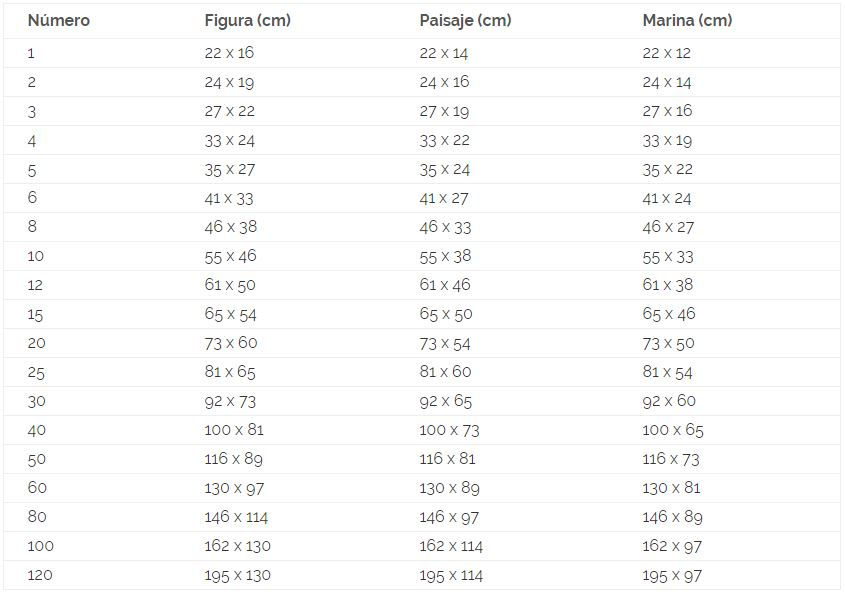
You can also use the table of universal stretcher sizes. One good approach is to assign a price per number. For example, a 55×46 artwork would be number 10. If you decide your price per point (the numbers on the left, matched to the different stretcher sizes) is €30, the value of the artwork would be €300 (€30 x 10). If you work in different formats, it will help you stay consistent across all your prices.






Comments (25)
Rosana Miami
November 1, 2022Pedro
September 7, 2022tasacion de obras de arte
January 14, 2022Theylor
March 27, 2021Coaching Granada
March 14, 2021master perito tasador obras de arte
April 7, 2020Jesús Zarzuela.
March 29, 2019Carmelo González Gutiérrez
June 23, 2016Pero, carda regla tiene alguna que otra ecepción.
Es el caso de obras que por su calidad, porque han sobrepasado las espectaivas y logros que el artista esperaba conseguir, a pesar de estar hechas en un tamaño pequeño, deben ser valoradas por su genialidad y no por su formato. De esto hay miles de ejemplos en la historia de la pintura y de esto debe darse cuenta el artista y el público. Claro que es mas honestamente entendido cuando se trata de un autor que haya trabajado décadas y la experiencia de su trabajo, le enseñe a saber dicernir cual obra es de este tipo prácticamente irrepetible y por lo tanto mas valiosa aunque no corresponda a las reglas generales de apreciación.
Rezthu
November 12, 2015Claudia Torres
June 1, 2015Log in to leave your comment. Log in