
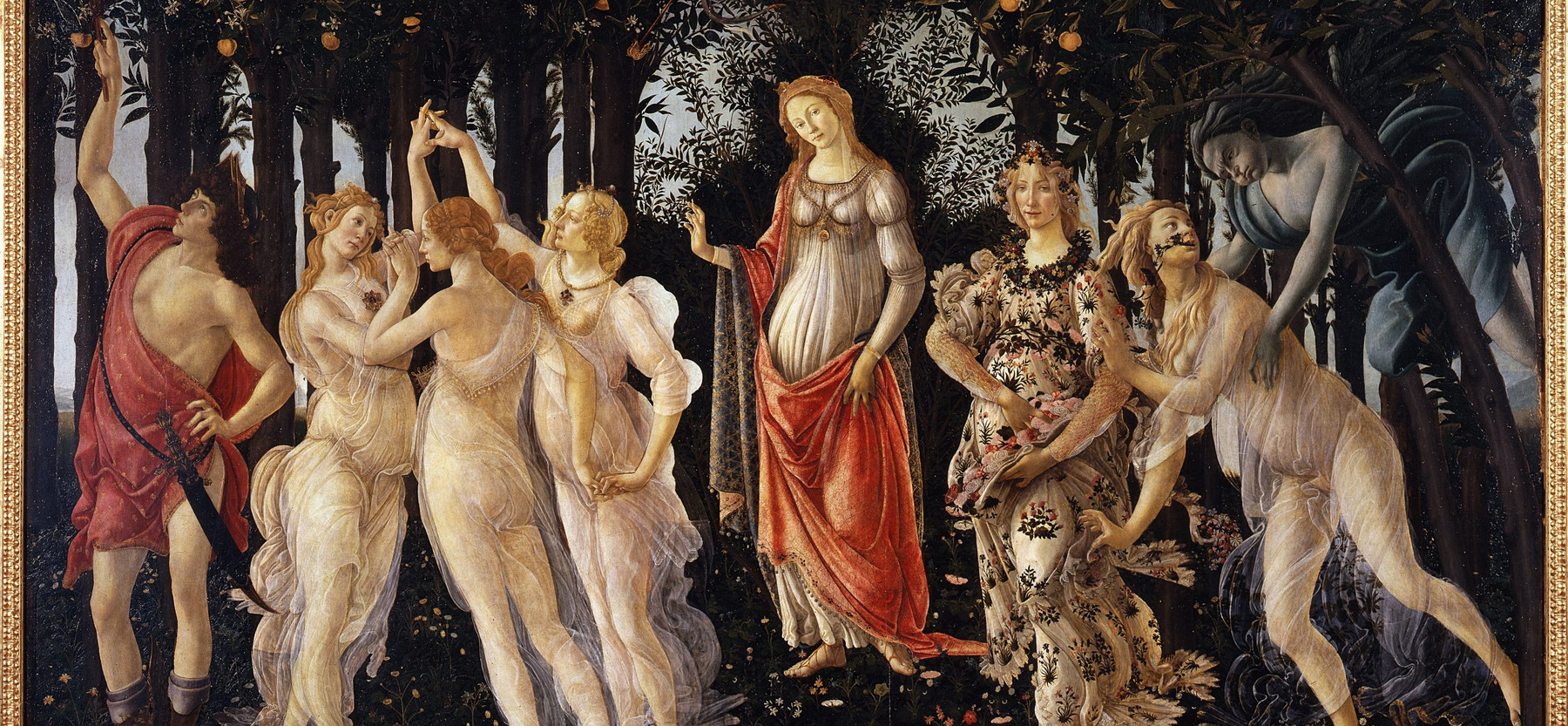
Every day hundreds of people walk past Botticelli's La Primavera in the Uffizi Gallery, admiring its beauty and sighing at its mystery. Because La Primavera is wonderfully beautiful… and enigmatic. We've spent five centuries trying to get at the story behind the painting and we've barely moved an inch. After all, this enormous canvas by the Florentine genius is the quintessence of the Renaissance: a double-edged art that pricks both soul and brain, that delights our aesthetic sense and switches on our intuition.
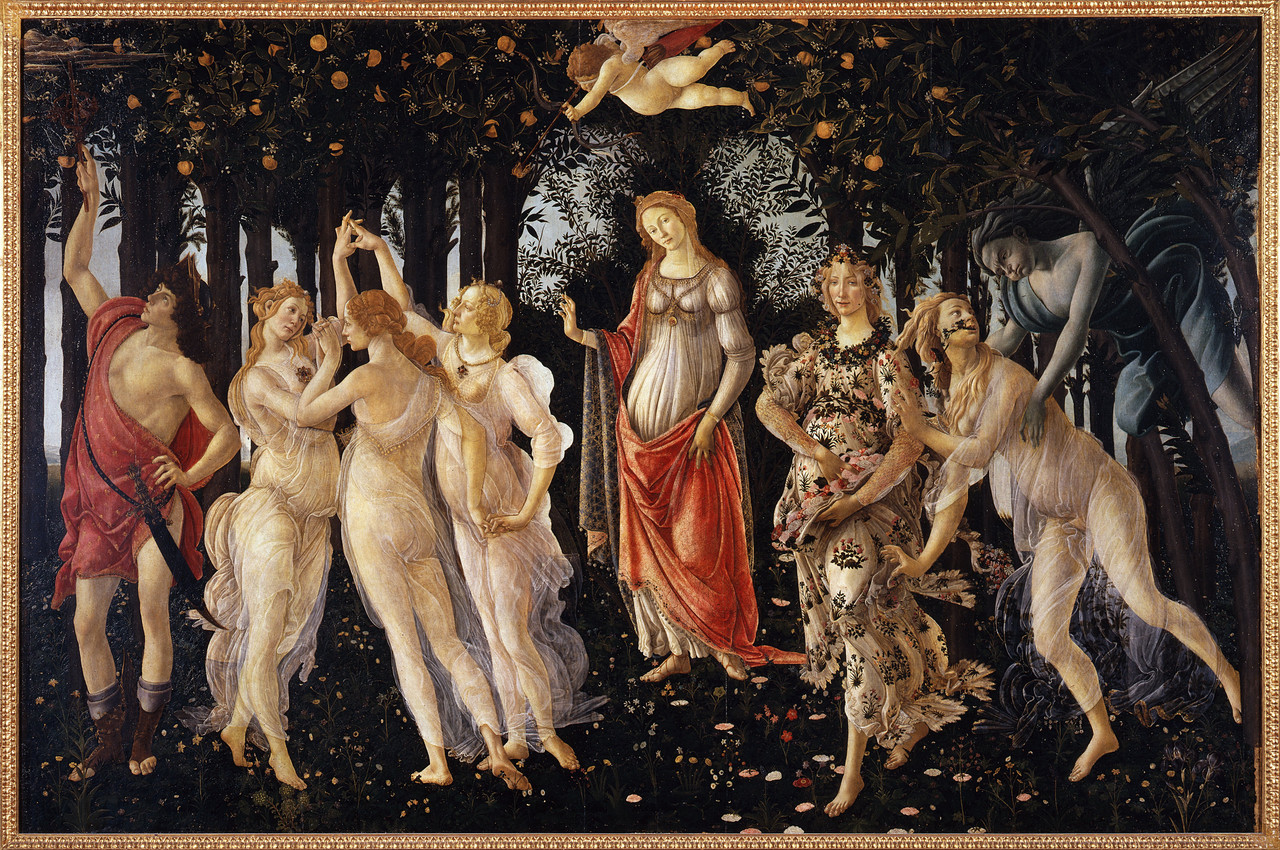
Botanists say that in La Primavera there are as many as 190 different kinds of flowers and plants, all of them chosen from among those that grow in the Tuscan countryside in spring. If Sandro Botticelli (1445 - 1510) wastes that much time taking note of hundreds of flowers to create a fitting and precise setting for his artwork, one can imagine that the story told by the nine (eight) figures in the painting isn't just a tribute to spring. It's something more.
Let's set the scene. The Florentine elite is reaching a degree of intellectualism that verges on mental disorder. The court of Lorenzo the Magnificent lives amid artistic arguments, heated philosophical debates, metaphysical fervour and the occasional frenzied party… Catholic commitment is mixed with the neoplatonic fever that sought to lead its initiates into a virtuous ecstasy. On those foundations stands the ivory tower in which Botticelli developed his art, one of the forerunners of the philosophical renewal of painting thanks to his contacts with Marsilio Ficino, the neoplatonic guru of the day.
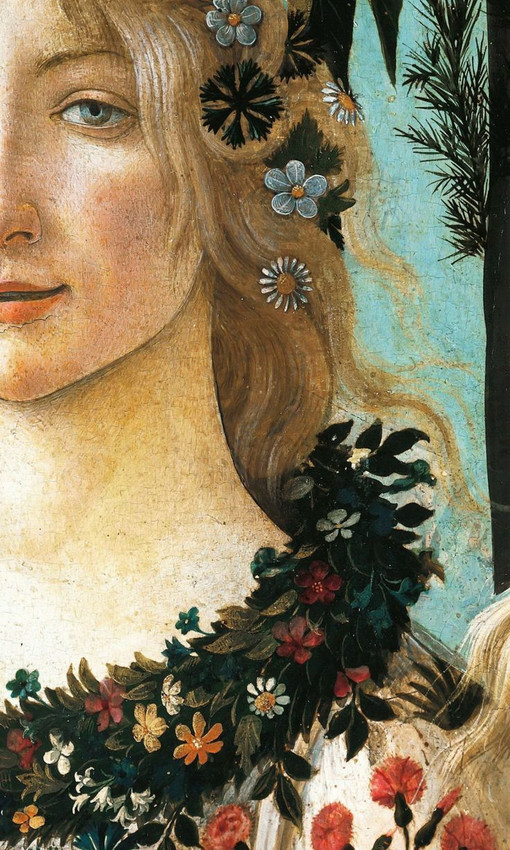
And so we come to La Primavera. This artwork combines a singular technique that even breaks with some of the classical tenets of the Quattrocento with a philosophical and allegorical depth that turns the artwork into an interpretative puzzle. There are 9 figures that are really 8, because one is repeated: from right to left, Zephyrus, the wind that brings the spring, holds Chloris, a nymph who is transformed into Flora. In the centre is Venus and above her Cupid, firing his arrow at one of the Three Graces. And at the far left (isolated, in a world of his own) Mercury, the most singular figure in the painting.
The surface iconography is clear. The painting is read from right to left. Zephyrus carries Chloris off by force but, after repenting and marrying her, gives her a garden that will bloom forever, and she becomes Flora, the Spring. Venus is the centre of the painting, the mistress of ceremonies who invites us into the Garden of Eden. The Three Graces, for some charm, beauty and fertility, for others chastity, pleasure and voluptuousness, dance while Cupid takes aim at one of them, who turns her eyes towards Mercury, falling under the spell of the master of wisdom and mystery.
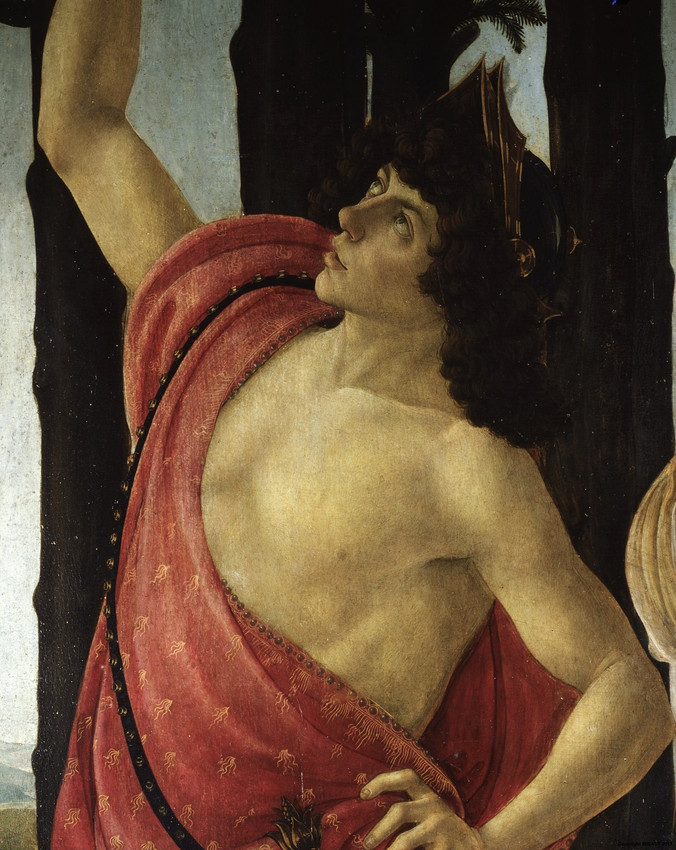
The classic reading of the painting, and probably the most accurate one, is the one that links its background to neoplatonic philosophy, marked by a fervent search for moral virtue and a defence of love (platonic love, not voluptuous, not carnal) as the driving force of the universe. La Primavera would therefore represent the cycle of platonic love, from the earthly love embodied by Zephyrus to the celestial love embodied by Mercury. And an intellectual cycle too, running from sexual urge to supreme understanding.
But La Primavera could also contain anything from political symbols to specific references to figures of the time, and it has been suggested that it may have been a wedding gift in which some of the figures, Mercury among them, stand for the couple being married. Art historians, along these lines, consider that La Primavera forms an iconographic pair with the hugely famous Nacimiento de Venus, the latter being the ecstasy of supreme truth, of the pure beauty embodied by the naked Venus.
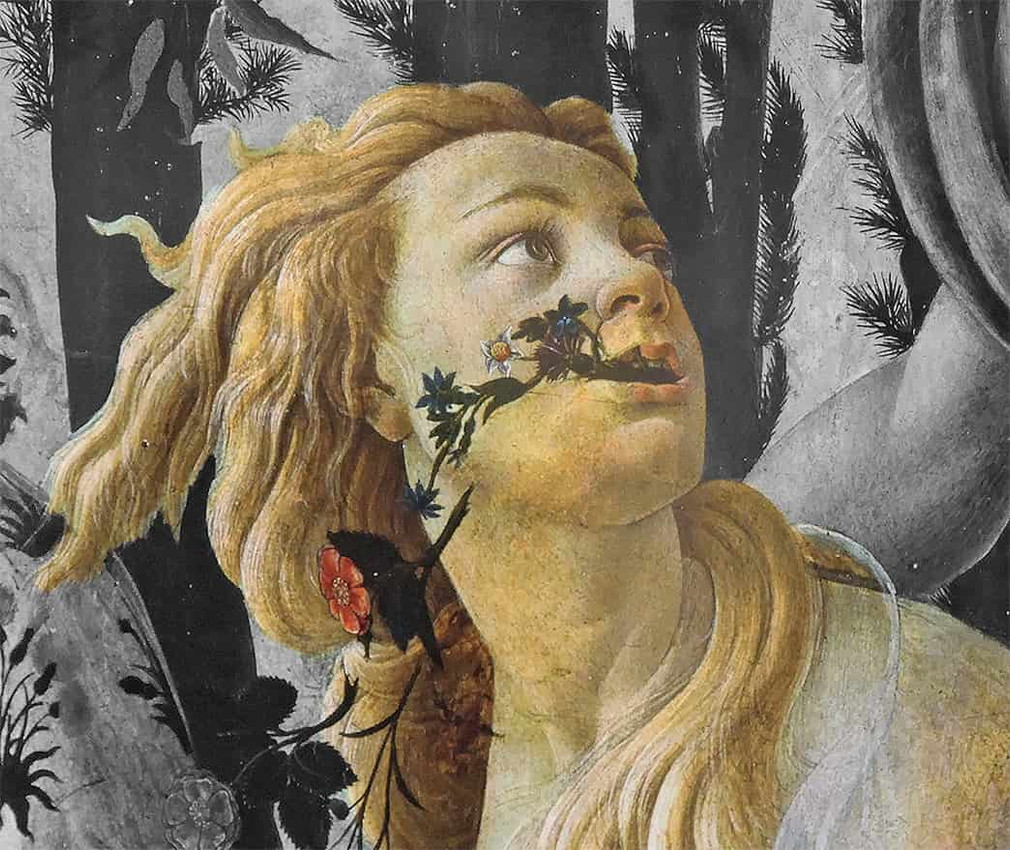
Botticelli, less interested than most of his contemporaries in capturing perspective (this painting is a tableau vivant with every figure in the foreground and hardly any background), produced with La Primavera one of his timeless artworks, full of beauty and full of mystery: a landmark in painting that we still enjoy... baffled.


Comments (0)
Log in to leave your comment. Log in