
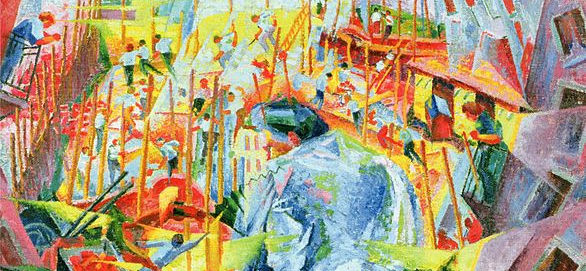
On 20 February 1909, the Paris paper Le Figaro published a text steeped in revolutionary overtones. It called for a reconstruction of the world based on the primacy of violence, speed and machines. The poet Filippo Tommaso Marinetti was the one who signed it, and the text went down in history as the Manifesto of Futurism.
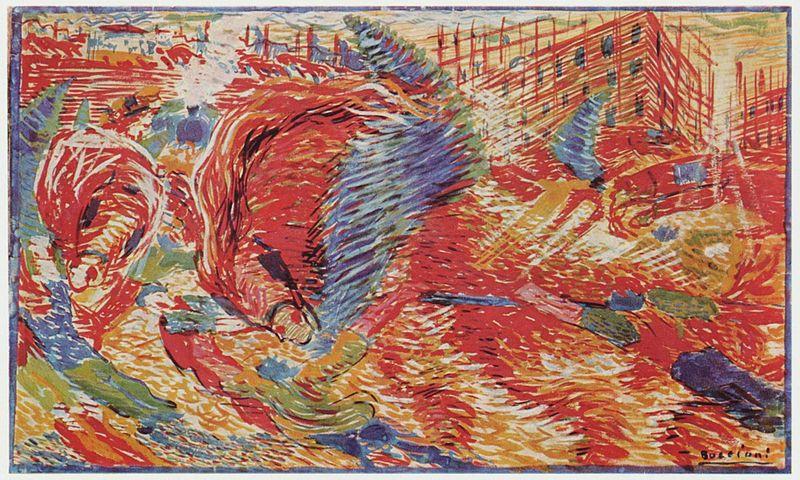
Numerous painters, sculptors and architects, as well as poets, musicians and other artists from the worlds of theatre, photography, advertising and design signed up, reaching 2,000 supporters almost on the spot. These were the years leading up to the First World War, and Europe was breeding artistic currents fed by a hunger for rupture never felt before. The idea was to raze the past without leaving any recognisable trace. In the case of futurism, on top of that, it had to be a sweeping assault driven by machines and movement, its two great obsessions.
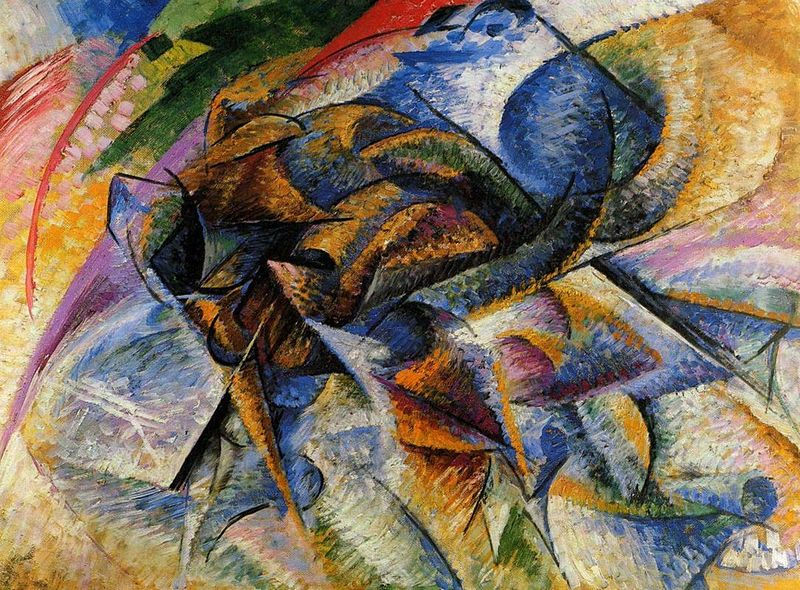
The futurists applied the neo-impressionist treatment of colour and cubist procedures to capture that movement. As for machines, in them they found the perfect aesthetic, just as they did in the city, both symbols of the modernity, agitation and speed they longed for.
Born in and closely tied to Italy, futurism was, of all the new currents that emerged at the beginning of the 20th century, the one most chained to a political purpose. In fact, many of its members, like its founder Marinetti, sympathised with fascism and glorified the War. With which, paradoxically, its decline coincided. Most of them ended up dead at the front, tainted by the fascist regime or handing their creativity over to advertising.
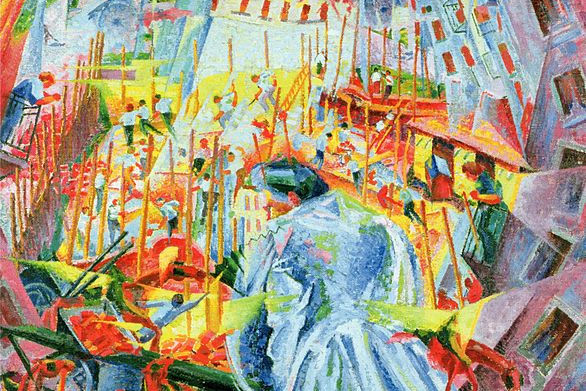
In the visual arts, one of the weightiest figures was Umberto Boccioni (Reggio di Calabria, 1882 - Sorte di Verona, 1916), both for his artworks and for his theoretical writings. Together with Giacomo Balla, Carlo Carrà, Luigi Russolo and Gino Severini, other essential pieces in the group's machinery, he drew up several manifestos that were key to futurist thinking in painting. In line with what Marinetti had set out, they criticised traditional art and demanded that painting take in the dynamism of the times they were living in. Their first exhibition as a group was held in Milan in 1911.
Boccioni also developed, in his own way, concepts crucial to futurism, such as force-lines, simultaneity, affinity of planes and the dispersal of bodies across the surface. Notions that sought an interrelation between matter and its surroundings. To that end, he said he conceived the object from within, so as to make its force emerge. A different poetics.
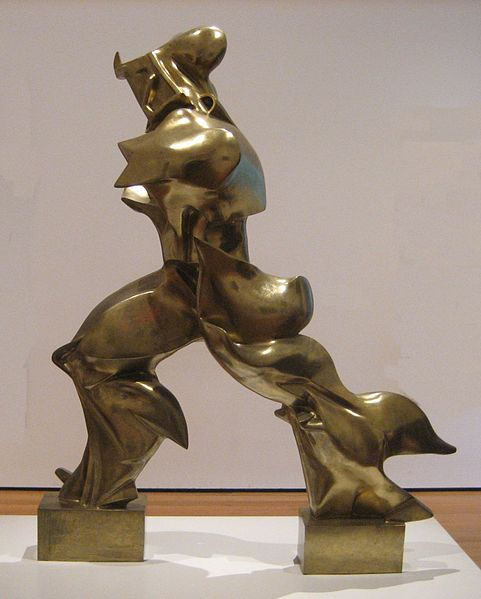
He took these aspects, in practice and in theory, into sculpture, a field in which he left few artworks, but ones of decisive importance. Because his restlessness about the dynamism of form and his rejection of solid mass place him among the most relevant figures in the contemporary transformation of sculpture. He was also a pioneer in working with new materials, such as glass, cement, iron, leather, mirrors or light, in the manner of a collage.
He was one of those who died at the front. It happened on 16 August 1916, after he fell from a horse. The group lost one of its leaders and everything that came afterwards was less about creating than about holding out.
Comments (0)
Log in to leave your comment. Log in