
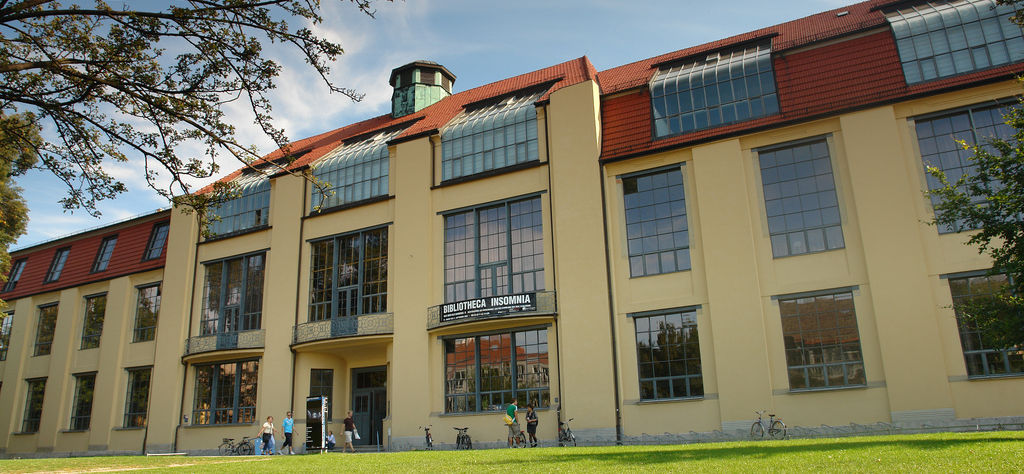
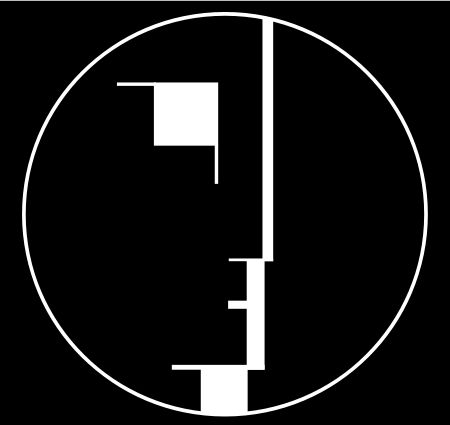
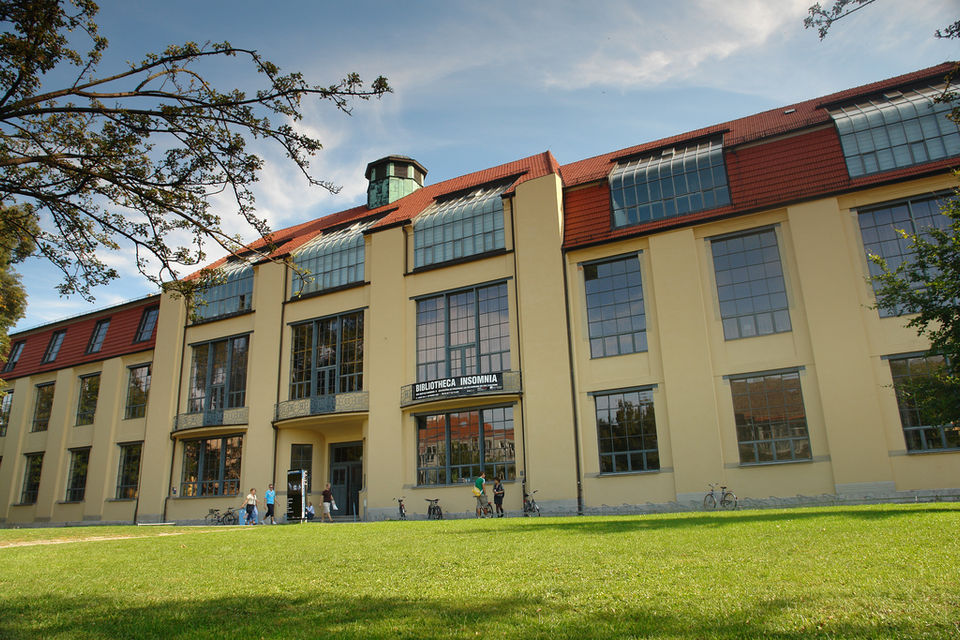
The Bauhaus academy, founded in 1919 by Walter Gropius and active until 1933, the year it was shut down by the German political machinery of the time, is a major point of reference in the methodology of studying Fine Arts, to the point that the paradigmatic echo of many of its principles still reaches us today.
Let's bear in mind that the Bauhaus school laid the foundations of a new conception of artistic teaching, and not only in architecture, a field on which it would end up having a decisive influence, but in every form of artistic expression.
To understand the emergence of this new school and the declaration of intent in its manifesto, we would have to place ourselves in the historical context of the early 20th century, a time when industrialisation, above all in England and Germany, had taken such hold that every trade was affected by the application and use of machinery and assembly line production.
As a reaction to this new way of looking at reality, to this alienation of the process of creation, if we may put it that way, Gropius set out to create a school from which would flow a current of art with a purpose, art with an end beyond the harmlessness of art for art's sake.
To get a better sense of his intentions, let's look at some of the phrasing of the Bauhaus manifesto: "The old schools of Fine Arts must become workshops again. This world of designers and decorators who only draw and paint must become once more a world of people who build", as Gropius himself put it, perhaps affected by that production system limited to making copy after copy of the same model. In short, for Gropius "there is no art as a profession.
There is no essential difference between the artist and the craftsman", since the former would be nothing more than a refinement of the latter. It's worth remembering here that the name Bauhaus itself comes from the two German words Bau (building) and Haus (house), which fits with the central thesis of using the arts to erect that common space at the service of useful things.
What was new in Gropius was, as we say, subordinating the school to a goal: the collectively raised building, to which every trade had to contribute. Artists would be craftsmen, and the fruits of their work could not amount to a mere product with purely aesthetic aims, they had to beautify, attract or bring harmony to necessary tools and spaces.
Although the Bauhaus School had three different homes over its fourteen years of existence (Weimar, Dessau and Berlin), and Hannes Meyer and Ludwig Mies van der Rohe replaced Gropius as director after 1927, the Weimar period with its founder at the head is probably the most important one for its creation and its taking root. Instead of the traditional professors, training was led by masters.
The students were called apprentices and could rise to journeymen and young masters. A Council of Masters decided at each turn and had the right to appoint new masters. A master of form and a master of craft had to train the students at the same time. In this way, according to Gropius, "the wall of arrogance standing between artists and craftsmen would fall" and "the new building of the future" could rise.
The Bauhaus's purpose was to offer a course of training with social consequences. Inside the academy everyone considered themselves artists who, either as craftsmen or as educators, wanted to contribute to the "cathedral of the future". This utopian idea of the cathedral as the highest of aspirations did not, however, prevent small commissions for furniture, metal objects, tapestries or wall decoration from being accepted and carried out. It would be in that wide margin, between the majestic and the mundane, that the school's significance and merit would be built.
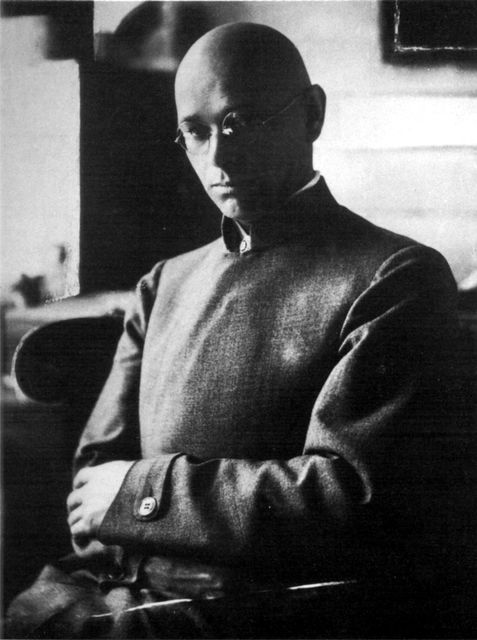
Gropius's first step was to look for relevant, outstanding personalities as teaching staff "even if they weren't easy to understand". As a result, the Council of Masters came to have guests of the stature of Paul Klee and Oscar Schlemmer. Still, the one who exerted the greatest influence was, without a shadow of a doubt, the painter Johannes Itten.
Since he is the one who developed the preliminary course and the heart of all the Bauhaus's later teaching, it's worth pausing on some of the details of his working method. At the risk of falling into the error of simplification, we could sum up his teaching principle by describing it as the pairing of the opposites "intuition and method", or in other words, the attempt to harmonise "the capacity for subjective experience and the capacity for objective recognition".
His classes often began with movement and breathing exercises. Students were required to relax, because only then could Itten achieve "direction and order in the flow". Class hours were structured around three central points: sketches from nature and materials, the analysis of the old masters and the life drawing class.
It's a fact that the idea of basic colours and forms played an important part at the Bauhaus in the years that followed. Paul Klee, who had sat in on one of Itten's classes, took up those ideas in his own teaching, and for Kandinsky, who back in 1912 had already written his thoughts on the matter in Concerning the Spiritual in Art, these forms would be a major concern within his teaching.
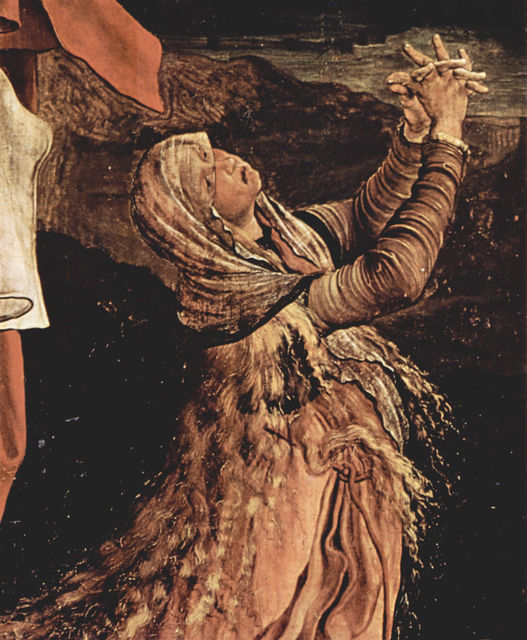
One of the anecdotes tells that Itten had a fondness for showing his students the Mary Magdalene of the Grünewald altarpiece so that they would attempt a reproduction of it. They would work hard at freeing the essential from the complication. Itten frequently examined their attempts and, on one occasion, he ended up shouting: "If you had the slightest artistic sensibility, instead of setting about drawing in front of this sublime depiction of weeping, which could well be the weeping of the world, you would stay seated and burst into tears". The master delivered these words with considerable anger and then slammed the door. What Itten was after, first and foremost, was for his students to have a deep experience of the artwork.
In the traditional classes of conservative academies and schools of arts and crafts, during the first year students only had to copy objects, such as plaster figures, ornaments, nudes. As a result, they acquired most of their skills by copying. Itten, by contrast, taught laws of colour and form, of composition and configuration. What was exciting about that then novel educational system came from its reformed teaching and from the avant-garde artists. The learning Itten developed sought to reach the inside of the person: students had to find their own rhythm and develop a harmonious personality. His students respected him deeply as a master.
For his course Analysis of the old masters, Itten mainly chose paintings from the Middle Ages, such as the Isenheim Altarpiece, the work of Mathias Grünewald and one of the masterpieces of German medieval painting. In the exercise, students had to experience the tragic depiction and translate it into their analysis. In 1921, Itten wrote about the analyses: "Don't be discouraged if your copy doesn't reproduce the original. The more alive the experience of the painting is in you, the more perfect your reproduction will also be, and it is the exact measure of the intensity of your experience. You live the artwork, and it is born again in you".
Comments (0)
Log in to leave your comment. Log in