
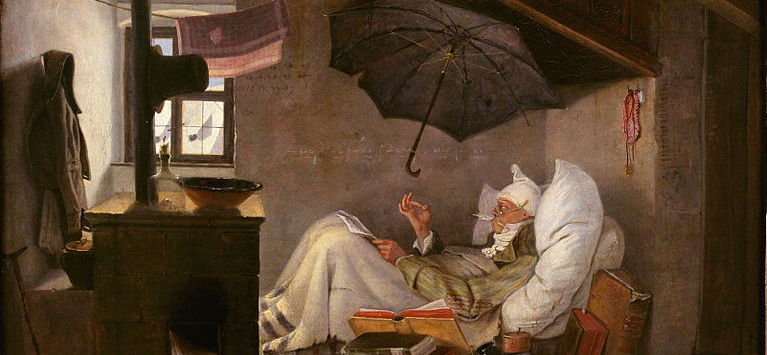
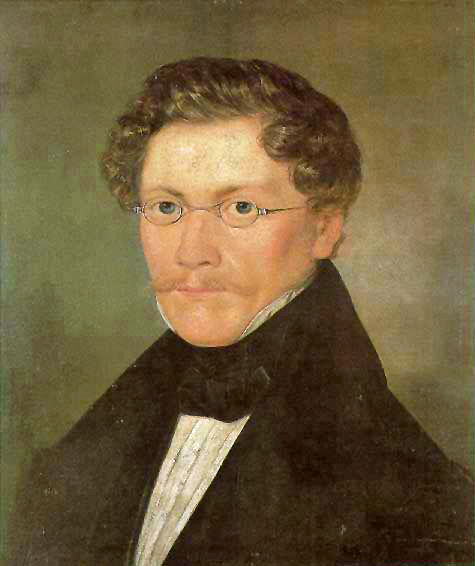
Spitzweg was born in Munich in 1808 and became a pharmacist because his father demanded it. When his father died he gave up his work in pharmacy and devoted himself to painting. The artist liked living above the city, and in 1833 he moved into an attic in Munich's old quarter. The happiness the painter got from the sight of snow-covered roofs is reflected in several of his artworks.
Thematically speaking, Spitzweg (Munich, 1808- 1885) belonged to the Biedermeier period, which in Germany runs from 1815 to 1848 and is marked by the restoration of a feudal regime in which citizens once again became subjects of the crown. Although later on the term Biedermeier ended up becoming a synonym for simplicity, for the cult of the family, for domestic comfort. The artist did a great deal to turn everyday objects of his time, such as top hats, umbrellas or walking sticks, into real symbols of his era.
Spitzweg's output as a whole is largely characterised by the sarcasm of his paintings. Let's remember that he started out doing drawings for satirical magazines and that most of his mature pieces are humorous, eccentric portraits. One of the best known examples of parody mixed at the same time with drama is one of his most famous paintings, El poeta pobre (1839), where caricature gives way to the depiction of the misery of a poet who cannot live off his talent and takes refuge in his inner life, withdrawing from society. The contrast between the character's intellectual stature and his situation bear witness to the grotesque and the ironic.
El poeta pobre is one of the paintings that recurs most in the German collective imagination. One of the favourites whenever surveys are taken on the matter. The small size of the painting, along with its huge popularity, even among people with no interest in art, has made it a coveted object for those with a fondness for other people's property. Since it was created in 1839 the artwork has been stolen and recovered on several occasions, as have various other pictures by Spitzweg. Today one of the three copies of El poeta pobre hangs in the Alte Nationalgalerie in Berlin.
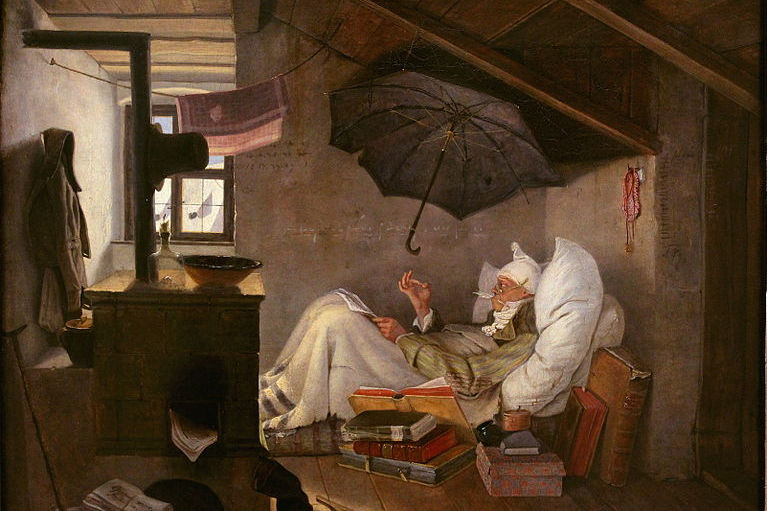
The composition of the artwork is linear. All the objects appear in order without adding any excessive sense of depth. The absence of furniture makes us think the poet has been forced to break it up and feed it to a stove that now holds nothing but manuscripts of the poet's own work, and they don't seem to be enough to keep it going. The sense of cold and poverty contrasts with the poet lost in thought, counting verses.
Another of the readings, based on an inscription on one of the surviving sketches for the painting where the words weg floh (away with the flea) appear, is that the poet might be squashing a flea between his fingers. Although the hexameter formula the poet has jotted down on the wall makes it just as easy, or easier, to read it as a way of keeping count.
Among the Romantics of the time, the kind of learning passed on through the big volumes lying at the foot of the mattress was frowned upon, and greater naturalness was what people were after. Hence a good part of the painting can also be explained as another form of satire confused with idyll. Perhaps the painting is so well liked because it gives us that feeling of protection, under the umbrella, of not having to face reality, of being able to take shelter, curled up comfortably inside the fantasies and stories that carry us away and populate our states of mind.

Comments (1)
Peter Vareschi
September 3, 2015Log in to leave your comment. Log in