
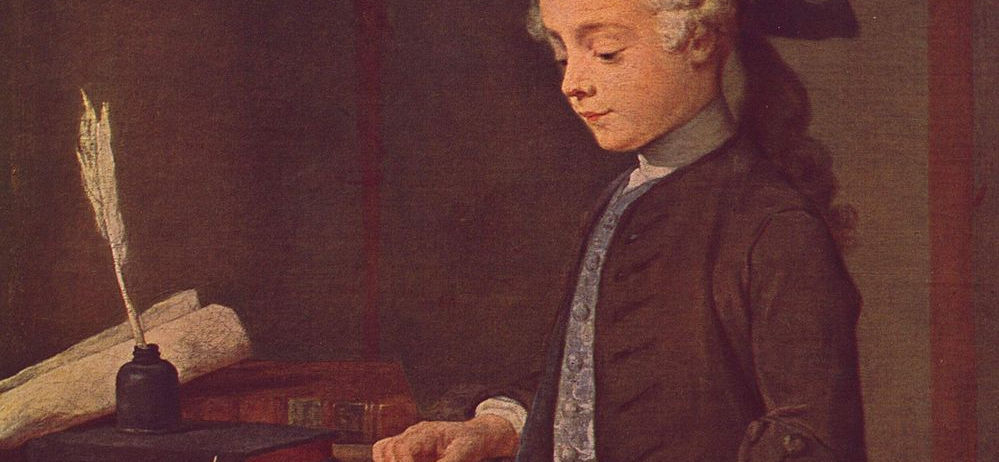
At a moment in history (1730-1760) when the Rococo movement, with its taste for the exotic, the refined and the sensual, ruled the French art scene, fate chose to place, in that free and rebellious counterpoint that exceptions always offer, one of the most celebrated painters of everyday life of the whole 18th century. Jean Siméon Chardin (1699-1779) was born and died in Paris, a city he barely left in all his life. His training as a craftsman would leave its mark of hard work and care on all of his artwork. Artwork that is scarce but painstaking, reworked over and over, reaching for the limits of perfection.
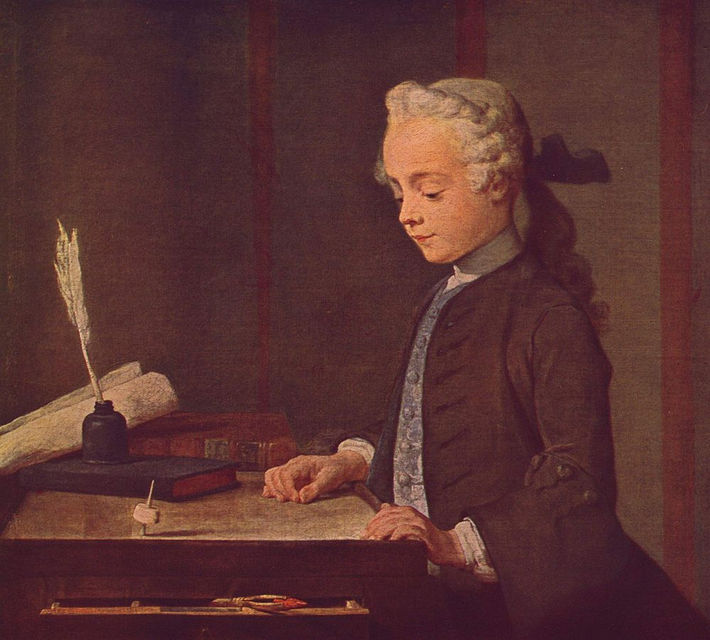
As for the slow, meticulous nature of his artistic work, Chardin himself wrote: "I take my time. I have grown used to not parting with my artworks until my eyes tell me that they need nothing more". France's historical situation, in a period of peace in which the growth of colonial and overseas trade turned craftsmen into businessmen and flooded the upper classes with luxury and display, encouraged an artistic current in which painters such as Antoine Watteau and Fragonard, among others, set out to show the grandiloquence and magnificence of palace halls and terraces, along with the pomp filling the wardrobes of the people who frequented them. In this context, Chardin would become an alternative to the current.
While it is true that, at the start of his career, his subject matter was not far from these motifs, there seems to be a turning point at which the painter took a marked new direction in his concerns. There is an anecdote about him pausing before a dead hare, a sight that would radically change his conception of art. It made him abandon affected, artificial settings to look for a plainer beauty, perhaps a more sincere one, among the banality of daily scenes and the presence of the most ordinary objects. His artworks therefore move away from any instructive or moralizing intent, carrying us with their "faithfulness" towards the natural quality of realities.
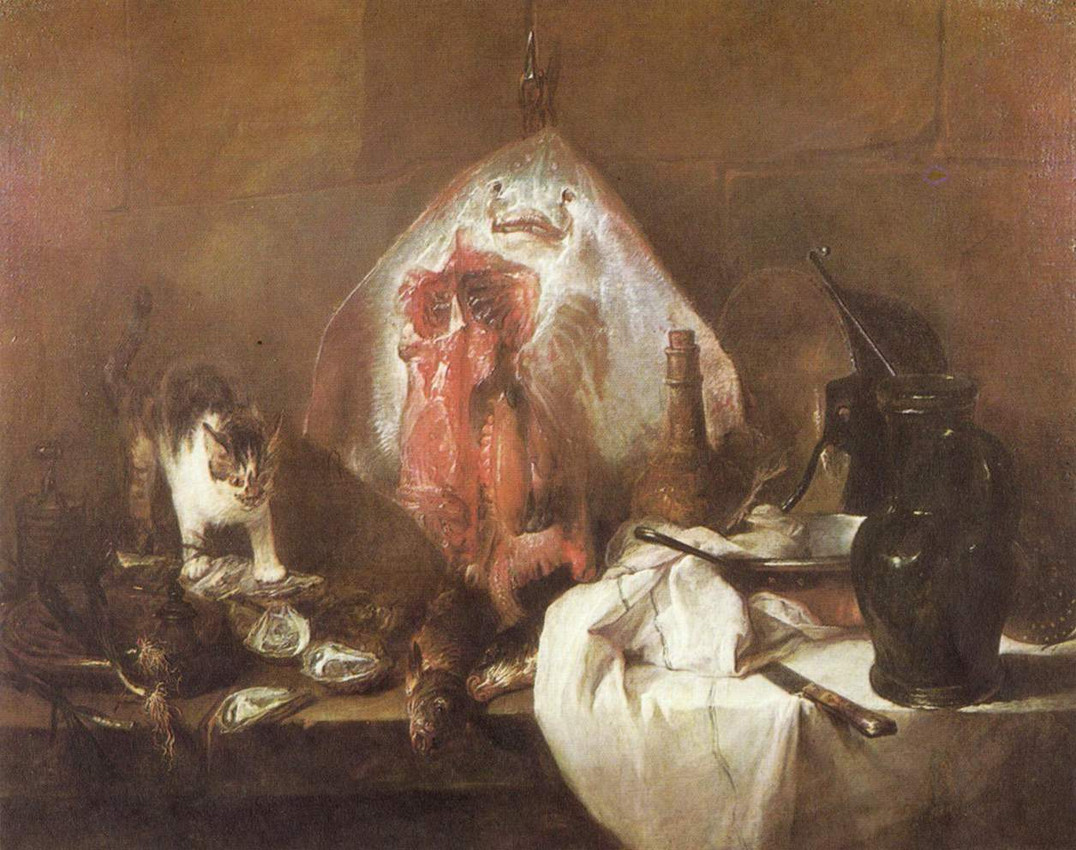
In 1728 the painter joined the Royal Academy of Painting and Sculpture within a minor category, that of "painter of animals and fruit". The subject of nature would be a constant throughout his career. His skill in this area led Chardin to become one of the great masters of the still life. As examples, Bodegón con gato y raya (1728) or Bodegón con cántaro y caldero de cobre (1728). In the latter we can see the mastery with which Chardin manages to render the textures of the wooden mortar, the glazed clay of the utensils or the copper of the cauldron, and all of it with a loose brushstroke. The contrasts of light, worked out through chiaroscuro effects and composition, are an essential part of the appeal of his paintings.
Although Chardin guarded his technique jealously, we know that he began by laying in the dark areas, then superimposed the half tones and finished by spreading the light colours, which he distributed across the whole painting. His brushwork shows a repeated return over what had already been painted, retouching and correcting again and again, until he achieved harmony and balance. His concern for lights and shadows is equal, and his brushstroke is small and fluid, with sudden changes of direction that give volume to the forms.
Around 1730 he changed course again, prompted by the greater demand for portraits on the art market, and focused on depicting everyday scenes, from which he would draw, like few others, the intimacy of their silences. His genre scenes also stand out, La pequeña maestra (1740) or La niña del volante (1741). His figures rarely look at the viewer and his artworks achieve a calm, innocent restraint that avoids detail, conveying the fleetingness of the moment.
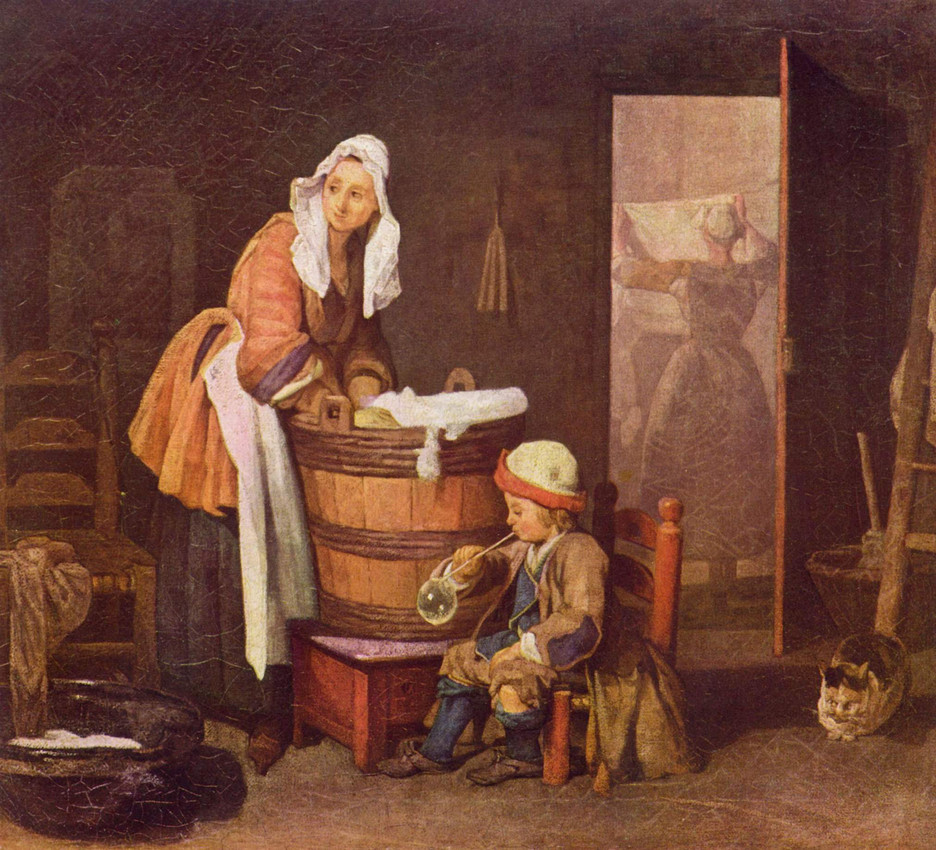
In his painting La Lavandera (1735) we can see how perfectly familiar the painter was with the objects he depicts, in the rush-seated chair as much as in the glazed earthenware vessels, and in the stool holding the tub, where his signature is hidden. In the whole we can observe the technique already mentioned of superimposing the light colours last, and we see how the white garments stand out against the darkness of the washhouse scene. White was a symbol of neatness and purity among the aristocracy and the bourgeoisie of the time, who had an almost obsessive interest in the cleanliness of their clothes. The work of laundresses was very hard before the arrival of soap, and they were forced to whiten with ashes that ended up seriously damaging their hands. That is not the case with the laundress in this scene. We know that she already uses soap, since the boy in the patched jacket and the worn-out stockings appears lost in himself blowing bubbles with it.
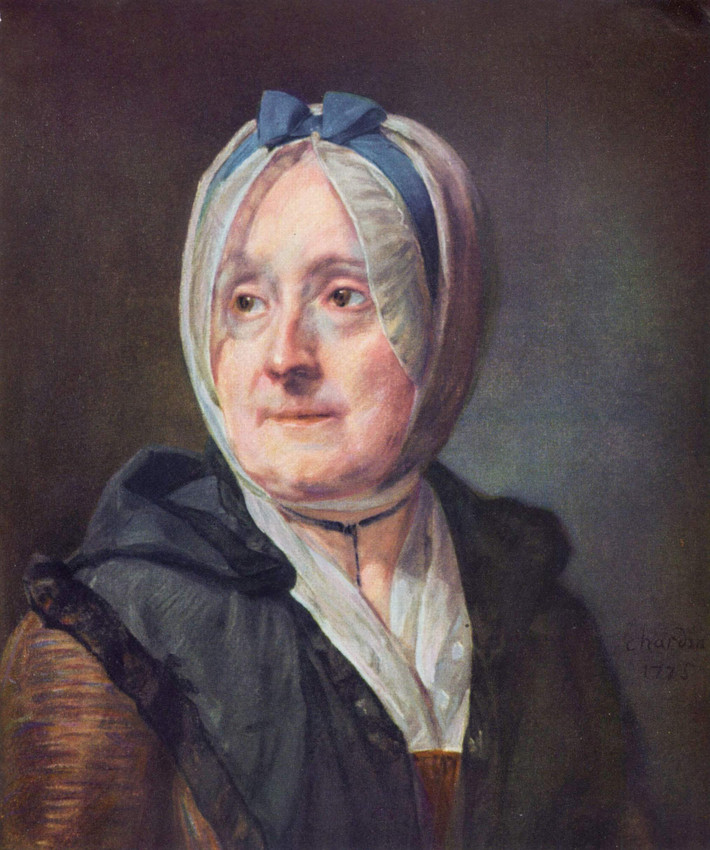
Children and women are the real protagonists of Chardin's scenes. Boys playing with a spinning top or building houses of cards. Women going about their usual chores. All of them engrossed and absorbed in their small occupations. Frozen in the stillness and the silence of forgetting that time passes. The aggressive technique used to bind oils at the time, in which lead was very commonly used, gave Chardin an amaurosis that came to paralyse his eyelids and left him almost entirely without sight. For this reason the painter had to switch his style to the pastel technique during his last working years. Among his final artworks his Retrato de Madame Chardin (1775) stands out
Denis Diderot, one of the leading figures of the French Enlightenment and also an expert in artistic matters, was a great admirer of Chardin's artwork. He singled out the calm and quiet that his scenes convey. On one occasion he confessed to the painter the delight he took in watching "how the light vibrates around the objects" within his compositions. His artwork has been a reference for artists such as Manet, Cézanne and Morandi. And also for many contemporary artists.

Comments (0)
Log in to leave your comment. Log in