
There are no reliable portraits, no letters, no diary, not even his sketches. All that is left to us of the French painter Georges de La Tour is some thirty artworks that for more than two centuries were relegated to second-rate museums and private collections under mistaken attributions. Since the first things of his to be rediscovered were a few nocturnal, pious scenes of saints lit by a candle, the painter's image was idealised in the collective imagination into a sort of ascetic or mystical figure who, as we shall see, bore no resemblance to his real self.
As parish records and deeds attest, de La Tour lived in Lorraine, a region on the border between France and Germany. A place particularly hard hit during the first half of the 17th century, the period in which the painter lived, by all manner of hardship, famine and epidemics stemming largely from what we know historically as the Thirty Years' War. It is safe to assume this was no easy place to make one's way for anyone born into a family without means, as was the case for the vast majority.
Later research on the painter has, in this respect, turned up facts that clash sharply with that first impression we mentioned, the one drawn from an analysis of his early paintings. Today we know, for example, that de La Tour made considerable sums of money from the timber trade and from speculating on grain in periods when hunger was biting hardest. We also know that his fellow townspeople did not hold him in high regard, since they reported him for behaving as though he were lord of the area and for trampling and destroying crops and sown fields as he pleased, along with the large number of dogs he kept. To this we could add a few episodes of violence, such as an assault on a member of the guard, or the one committed in 1652, shortly before his death, on a peasant he accused of having damaged his property. Georges de La Tour was far from being a man of renunciations.
Let us understand, on the other hand, that drunkenness, lust and games of chance were among the most prized amusements of 17th-century men. And to this day it cannot be said that things have changed all that much. Let us go on. For de La Tour's contemporaries, gambling was almost as important as drink. Not just adults, children too spent a great deal of time at it. Gambling helped them forget for a while the harshness of daily life in a reality full of wars and epidemics. To look no further, soldiers always carried dice and playing cards with them. In the same way, gambling helped break the monotony of those people, a good part of the population, who lived out their existence within the narrow circles of rural villages.
Even though King Henry IV insisted again and again on banning gambling by decree, it was tacitly tolerated, to the point that at the beginning of the 17th century there were 43 betting houses in Paris, and those were only the ones known about. There is also testimony that it was the monarch himself who, in a display of consistency, spent whole nights gambling large amounts of money at cards and dice. The fact is that piety and gambling were not in the least mutually exclusive. On this subject Caillère, a strict marshal, wrote in his Consejos para jóvenes nobles in 1661 that "a man of the world" both did and should take part in gambling, because there was no more accessible way in "to the best circles".
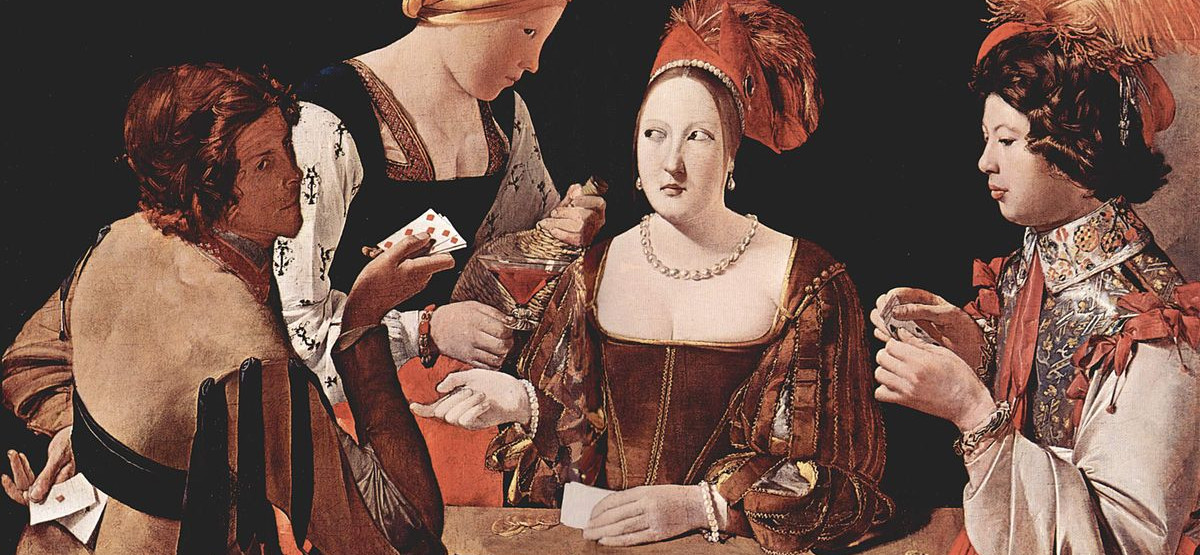
Well then, now that we have all this at our disposal, let us stop and briefly analyse some of the details of the painting known as El tramposo del as de diamantes (1630). In the scene, four figures, a lady, her courtesan companion, a man and a young boy, are playing a hand of cards. From the gold coins on the table, especially on the boy's side, we gather that a considerable sum of money is at stake. At a glance we can see that the scene is dominated by a series of discreet winks and signals with which the figures are trying to communicate.
The dark background gives us no information with which to place the game, the clothing of both lady and maid is demure for what the subject would lead us to expect, and inside the scene no kind of excess seems to be taking place. Despite all that, the painter's contemporaries would have recognised at a glance what is going on, since this episode came up again and again in the comedies and novels of the period. Let us recall at this point that De la Tour immortalised this very scene in another painting, differing only in shades of colour and a few details. On that occasion the card the cheat pulls from his belt is the ace of clubs. Neither artwork is dated, but they are reckoned to have been made between 1620 and 1640.
It was a common scene, as we say, for a courtesan to invite an inexperienced young man to a romantic supper. After wining and dining him and clouding his vision with a few good doses of wine, she would suggest a game of cards with an acquaintance who, by the most capricious of coincidences, happened to be around. The two of them would then take the chance to fleece the boy, for whom love was not in store, but the loss of his money. In Georges de La Tour's canvas, judging by his features, we can see that the boy cannot be more than fourteen or fifteen. This would not have been shocking at the time, since at that age they were already beginning to be considered adults.
Let us now look at the hands, because they are highly eloquent in the way Georges De La Tour tells the story. Notice that it is the lady's white hand that gives the signal for the ace of diamonds hidden by the cheat to come into play. In those hands, which reflect the feminine charm adorned with pearls that has probably seduced the boy and drawn him to the table, the trick also begins. That whiteness offers, on the other hand, a contrast with the coarse hands of the maid pouring the wine. As we can see, the maid decants it into an elegant Venetian glass. The wine is of course, along with the lady's sensual appeal, the element of action that clouds the boy's reflexes.
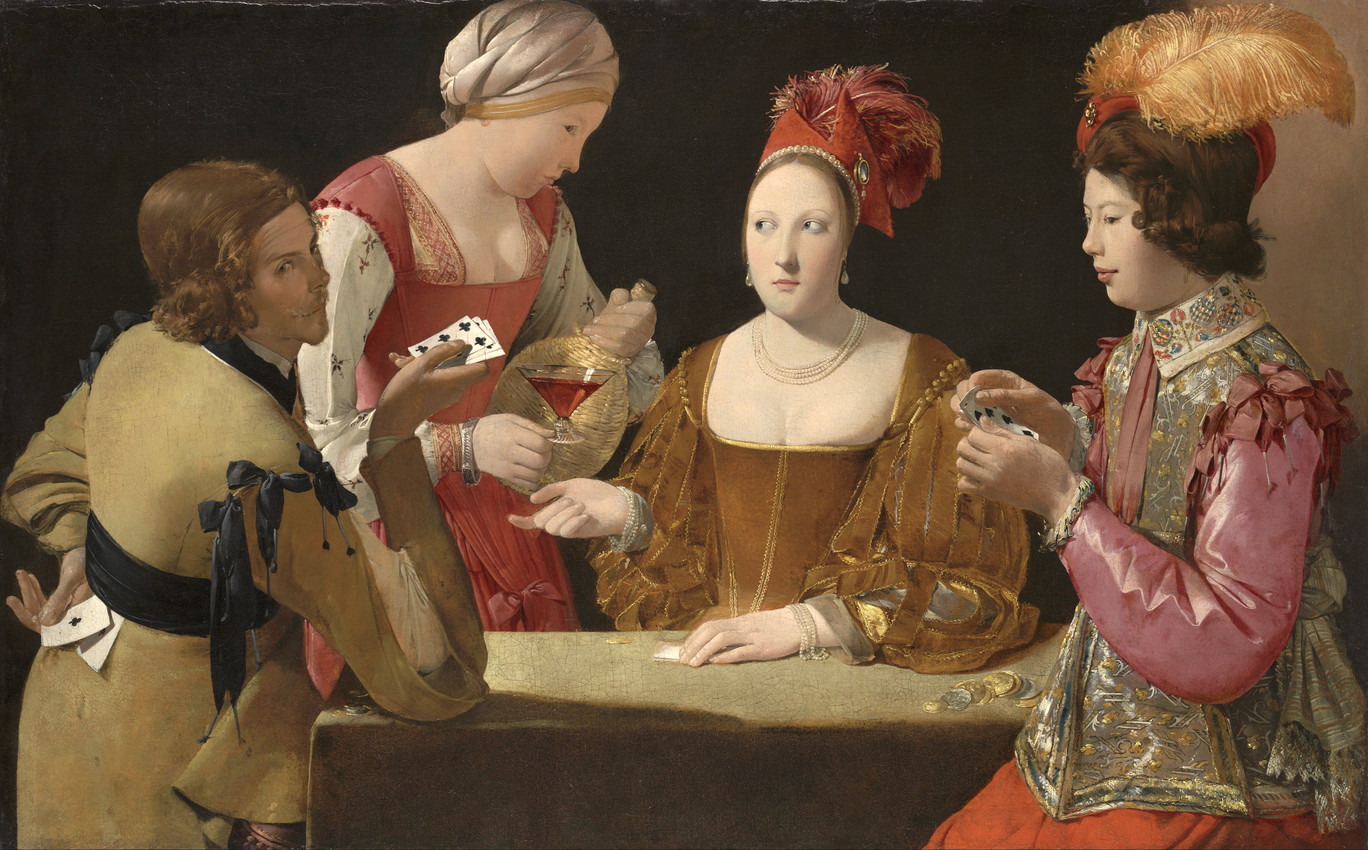
To visit his hosts, the boy has put on his Sunday best. The satin doublet, his cravat and silk ribbons tell us how luxurious his clothes are, from which we gather that he most probably belongs to the nobility, since at that time access to such garments was a privilege exclusive to the aristocracy. As for the deck, in the painting we can see that the lady is resting cards with white backs on the table. On that whiteness, marks of dirt or even sweat were common, and experienced players were able to memorise them quickly. Another much used tactic was to let the rival win the first hands so that he would lower his guard and become more vulnerable.
Let us bear in mind that, in the mindset of card sharps, their action called for no moral censure, since what they were after was a kind of redistributive justice in a world where the boy has been handed his gold pieces, and without any effort, before he has even learned to put them to good use. On the subject of card sharps, Caillerè claimed to know men whose entire inheritance amounted to a deck of cards or three dice and who were able to live off it in greater splendour than many a feudal lord. If a card sharp was caught, the usual outcome was that he lost his thumb, or even his whole hand. Although there was always a way of commuting the sentence, and that was none other than giving those responsible for law and order a share of the profits.
To finish the analysis, let us meet the gazes. While the lady's is cold and calculating, the cheat's turns towards us in a knowing gesture, showing us the trick he is about to pull off with his skill. Only the courtesan's sidelong glance seems to show a small glimmer of pity for the boy who is about to be swindled.



Comments (0)
Log in to leave your comment. Log in