
Munich, 1911. The arrival of a group of artists who went by the name Der Blaue Reiter (The Blue Rider) shook up the unstoppable deforming course of Expressionism. Their proposal was to replace that violent, savage alteration of reality with lines and colours that, in harmony, would reflect spiritual values.
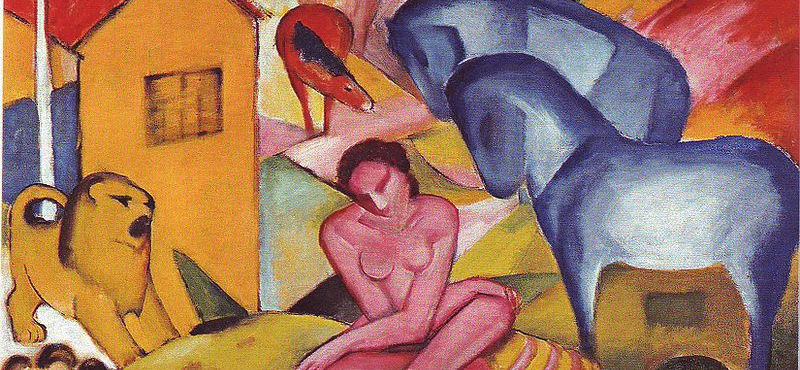
Franz Marc (Munich, 1880 - Braquis, 1916) was one of the group's founders, and his allegory El sueño (1912) one of the canvases that best capture that mystical vision of nature they were so set on. Here the German painter presents a night scene, as the black of the sky in the background suggests. On the left, the yellow house seems to establish a point of contact with reality, while in the centre the presence of the naked female figure surrounded by animals hints at an understanding between the human being and the natural world.
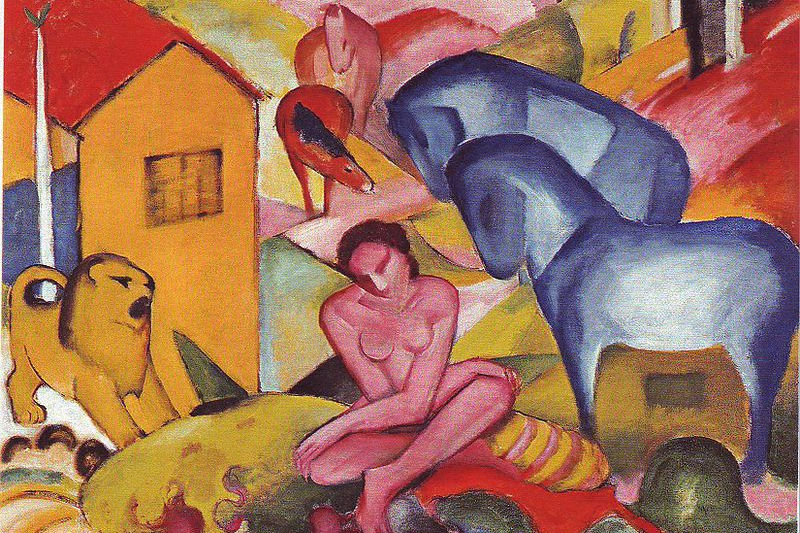
Marc felt a deep attachment to animals and especially to horses, which he turned into magical creatures and essential elements of his painting. The other founder of Der Blaue Reiter, Vassily Kandinsky (Moscow, 1866 - Neuilly sur Seine, 1944), shared that taste for steeds and also for the figure of the rider. In fact, this image appears again and again in his work as the embodiment of the spiritual regeneration that, in his opinion, art needed. Blue likewise appealed to both of them and, like the other colours, carried a symbolic value. Specifically, it gave off a spiritual and at the same time intellectual sense, thus allowing the longed-for purification of artistic matter. No wonder the group's name, The Blue Rider, came about almost naturally.
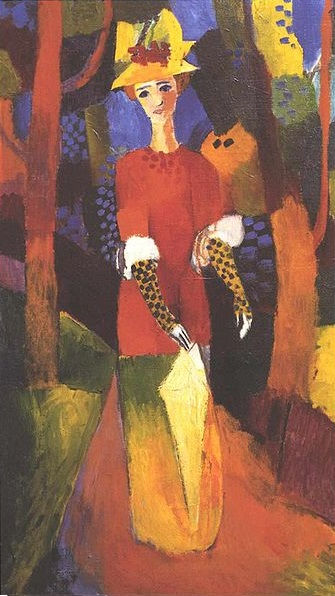
Kandinsky, for his part, stands for this artistic renewal, which goes beyond a realist statement and enters the purest corners of the soul, drawing on the evocative qualities of music. This idea was backed by Klee, one of the group's main members, along with Macke, Jawlensky, Campendonk and Gabriele Münter. Most of them had already worked together in the New Association of Munich Artists, created around 1909 and chaired by Kandinsky. Their artworks took part in the group's well-known Almanac, published in 1912, which brought together texts and paintings in tune with their criteria.
Der Blaue Reiter took in Cubist, Futurist and Fauvist influences, as well as the mysticism of German Romanticism. It was short-lived. In 1914 they held their last exhibition, since with the First World War the group was left orphaned. Marc and Macke died in the fighting and Kandinsky went back to his country. Even so, Der Blaue Reiter was destined to have great relevance in the artistic life of Europe to come, because it had transformed the plans of Expressionism.
Comments (0)
Log in to leave your comment. Log in