
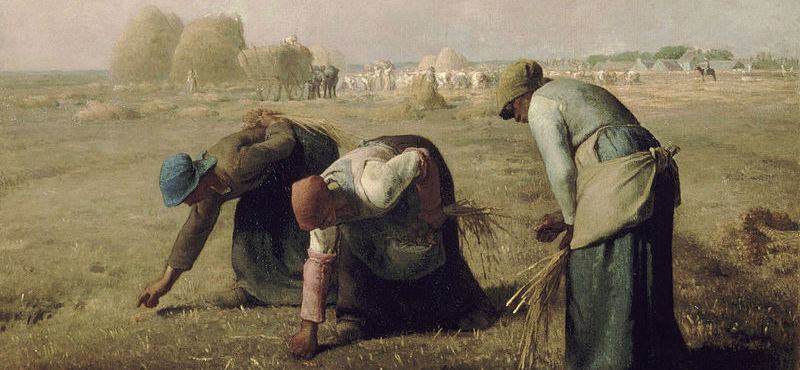
Vincent van Gogh learned from many masters. The one who also became his spiritual guide was the great Jean- François Millet (Gruchy, 1814 - Barbizon, 1875). What drew the Dutch genius was his particular ability to load an image with expression and to breathe life “not only into beings, but also into things”, as Jules Breton said of him. Here are five artworks that run through the career of one of the most influential artists of the 19th century.
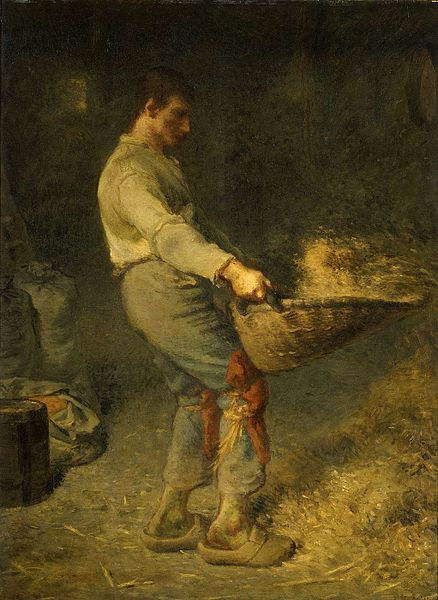
Un cribador (around 1848)
Millet, like so many other painters of his time, moved to Paris to study art. He had the chance to do it in Delaroche's studio. He soon developed a style of his own, though. He banished the mythological and the picturesque from his canvases and turned to peasant work and life from an innovative point of view. This painting holds the pure essence of Millet: simplification, intense contrasts of tone, values merely hinted at and a vigorous figure. He is also concerned with capturing the reality of labour and portraying with precision the effort the body makes. Courbet was smitten with it and probably had it very much in mind when he created Los Picapedreros (1849).
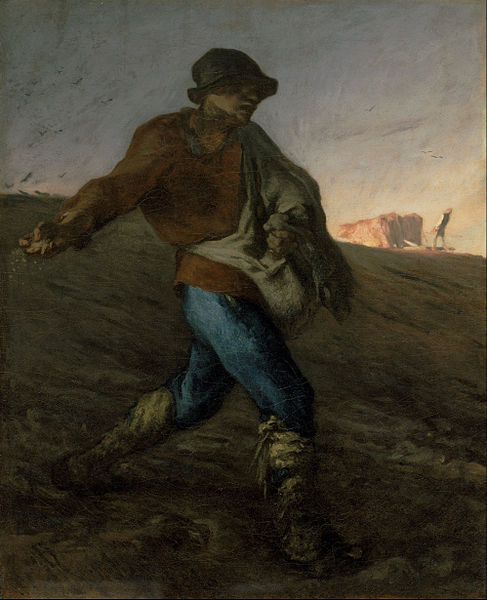
El sembrador (1850)
One of the paintings that moved Van Gogh most was precisely this one. Like Millet, the Dutchman came from the countryside. The subject matter spoke to him, and so did the Frenchman's style. He was fascinated by the evangelical halo that permeated his images and, even more, by that earthy colouring which, as he wrote to his brother Theo, seemed to come out of the soil itself. Van Gogh reproduced Millet's El sembrador as many as eight times. Then he gave up, because he believed it would be impossible to match his master.
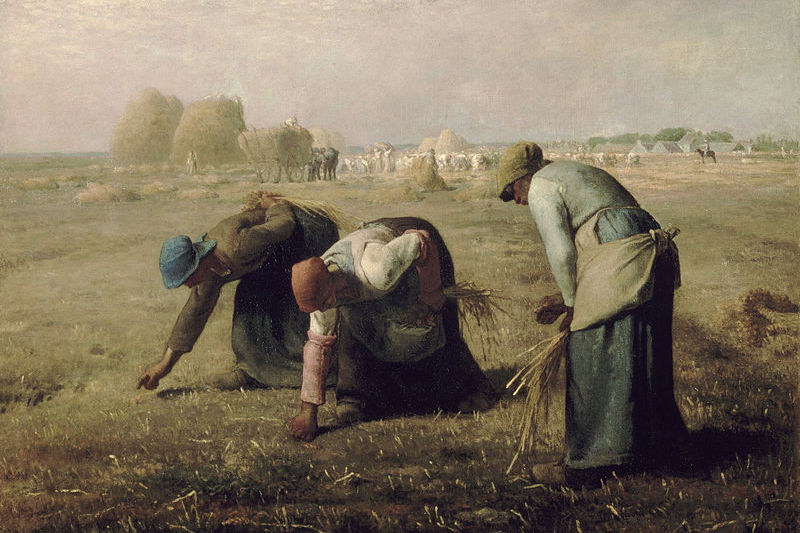
Las espigadoras (1857)
After ten years of work, he finished one of his key pieces, which crowned the realist style he had begun with Un cribador. The leading roles go to sturdy figures set against a landscape background, in a composition that does without anything superficial and exalts the everyday. Millet paints three women, allowed to pick up the ears of grain left behind in the sown fields, in order to convey the exhausting motion of their task: bending down, gathering and standing up. Over and over. The restraint of the foreground contrasts with the abundance in the distance. Millet accentuates the volume of the three women with sunlight and emphasises their hands, necks, shoulders and backs, brightening the colours of their clothes. With this he sought to give his gleaners a dignifying touch and to steer clear of any hint of wretchedness.
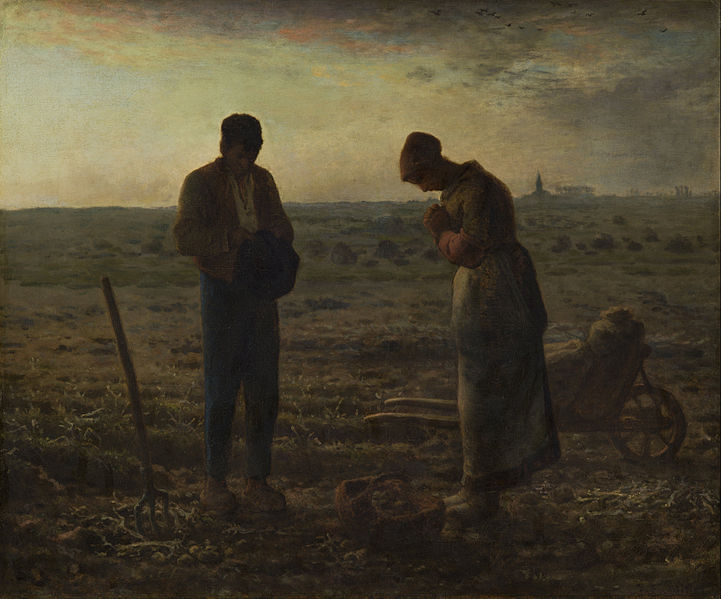
El Ángelus (1857- 1859)
Still, if there is one artwork tied to his name, it is this one. Here, a peasant couple break off their work to pray the Angelus. Their faces stay in shadow and the light picks out their gestures and postures. Their bodies take on a monumental look in the middle of an endless, empty landscape. Millet was not really after religious exaltation, but an evocation of his own past. The canvas is a memory of his childhood, when his grandmother, on hearing the bells, would stop the work to say the prayer. Once again he takes the chance to enter peasant life and its unchanging rhythms. El Ángelus became an artistic icon throughout the 20th century, reinterpreted by many, Dalí among them.
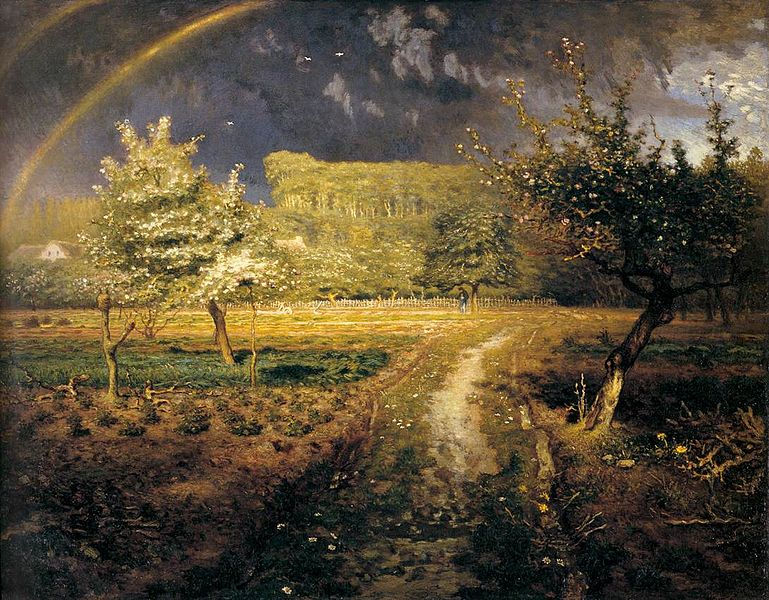
La Primavera (1868- 1873)
This painting belongs to the last cycle of his career. From 1863 on, under the influence of Théodore Rousseau, he took up landscape painting, producing several works on the seasons of the year in which he broke with what had come before. He leaves little room for man, reduced here to a small silhouette placed under the tree at the centre. It is the expression of an encounter, full of lyricism, between the human being and nature. An artwork in which every element has a symbolic value to express the renewal of spring. He also looks closely at nature, captures the instant, pays attention to the changes in the light and picks fresh colours. He was moving closer to Monet or Renoir, who by then were already going out to the forest of Fontainebleau, near Barbizon, where he had moved in 1849 and where he stayed until his death.


Comments (1)
Diego yael
May 18, 2021Log in to leave your comment. Log in