
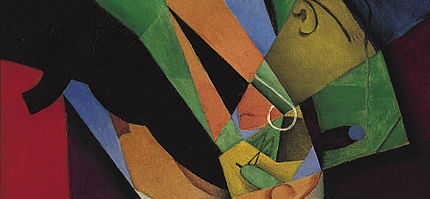
Every definition his contemporaries gave of José Victoriano González Pérez (Madrid, 1887 - Boulogne-sur-Seine, 1927), universally known as Juan Gris, had one thing in common: his passion for exactitude. Guillaume Apollinaire called him “the demon of logic” and Pablo Picasso “the sage of Cubism”. In fact, he himself believed that the Cubist movement and his own work were the visual translation of his time. A mechanized age in which human beings were already becoming aware of how deceptive their experiences could be.
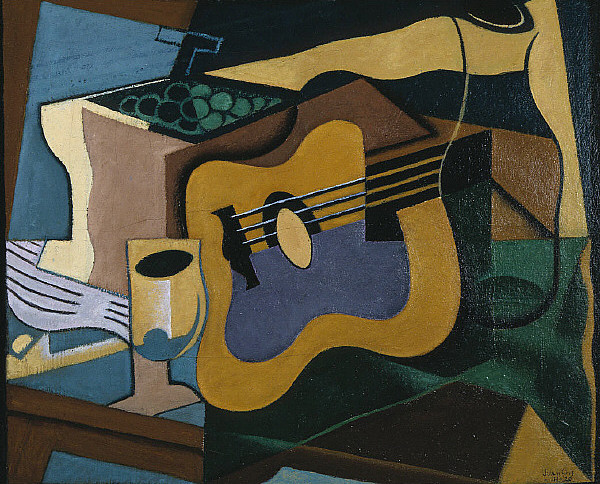
Juan Gris was one of the most important artists of Cubism and, almost certainly, the one who took the most trouble to explain it. But with his artworks, necessary to and inseparable from his theoretical thinking, he also put forward new pictorial solutions and a very personal interpretation of Cubism, keeping a figurative sense in it.
The pseudonym Juan Gris appeared for the first time on the cover of the book Alma América. Poemas indo-españoles (1906) by the Peruvian José Santos Chocano, as the author of the illustrations for the text, in which he was already announcing his geometric leaning and his taste for musical instrument motifs. Shortly afterwards he settled in Paris, where he carried on working as an illustrator.
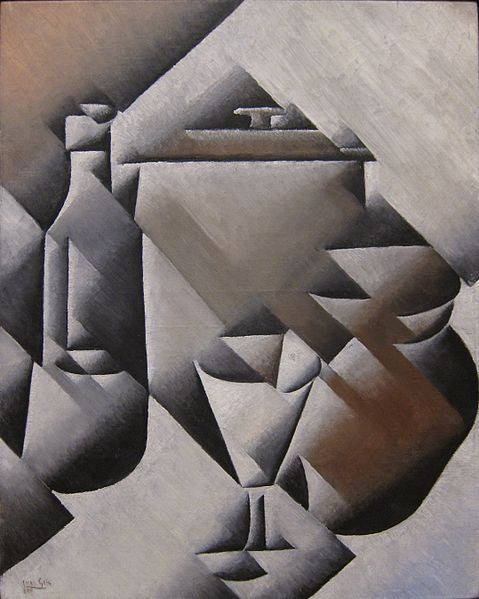
From 1910 onwards his work took a turn, and Jarra, botella y copa (1911) is one example. Although his commitment to Cubism was increasingly clear, he kept serious differences with his colleagues. Juan Gris does not cancel out the sensation of volume, keeping the chiaroscuro, and he also looks for a unifying geometric structure, with rhythmic forms that break with the complexity proposed by the other Cubists. His contribution would be to undo the disorder that makes it hard to read the object supposedly being represented.
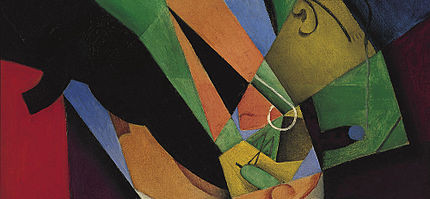
We find more elements of Juan Gris's take on Cubism in creations such as El fumador (1913). They reveal a palette of bright colours and clearly show the deductive method intrinsic to his artworks and his creative process, in which the idea comes first and the object afterwards.
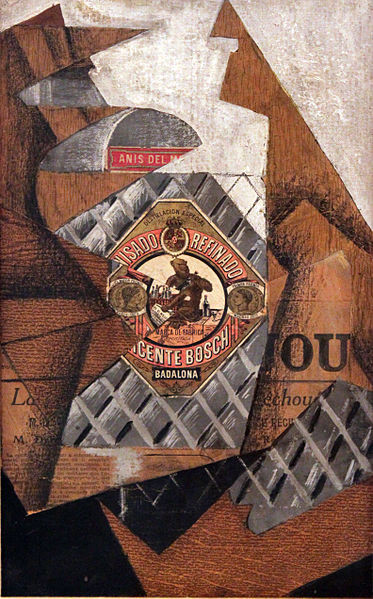
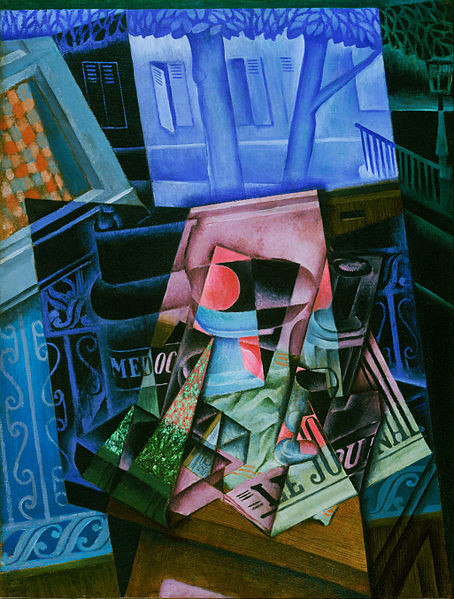
Gris's best paintings were produced during the First World War, taking the sophistication of collage as far as it would go in Botella de anís (1914). And without a doubt, one artwork stands out in his whole career, Naturaleza muerta y paisaje: Place Ravignan (1915), with which he opened up the genre, of vital importance in his work, in a Cubist code. This is a still life set against an open window with an exterior background. Which corresponds to reflection, inside, and to liberation, outside. An appealing, suggestive landscape, perhaps an influence of Henri Matisse. So he lays out the alternative between an intellectual universe, indoors, and a sensory one, beyond the window. Here he displays masterfully the dilemma that underpins his creation: the creative conflict between intellect and sensuality.
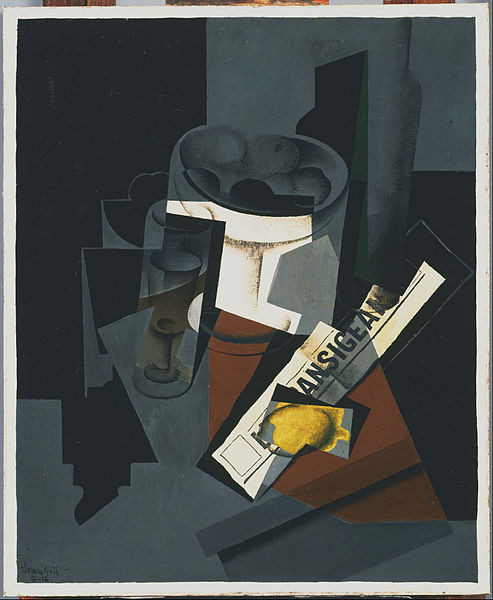
In Frutero, vaso y limón (1916), on the other hand, he shows his extraordinary handling of black and white, and it also stands as evidence of another of the Madrid painter's aims: to place his work within the tradition. The power of the black in his canvases has been compared to the black typical of Spanish painting, used by Diego Velázquez and Francisco de Goya. The way the object is characterized as something sacred, which gives the still lifes a metaphysical tone, has also brought the Spanish Baroque to mind.
Juan Gris devised a painting that aimed, in equal measure, at the aesthetic and the rational. Creating, in this way, his own Cubist vision, resolved in a poetic structure.

Comments (1)
Juan
April 18, 2021Log in to leave your comment. Log in