
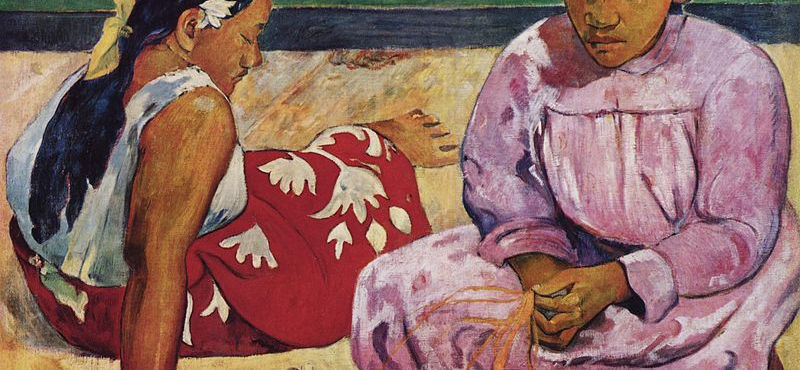
Paul Gauguin left his successful career as a stockbroker to devote himself to painting in those years when the Impressionists were revolutionising the art world, filling it with immediacy and accident. He would end up taking a different path, chasing what remained hidden, invisible, bound to the soul of the individual.
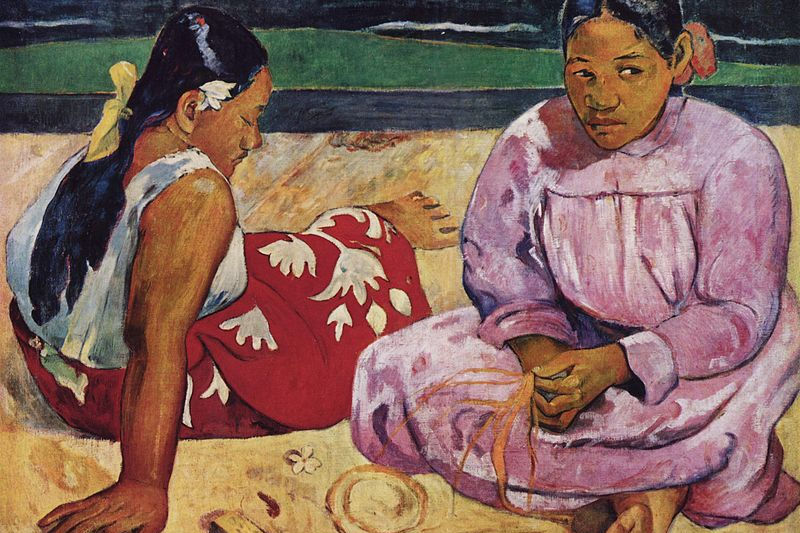
Although his first visit to Tahiti came at the age of 43, Paul Gauguin (Paris, 1848 - Atuona, 1903) had his first contact with primitive art as a child. His family, of liberal leanings, had to flee to America after Napoleon III's coup in 1851. He was orphaned during the voyage, and he and his mother survived thanks to the generosity of relatives living in Peru. Later they would return to France, he would learn the stockbroking trade, marry and have five children. But Gauguin needed to be born again and, after his immersion in Impressionism and the collapse of his family and professional life, he left it all behind and set course for Tahiti, where he would find his true inspiration.
There Gauguin, in poor health, expected an idyllic life, one that came before the civilisation that would end up banning its dances and its music. And he painted that wild, untouched nature, the sacrifices the natives made to their gods and their carefree hours of leisure with games of fruit and flowers. These images, though, were only what he would have liked to find, because the reality he came up against was another thing. To paint them he used a pictorial language that was hardly naturalistic, based on flat forms, bright colours and unconcerned with any known perspective. They are artworks that mix ancestral myths, an unhurried rhythm and exotic landscapes.
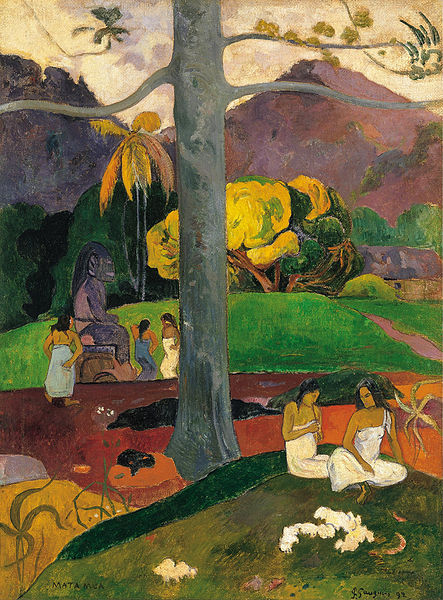
Mata Mua (Érase una vez, 1892) renders exquisitely that idyllic world, that original life he so longed to discover. A landscape closed in by mountains, in which a group of women worship Hina, the goddess who stands for the Moon. Like a metaphor for the beauty and mysticism the artist was after in the remote islands of French Polynesia, for the glorious past that, by the time he arrived, was already on its way out. On his second trip, the contaminated primitive world comes to light. His paintings now show the work of the colonisers and of the Protestant and Catholic churches that put an end to the paradise he had imagined finding there, and he does it with darker tones and with symbolism. He wanted a harmonious existence, following the innocence and the life of the natives. His aim was to express, "as a child would, the impressions of my mind, using only the medium of primitive art; the only correct medium, the only true medium". All he wanted, then, was to love, paint and die.
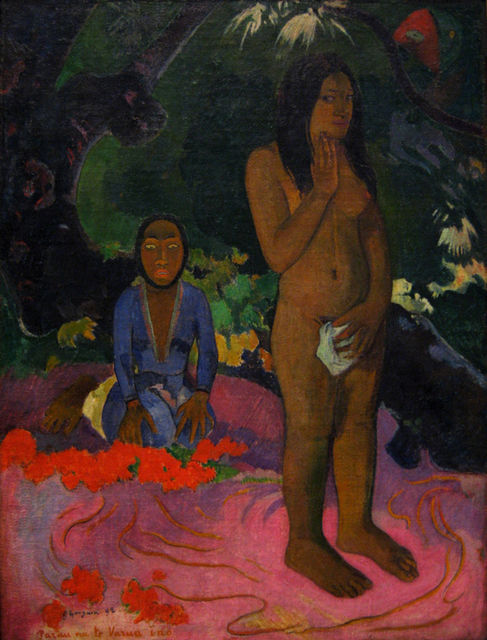
The truth is that his inspiration did not come only from primitive art. Fond of it as he was, Gauguin also made the most of the technological innovation of the moment, such as photography and advances in printing, which made it possible to have the image of any artwork, landscape or building right in front of you. For instance, the archaic forms of an Egyptian bas-relief or the Parthenon frieze. Forms whose rawness and roughness, whose primitive force, woodcut heightened. And so Gauguin built his Polynesian mythologies in long, narrow formats.
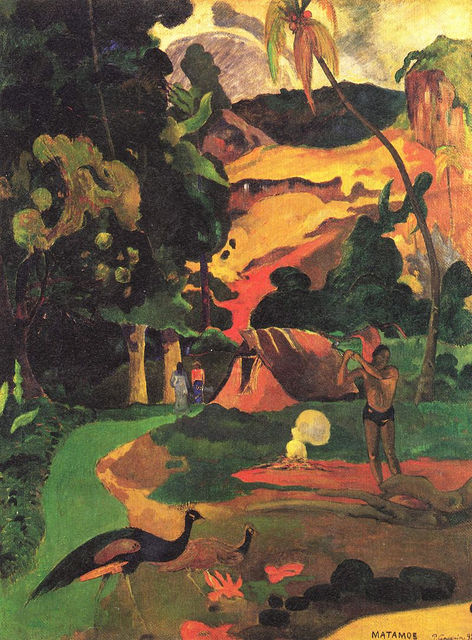
The primitive forms and the wild colour he brought to his painting made him one of the most influential artists in the whole history of art. A recognition that, like his friend Vincent van Gogh and so many others, he never lived to see. His exhibitions in Paris were a failure and he barely managed to sell his painting. In fact, to pay for his first trip he asked the French government for a grant. He spent his last years trying to give Tahiti back to the natives and living as one more of them.
Comments (0)
Log in to leave your comment. Log in