
The artistic side of Peter Paul Rubens as a painter is well known, and his women of majestic proportions are famously the paradigm of beauty of other centuries. We're announcing nothing new by praising the grandiloquence of his paintings, his great technical skill, his particular flair for handling mythological, religious and historical subjects, in which the elaborate rhythm of his compositions stands out, as does the psychological treatment of his characters. Rubens (Siegen, 1577 - Antwerp, 1640) was one of the geniuses of 17th century painting. We know that already. He was the favourite of the Spanish monarch Philip IV. He was "the Homer of painting", according to Delacroix. The Prado Museum holds a good part of his artworks. But Rubens was not only a painter.
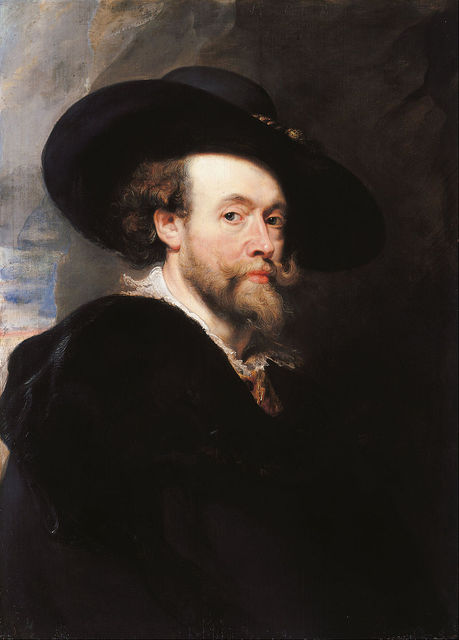
While his followers know it well, what is not so widely known is the social skill with which the artist was able to move through the political and social stages of his time. Remember that the sword with which the painter depicts himself in paintings such as El jardín del amor (1630-1635) was a gift from the English monarch Charles I, who knighted him not exactly for his artistic merits but for his valuable diplomatic contribution. In the words of Joachim Sandrart, painter and art chronicler, Rubens "was attentive and courteous with everyone, always received with affection and joy wherever he went".
In Antwerp, the city where he lived, he was often called upon by the Archduchess Isabella for diplomatic missions, with such favourable results that the governor did not hesitate to recommend him to the monarch of the Spanish Court himself. The latter delegated a good deal of responsibility to him, sending him to London in 1629 as mediator in the long conflict pitting Spain against England. The artist was always proud that, thanks to his travels, that tight spot was resolved favourably for both sides. His later secret missions carried out in his own country, as an unsuccessful attempt to reunify the divided territory of the Netherlands, made Rubens, luckily for art, give up that occupation and devote himself from then on entirely to painting. Also decisive in this respect, and after the death of his first wife, was the arrival of a new love.
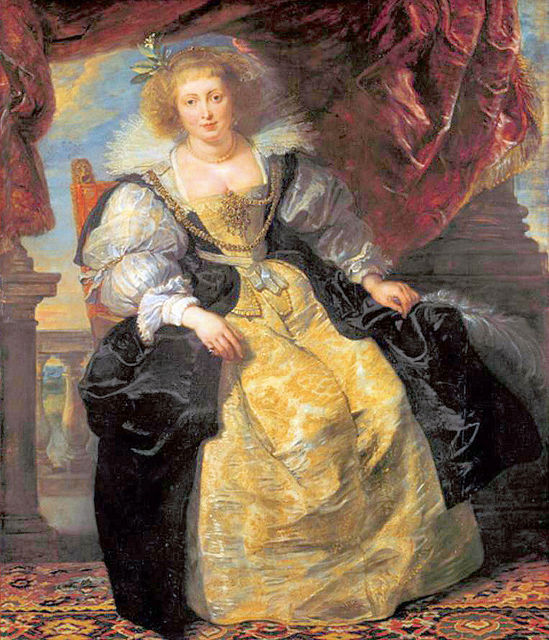
"From now on I shall lead a peaceful life again", Rubens wrote to a friend shortly after celebrating his second marriage. The painter, who had been widowed from his first wife four years earlier, in 1630 married again, to a young woman of barely 16 when he was already 53. The artist's standing, at the peak of his career, helped to smooth over, to a large extent, the social obstacle that such an age difference also represented in the eyes of that time. And so, in the company of Hélène Fourment, Rubens recovered a good part of the joy in living he had lost.
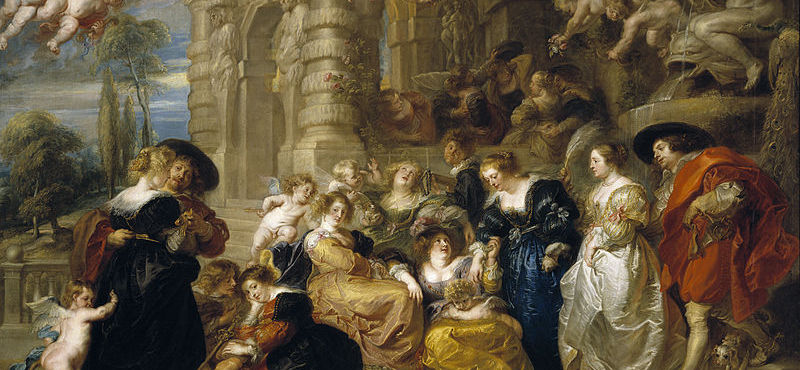
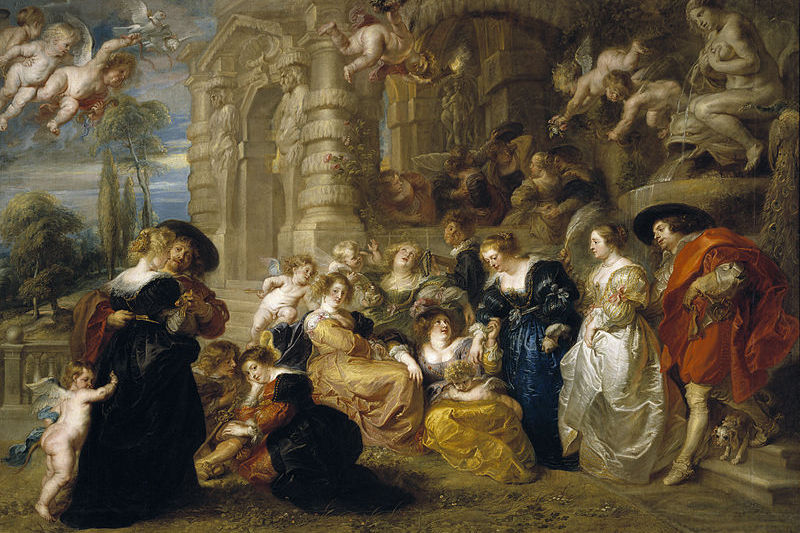
The fruit of this recovered enthusiasm is one of the painter's most personal artworks, the one already mentioned: El jardín del amor, once also known as La corte de los placeres de Venus. It is one of the few artworks Rubens did not paint on commission, but composed with no other aim than keeping it for himself, as an expression of the new vitality that his new story of affection with Hélène was giving him. Rubens thus broke "the golden chain of ambition" with which court society enslaved him and gave himself over to an independent, quiet life.
El jardín del amor is full, how could it not be, of little cupids, those winged mythological beings related to Cupid who work their forces on the real characters. On the left side of the painting we can already see how one of them pushes a hesitant girl into the arms of a man holding her by the waist. The uniformity of the features of all the women, with their straight noses and slightly sunken eyes, suggests that they could all be Hélène herself, from her shedding of shyness to her decided surrender on the ground, looking straight at the viewer. And at the far right she comes down the stairs with full authority, raising a plume of feathers, on her husband's arm.
The three central female figures, on the other hand, would also be the painter's own wife, who by the way repeats himself in the same way in the male figures. Those three women could represent the three different forms of love: the passionate, the serene and the maternal, this last one with one of the little cupids resting in her lap. The whole scene is set in the garden, whose importance was fundamental in the 17th century, since gardens were where the meetings between ladies and gentlemen of the upper spheres found a place. It was there that they could find the intimacy they needed to exchange their confidences.
In the upper right corner Rubens places a fountain of Venus, with water gushing from her breast, a symbol of fertility. The shell above the portico is also a clear allusion to her. In the fountain in the background one can make out a broad depiction of the three Graces. The right side of the painting closes with a peacock that would symbolise the goddess Juno as protector of marriage. As we can see, El jardín del amor, like almost all of Rubens's artworks, is packed with mythological references in its details. The narrative composition of this painting is a good example of Rubens's prodigious ability to tell a story in paint.


Comments (0)
Log in to leave your comment. Log in