
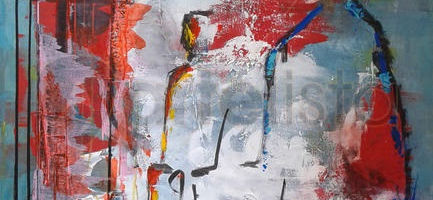
Although the mechanism of visual perception is the same in both cases, looking at the outside world and looking at an artwork are two different acts. The physical world is perceived with no more effort than that of looking, but observing and understanding call for a certain amount of learning and training. No object, no everyday event comes free of the way we interpret it.
Influenced by our culture, our beliefs, how deep our knowledge goes, even by our mood, the gaze finds completely different meanings in the same images. And painting, which is nothing other than images, becomes understandable or incomprehensible depending on the gaze that takes it in.
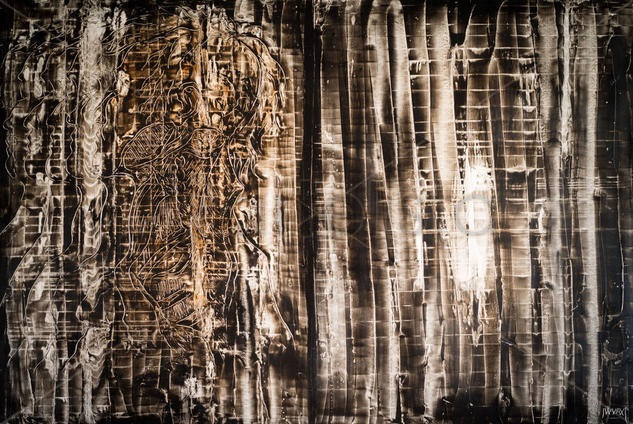
Like any other language, the language of painting uses its own codes, and those codes shift and adapt according to each period and its circumstances. Hence how important it is to come into contact with the cultural evolution of the different centuries and civilizations if we want to work out what a given artistic expression, painting in this case, has tried to convey to us. Art History takes on that titanic and practically boundless task, and it is at the same time the record of human experience in every time and every place trying to decipher existence and give it meaning. Let's leave the impossible in its hands, then, and focus here on something less ambitious. Let's study the ways of looking, let's analyse the different levels of the gaze. The ones that decide whether an artwork connects with us or not.
According to Bernard Rancillac, there are four different levels in the act of looking. On one side we have the physical or sensory gaze, understood by biology as an act entirely dependent on the brain system. On another, the chemical or affective gaze, apparently irrational and determined by behaviour that is not necessarily hormonal and that often escapes the control of our will. Third, the sociological or cultural gaze, in which, as we have already said, place and period hold in themselves a potential for expression that neither the artist nor the observer can go beyond. And at a more internal level, what may be the ultimate purpose of our capacity to look, the metaphysical or mystical gaze, the one that tries to unravel what is true and unchanging among the fleeting appearances of the real.
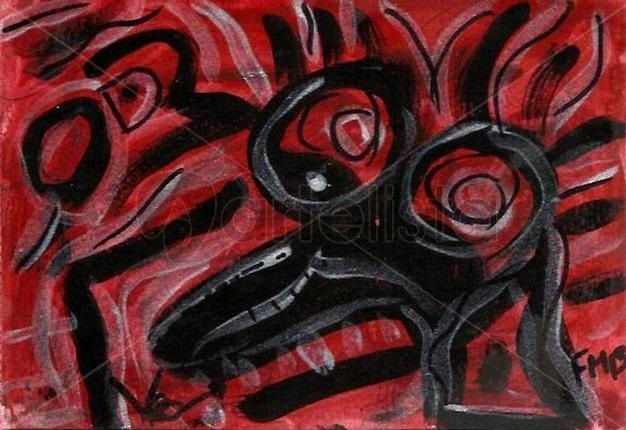
The physical or sensory gaze has been explained scientifically through the workings of the visual organs, and is often compared to the mechanism cameras use to capture images, cameras which, paradoxically, were designed in imitation of the properties of the eye. Later on this comparison falls short, since further research has shown us that our eyes not only capture light but that light is encoded and transmitted through nerve impulses to a specific region of the cerebral cortex where it is decoded and interpreted. That is where the mystery lies.
Today we know, for instance, that our interpretation of the world does not depend strictly on the images we observe but on the information we obtain from those coded messages. Which is why the explanation of our physical gaze has come to be compared, with a greater degree of equivalence, to the way computers work. Perhaps this explains why modern art has lost interest in real forms and favours mental games played simply through the value of colours, of depths, of axes and symmetries, of the condensing of dimensions or of non-figurative strokes.
With the chemical or affective gaze we would move into a more internal level, where that information captured by our sight mixes with our pleasures, our hatreds, our anger, in short our passions or humours, as they used to be called. Humours in the endocrine sense of the word, where a whole series of glandular secretions largely determines our attitude. This is why chemistry and affection are left in a relationship of interdependence that gives rise to our internal drives and to our predisposition to react, ultimately, in one particular way to whatever this or that image evokes.
In the sociological or cultural gaze we would take into account, along with the outside information and our passions, our store of knowledge and our command of objective conditions. There are plenty of examples here. Without going any further, a gaze that lacks the necessary information, faced with a Mondrian, would only be able to see a more or less decorative fantasy, without getting as far as working out that this is an extreme solution to representing the world, reducing it to vertical and horizontal lines and to the primary colours red, yellow and blue. The simplification is loaded with meaning only for those who have enough command to get at that meaning. Most of the time we just say we like something or we don't like it when in fact we haven't even understood it.
To finish, let's sketch out what Rancillac defines as the metaphysical or mystical gaze. As we have said, we obtain the information, we decode it, we mix it with our humours, we interpret it according to our knowledge, but what is left beyond that? What is the ultimate purpose of our gaze? The visible world does not stand up unless we prop it against an invisible world. No culture, no current, no society leaves this fact aside. The gods, the genies, the spirits of the dead…, they all take part in every one of our daily gestures.
The deepest thing our gaze looks for is whatever moves us. But perceiving that invisible requires extreme concentration, from the painter as much as from the person observing. As Rancillac rightly adds, "when the painter, by sheer concentration, becomes the object he is representing, and when the observer becomes the painting, both are in a state to perceive the charge of the invisible that the object holds".



Comments (0)
Log in to leave your comment. Log in