
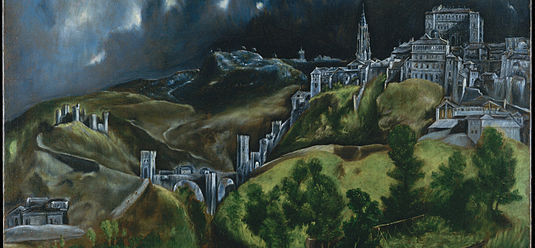
An unreal, deeply emotional atmosphere presides over the imposing Vista de Toledo that El Greco painted around 1604-1614. It's a revolutionary artwork from the last period of his life, when his unique, visionary style had already taken complete hold of his painting, and one whose value was only appreciated centuries later.
Doménikos Theotokópoulos (Crete, 1541- Toledo, 1614) arrived in Toledo in 1577, aged 36. By then he was already a mature artist, fed by Italian painting, close to Titian, familiar with the mannerism of Michelangelo and with a wide intellectual training. He failed in his aim of working in the service of King Philip II and set up on his own. That gave him greater freedom to let his creative will loose and to develop a pictorial language like no other, one that would go on to inspire many 20th-century artists, especially Cubists and Expressionists. Vista de Toledo is a piece full of mysteries and subjective elements that fully exemplifies that very personal style of the Cretan genius, marked by the distortion of reality and the hallucinatory air that soaked his canvases.
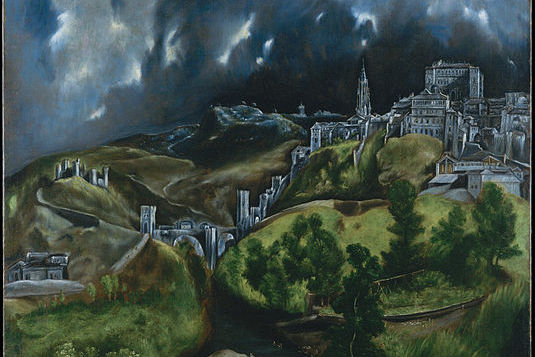
From a distance, from a high vantage point, he gives detailed shape to the city's outline, letting its core slip away from the centre of the painting. That move lets him dig into the natural landscape around the river Tagus. The cathedral, the old Alcántara bridge, the Alcázar and the castle of San Servando are, for their part, the architectural landmarks that cut across the Toledo sky. The artist has altered the order of some of them, such as the cathedral tower. In the painting it appears on the left, when its real location is on the right. Other elements of the composition have even been invented. This distortion of reality aims at greater expressiveness, as do the sharpened slopes of the terrain, the gloomy light and the intense chromatic contrast that shakes the canvas: the green of the vegetation clashes with the blues of the sky which, in turn, darken the area closest to the city, bringing out the beauty of Toledo's architecture.
In essence it is a truthful image, but the fact is that El Greco is not proposing a simple topographical representation, rather an almost spiritual portrait. Toledo lends itself here, as it so often does in his work, to a subjective reading that captures the painter's identification with the city, along with the mystical content the Cretan poured into it. The apparent absence of religious and mythological motifs and of the human figure has led the oil Vista de Toledo to be considered the first Spanish landscape.


Comments (1)
Aura Torres G.
May 15, 2015Log in to leave your comment. Log in